
How to Read the Approved Rice, Pasta and Potato Comparison FAQ
This FAQ helps readers read the approved rice and pasta entries exactly as listed, notice when boiled or non-boiled form matters, and keep missing potato data visible. It is for adults who want a careful source-reading guide, not a universal ranking or personal diet prediction.
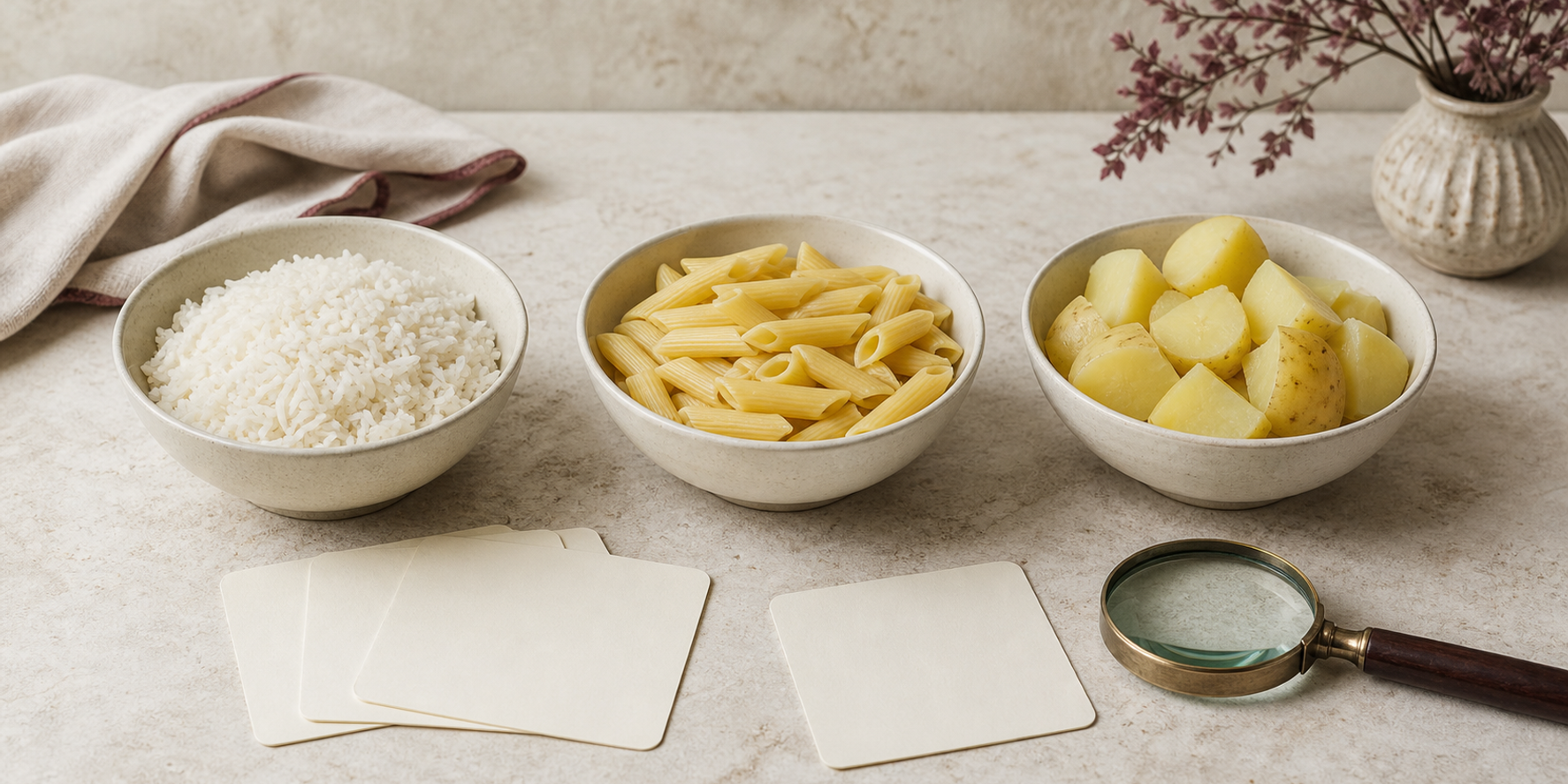
Key points
- Compare only the exact food entry shown in the approved source text.
- Do not transfer a value between different preparation forms or food forms.
- If a value or potato entry is missing, keep that gap visible instead of guessing.
- A lower listed GI value is source information, not a universal ranking.
- The approved sources do not support predicting individual blood-glucose, weight, or health responses.
What this comparison FAQ can answer
This FAQ is for readers who want to read the approved Health360 entries carefully and avoid over-interpreting them. It can help you identify the exact rice or pasta entry shown in the source, check whether the item is listed in boiled or non-boiled form, and notice when a value is missing or an entry is incomplete.
The approved sources include specific GI-listed entries such as Pasta GI 48, Brown Rice Pasta GI 50, Rice Noodles GI 53, Rice Vermicelli GI 58, Brown Rice (Boiled) GI 68, and Wild Rice (Boiled) GI 57. They do not provide a potato entry in the supplied text, so potato comparisons should not be filled in from outside information.
For readers comparing foods in a source-aware way, the key point is simple: use the exact entry that appears in the approved text, not a guessed substitute.
Why the exact source entry matters
The source format embeds identity details inside the food name itself. That means the listed value belongs to the exact item named in the source, including any preparation label.
For example, Brown Rice (Boiled) and Wild Rice (Boiled) are not just generic “rice” entries. Likewise, Rice Noodles and Rice Vermicelli are separate items, even though both are rice-related foods. A value attached to one entry should not be moved to a different food form unless the source explicitly says they are the same.
This matters because the FAQ is meant to support accurate reading, not to collapse distinct entries into one broad category.
Practical rule
Before comparing anything, check three things:
- the exact food name,
- the preparation form, and
- whether a visible value is actually present.
If any of those are missing, the comparison is incomplete.
Can values be transferred between preparation forms?
No. The approved source entries show that preparation form is part of the listed identity. Brown Rice (Boiled) and Wild Rice (Boiled) are labeled that way in the source, so boiled rice entries should not be treated as interchangeable with other rice forms unless the source explicitly says they are the same.
That same caution applies across the list. Pasta GI 48, Brown Rice Pasta GI 50, Rice Noodles GI 53, and Rice Vermicelli GI 58 are each source-listed items. A listed value belongs to the exact entry that names the food and form.
A useful way to think about this is: if the name changes, the entry may also change.
What to do when a source value is missing
If a value is not visible in the approved text, keep that gap visible. The source includes at least one incomplete entry, such as Lentils (Brown), which appears without a GI number in the supplied text.
That means the correct reading is not to guess, estimate, or import a value from somewhere else. It is simply to note that the value is missing in the approved source material.
This is especially important for potato comparisons. Because the supplied approved sources do not show a potato entry, no potato GI value should be inferred or inserted from outside the source text.
Does a lower listed value make one option universally better?
No. A lower listed GI value describes only the source entry itself. It does not establish a universal best choice for every person, every meal, or every goal.
The approved sources are value lists, not ranking rules. They do not provide universal superiority claims, and they do not support personal dietary prescriptions.
So if you see a lower value in the list, treat it as source information, not as a command to choose that food in every situation. That distinction keeps editorial interpretation separate from the source text itself.
Can these entries predict an individual response?
No. The approved sources do not support predicting a person’s blood-glucose, weight, or health response from a GI value alone.
That limitation is important because a source-listed value is not the same as a personal assessment. These entries can help with general reading and comparison, but they do not provide individualized advice.
If someone needs personalized interpretation of diet-related questions, qualified professional guidance is appropriate. The approved sources themselves are reference lists rather than personal medical or dietary guidance.
How to compare two entries without overreading them
Use a short source-reading workflow:
- Find the exact food name in the approved text.
- Check whether the item includes a preparation label such as boiled.
- Confirm that both entries actually have visible values.
- Compare only the listed entries, not outside assumptions.
- Keep missing values and missing food types visible.
This approach helps you stay inside the evidence gate. It also keeps the source list separate from a universal ranking, which the approved evidence does not support.
If you want a broader guide to comparison pitfalls, you may also find How to Compare Rice, Pasta and Potato Options Without Rigid Rules useful, along with Five Rice, Pasta and Potato Comparison Mistakes to Avoid.
Short source-reading checklist
Use this quick checklist whenever you read the approved entries:
- Is the exact food name visible?
- Is the preparation form part of the name?
- Is a GI value actually shown?
- Are you comparing only entries that appear in the approved source text?
- Are you leaving missing data missing?
- Are you avoiding universal ranking language?
If the answer to any of these is no, the comparison should stay limited.
Three checks that keep the comparison evidence-bounded
A careful comparison separates three different questions. The first is an availability question: does the approved source actually contain the entry and a visible value? In this source set, some pasta and rice-related entries have visible values, while no potato entry is shown. That gap must remain visible. It is not evidence for a potato value, and it is not permission to import one from another source.
The second is an identity question: are the food name and preparation form the same? A value belongs to the exact entry that carries it. When the entry names a boiled form, the value should remain attached to that named form. A different rice, pasta, or preparation label is a different comparison item unless the approved source explicitly connects them.
The third is an interpretation question: what conclusion does the listed value support? The approved brief supports reporting the entry and comparing visible values when their labels are clear. It does not support declaring one food universally better, predicting an individual's response, or turning a source table into a personal meal rule. Source-listed information and editorial interpretation therefore need to remain visibly separate.
These checks produce a more transparent answer even when they produce less certainty. A comparison can say that one visible source value is lower than another visible source value for the exact named entries. It should also state what remains unknown: an absent potato entry, a different preparation form, or any individual response.
When professional guidance is appropriate
The approved sources are useful for reading and comparing listed entries, but they do not provide individualized advice. If a question is about your own diet, your own health context, or how to interpret a value in relation to your circumstances, a qualified professional can help.
That is the right next step when the goal is personal interpretation rather than source reading.
FAQ
What can the approved rice, pasta and potato entries support?
They can support careful reading of exact source-listed entries, including values for some pasta and rice-related foods, and they can show when a source entry is missing or incomplete. They do not support a universal ranking or personal health prediction.
Why is there no potato comparison here?
Because the supplied approved source text does not show a potato entry. The correct approach is to keep that gap visible rather than infer a value from outside the approved sources.
Can I use a boiled rice value for another rice form?
No. The source shows that preparation form is part of the entry name. Brown Rice (Boiled) and Wild Rice (Boiled) are not interchangeable with other rice forms unless the source explicitly says they are the same.
What should I do if an entry is incomplete?
Leave it incomplete in your reading. For example, Lentils (Brown) appears without a visible GI number in the supplied text, so the missing value should not be invented.
Does a lower GI value mean a food is universally better?
No. The approved sources do not state that. A lower listed value describes the source entry itself and does not make it universally better for all people or meals.
Can the GI values tell me how my body will respond?
No. The approved sources do not support predicting an individual person’s blood-glucose, weight, or health response from GI alone. For personal questions, use qualified professional guidance.
Summary
Read the approved entries exactly as they are written. Match the food name, check the preparation form, confirm that a value is visible, and leave missing data missing. That is the safest source-reading approach for this rice pasta potato comparison FAQ.
Questions readers often ask
What can the approved rice, pasta and potato entries support?
They can support careful reading of exact source-listed entries, including values for some pasta and rice-related foods, and they can show when a source entry is missing or incomplete. They do not support a universal ranking or personal health prediction.
Why is there no potato comparison here?
Because the supplied approved source text does not show a potato entry. The correct approach is to keep that gap visible rather than infer a value from outside the approved sources.
Can I use a boiled rice value for another rice form?
No. The source shows that preparation form is part of the entry name. Brown Rice (Boiled) and Wild Rice (Boiled) are not interchangeable with other rice forms unless the source explicitly says they are the same.
What should I do if an entry is incomplete?
Leave it incomplete in your reading. For example, Lentils (Brown) appears without a visible GI number in the supplied text, so the missing value should not be invented.
Does a lower GI value mean a food is universally better?
No. The approved sources do not state that. A lower listed value describes the source entry itself and does not make it universally better for all people or meals.
Can the GI values tell me how my body will respond?
No. The approved sources do not support predicting an individual person’s blood-glucose, weight, or health response from GI alone. For personal questions, use qualified professional guidance.
Need a calm next step?
Visit the Health360 overview.
Visit the Health360 overview