
Compare Rice, Pasta and Potato Options: What the Approved GI Sources Actually Show
A source-grounded look at selected rice and pasta GI examples, why preparation and food form matter, and why potato cannot be compared here from the approved source set alone.
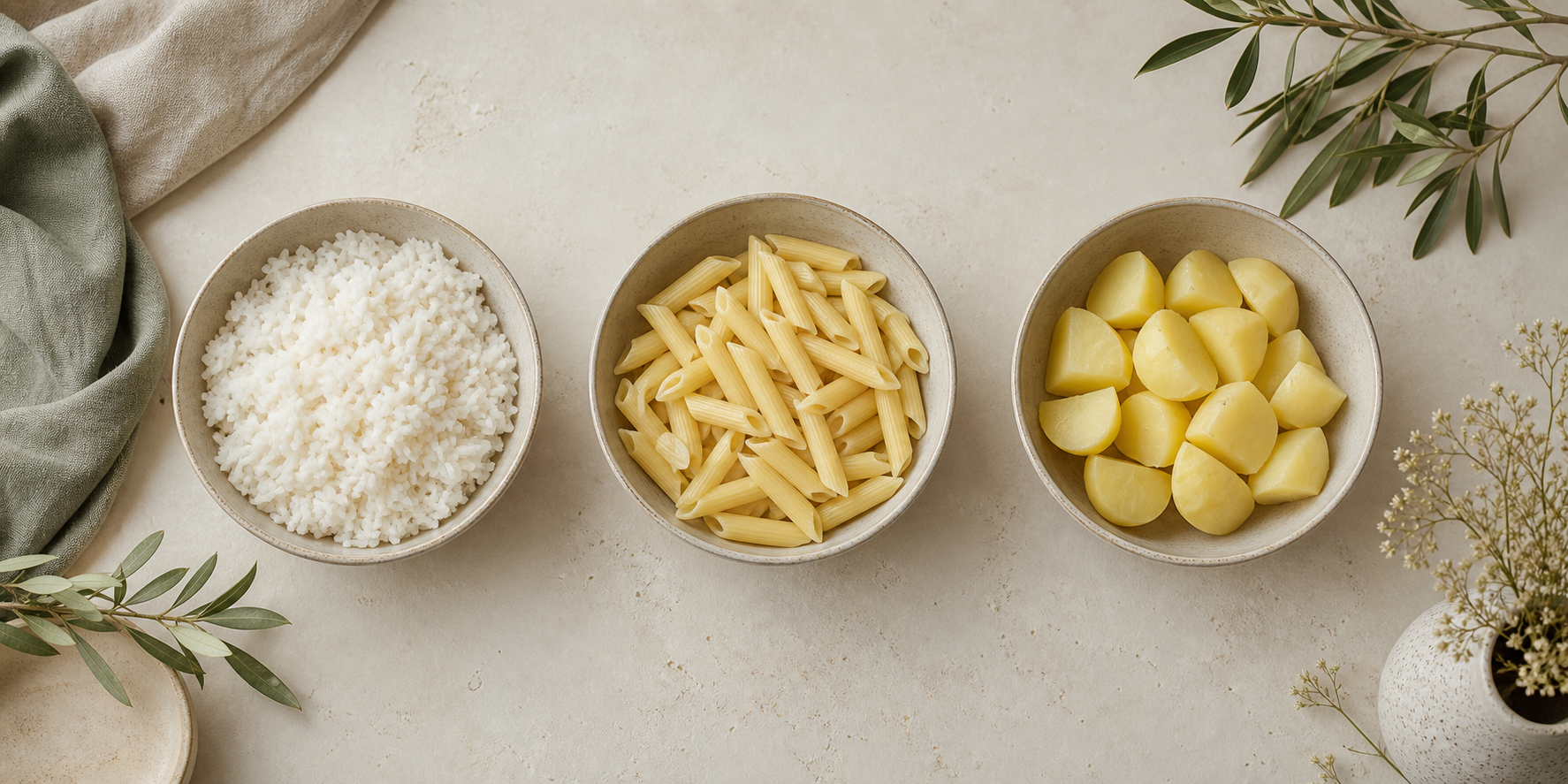
Key points
- The approved sources support a limited comparison of specific rice and pasta entries, not a universal ranking.
- Food form matters: boiled rice, rice noodles, rice vermicelli and different pasta types have separate listed GI values.
- Potato is not covered by a GI value in the supplied approved source set, so it should not be compared numerically here.
- A single GI number is a reference point, not a full judgment of food quality or a personalised recommendation.
- For individual questions, professional guidance is more appropriate than turning a source table into a rule.
When people ask how to compare rice, pasta and potato options, the safest place to start is with what the approved source set actually shows. In this case, the source material supports a limited comparison of several named rice and pasta examples with listed glycemic index (GI) values. It does not support a universal ranking of all rice, all pasta, or all potato foods.
That distinction matters. The source entries are specific, named foods as prepared or labeled in the source list. They are not a blanket score for a whole food category, and they are not a personalised guide for one person’s meals.
What a bounded rice, pasta and potato comparison can show
The approved source list includes several pasta examples and several rice examples with GI values. For pasta, the source lists Pasta GI 48, Brown Rice Pasta GI 50, Quinoa Pasta GI 53, Oat Pasta GI 55, and Barley Pasta GI 52.
For rice and rice-derived entries, the same source lists Brown Rice (Boiled) GI 68, Wild Rice (Boiled) GI 57, Rice Noodles GI 53, and Rice Vermicelli GI 58.
That is enough to make a limited comparison among the listed entries. It is not enough to say that one whole food group is always better than another in every context.
It is also important to note what is missing: the approved source material supplied for this request does not include a potato GI value. So potato cannot be placed into the same source-grounded comparison here without a separate approved entry.
What the approved source values represent
The numbers in the approved source set are attached to specific food names. That means the comparison is about the exact listed item, not a general idea of the food.
For example, the source lists Pasta GI 48 and Brown Rice Pasta GI 50. Those are close in value, but they are still distinct entries.
The same applies to the rice examples. Brown Rice (Boiled) is listed at GI 68, while Wild Rice (Boiled) is listed at GI 57. Rice Noodles are listed at GI 53, and Rice Vermicelli at GI 58.
So the most accurate way to read the source is: “this named food, in this listed form, has this GI value.”
That is narrower than a food verdict. It is a reference point, not a complete dietary assessment.
Why preparation and food form matter
One of the clearest lessons from the source list is that form matters.
The source does not lump all rice together. It separates brown rice (boiled), wild rice (boiled), rice noodles and rice vermicelli, and gives them different GI values. It also separates several pasta-related foods, including regular pasta and alternative grain-based pasta types.
That means it would be misleading to assume that all rice behaves the same way, or that all pasta behaves the same way, based on one number. The approved source set shows the opposite: different forms of similar foods can carry different GI values.
For readers, the practical takeaway is simple: keep the exact food name attached to the number. “Rice” is too broad. “Brown Rice (Boiled)” is much more precise. The same is true for pasta entries.
Why one number is not a complete food judgment
GI can be a useful comparison point, but it is only one lens.
The approved sources give a narrow metric for specific listed foods. They do not provide a full nutritional profile, and they do not establish a universal ranking for all meals or all people.
That means a lower listed GI value should not be treated as an automatic sign that a food is best in every situation. Likewise, a higher listed GI value should not be treated as a reason to make broad food-group rules.
The sources support bounded comparison, not a universal “good” or “bad” label. That is the safest and most accurate reading.
Editorial examples for reading comparison entries
Here is a source-grounded way to think about the list:
- The source lists Pasta GI 48 and Brown Rice Pasta GI 50, so these two entries are close in value, but they are still separate foods in the source list.
- Brown Rice (Boiled) is listed at GI 68, while Wild Rice (Boiled) is listed at GI 57; the source treats them as separate entries.
- Rice Noodles are listed at GI 53 and Rice Vermicelli at GI 58, showing that similar-sounding foods can still differ.
- Potato is not assigned a GI value in the approved source set supplied here, so it should not be compared numerically in this article.
These examples are useful because they keep the comparison grounded in the actual source text. They do not turn the numbers into a universal ranking.
Keep the comparison inside the source boundary
The approved material is a list of food-specific GI entries, not a complete nutrition assessment. It supports comparison among the exact rice and pasta forms named in that list. It does not supply portion sizes, complete nutrient profiles, full preparation histories, meal combinations, or an individual-response model. Those missing fields are reasons to narrow the conclusion rather than fill the gaps with assumptions.
Potato illustrates the boundary clearly. No potato GI entry appears in the approved source set used for this article. That is a source-coverage limitation only. It does not establish that potato lacks a GI value, that every potato preparation is alike, or that potato should be preferred or avoided.
Editorial example: When two listed entries are compared, write down their exact source names and forms before looking at the numbers. “Brown rice (boiled)” and “rice noodles” are separate entries; neither label represents every rice product or preparation.
Editorial example: If a meal contains other foods or a different portion, keep that context separate from the listed value. The approved sources do not provide enough information to calculate the response to a whole meal or to turn one number into personalised dietary advice.
Questions to ask before applying the information
If you are reading GI-style comparison information, a few questions help keep it in context:
What exact food is named?
The approved source set uses specific labels such as brown rice (boiled), rice noodles and rice vermicelli. Those names matter.
Is the form the same?
The source itself shows that food form changes the listed value. Boiled rice is not the same entry as rice noodles or rice vermicelli.
Is the item actually in the approved source set?
In this request, potato is not. That means there is no source-grounded potato value available here.
Am I reading a reference point or a rule?
The source list is a reference set. It is not a rule that tells every person what to choose.
When individual professional guidance is appropriate
General GI comparison tables can be helpful for education, but they do not replace a professional assessment when personal context matters.
That is especially true if you are trying to make sense of food choices in the context of a medical condition, a new symptom, or a detailed nutrition question. A source list can show how entries compare. It cannot tell you what one specific person should eat.
It can also be useful to discuss the information with a qualified professional if you want help interpreting the numbers alongside portion pattern, meal timing, or your own food preferences. Those are context questions, not conclusions that can be drawn from GI values alone.
A simple way to read the approved source set
A careful reading of the approved sources leads to three short principles:
- Use the GI value only for the exact food named in the source.
- Keep preparation and food form in view.
- Do not turn a limited comparison into a universal ranking.
That approach keeps the information useful without overstating it.
Bottom line
The approved source set supports a limited comparison of selected rice and pasta examples by listed GI values. It shows that preparation and food form matter, because similar foods can have different listed values.
At the same time, the sources do not include a potato GI value, so potato should not be added to the comparison from this evidence alone. And because the source list is bounded, it should not be used as a universal food ranking or as personalised nutrition advice.
Used carefully, the information is still helpful: it gives readers a source-grounded way to compare specific named foods without overgeneralising.
FAQ
What rice and pasta values are actually listed in the approved sources?
The approved source list includes Pasta GI 48, Brown Rice Pasta GI 50, Quinoa Pasta GI 53, Oat Pasta GI 55, Barley Pasta GI 52, Brown Rice (Boiled) GI 68, Wild Rice (Boiled) GI 57, Rice Noodles GI 53, and Rice Vermicelli GI 58.
Can I compare potato with rice and pasta from these sources?
Not from the supplied approved source text alone. The source set provided here does not include a potato GI value, so potato cannot be compared numerically on the same basis in this article.
Does a lower GI value mean a food is always the best choice?
No. The approved sources provide a narrow comparison for specific listed foods. They do not state a universal best choice for every person or every meal.
Why do similar foods have different GI values?
Because the source list treats different forms as separate entries. Brown rice (boiled), wild rice (boiled), rice noodles and rice vermicelli are distinct source items with different listed values.
Should I use this information as personal medical guidance?
No. This article is general education only. If you need help applying food comparison information to your own situation, a qualified professional can interpret it in context.
Questions readers often ask
What rice and pasta values are actually listed in the approved sources?
The approved source list includes Pasta GI 48, Brown Rice Pasta GI 50, Quinoa Pasta GI 53, Oat Pasta GI 55, Barley Pasta GI 52, Brown Rice (Boiled) GI 68, Wild Rice (Boiled) GI 57, Rice Noodles GI 53, and Rice Vermicelli GI 58.
Can I compare potato with rice and pasta from these sources?
Not from the supplied approved source text alone. The source set provided here does not include a potato GI value, so potato cannot be compared numerically on the same basis in this article.
Does a lower GI value mean a food is always the best choice?
No. The approved sources provide a narrow comparison for specific listed foods. They do not state a universal best choice for every person or every meal.
Why do similar foods have different GI values?
Because the source list treats different forms as separate entries. Brown rice (boiled), wild rice (boiled), rice noodles and rice vermicelli are distinct source items with different listed values.
Should I use this information as personal medical guidance?
No. This article is general education only. If you need help applying food comparison information to your own situation, a qualified professional can interpret it in context.
Want a clearer way to read food comparison tables?
Explore Health360’s educational guides to understand GI-style lists, compare source-labeled foods more carefully, and keep the focus on general learning rather than personal diagnosis.
Read the GI guide