
Rice, Pasta, and Potato Comparison Mistakes to Avoid
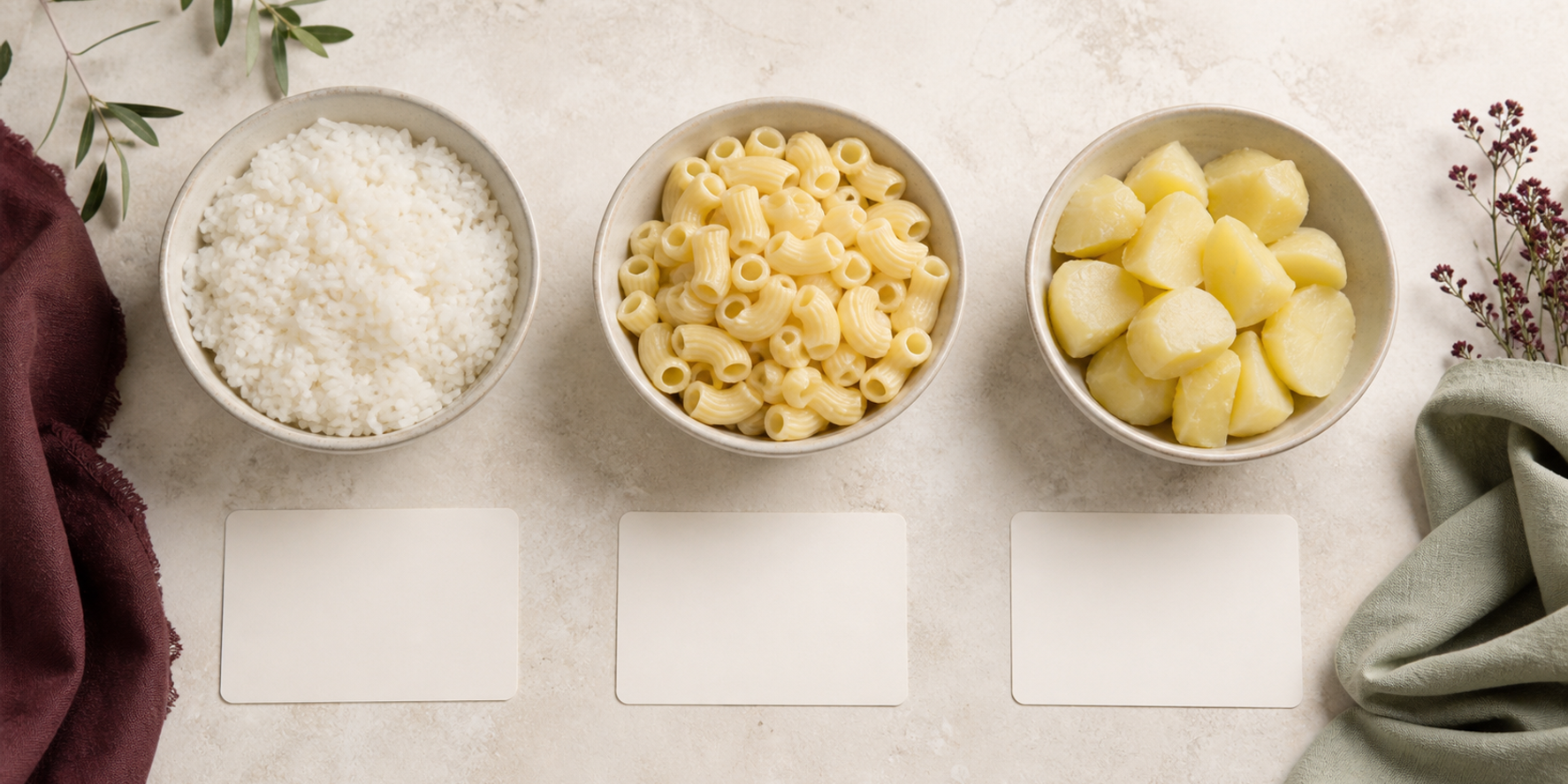
If you are comparing rice, pasta, and potato foods, the approved Health360 sources only support exact item-by-item comparisons for listed rice and pasta entries. They do not provide a complete potato value, so a careful article should keep that gap visible, avoid broad category rankings, and never predict a personal glucose or weight response.
Key points
- Compare the exact food entry, not the broad category label.
- Keep preparation wording like boiled, noodles, or vermicelli attached to the item.
- The approved source set does not provide a potato value, so the potato comparison stays incomplete.
- Treat GI values as source-reported data, not a universal ranking.
- Do not use the source to predict an individual person’s blood-glucose or weight response.
When people ask for a rice pasta potato comparison, the safest answer is more specific than the category labels suggest. The approved Health360 source set gives GI values for exact rice and pasta entries, but it does not provide a potato entry. That means you can compare only the listed foods as written, keep preparation wording attached, and avoid turning one source-reported number into a universal ranking or a personal prediction.
This article is for adults who want careful, non-diagnostic food-comparison education. It shows what the source set actually covers, what is missing, and which common comparison mistakes to avoid.
What the approved sources cover and what remains missing
The approved source set contains several exact rice and pasta entries with GI values. The listed examples include Pasta, Brown Rice Pasta, Quinoa Pasta, Oat Pasta, Barley Pasta, Brown Rice (Boiled), Wild Rice (Boiled), Barley (Boiled), Rice Noodles, and Rice Vermicelli. These are item-specific data points, not a blanket value for every rice, pasta, or potato food.
The important limitation is just as clear: the approved source set does not establish a complete potato comparison, because no potato entry or potato GI value is provided in the supplied approved content. If you mention potatoes, the missing evidence must stay visible rather than being filled in from outside assumptions.
Quick reading rule
Compare the exact named entry, not the category label. If the source says Brown Rice (Boiled), treat it as that exact item. If the source says Rice Noodles, do not merge it with all rice or all pasta.
Mistake 1: comparing broad food categories instead of exact entries
A common comparison error is to treat “rice,” “pasta,” and “potato” as if each label represented one identical food. The approved sources do not support that shortcut. They list multiple distinct entries inside the rice and pasta groups, which shows that category labels are too broad for precise comparison.
For example, the source set includes Pasta GI 48, Brown Rice Pasta GI 50, Quinoa Pasta GI 53, Oat Pasta GI 55, and Barley Pasta GI 52. It also includes Brown Rice (Boiled) GI 68, Wild Rice (Boiled) GI 57, Rice Noodles GI 53, and Rice Vermicelli GI 58. Those are separate entries, so they should be compared as separate entries.
A useful editorial test is simple: if the source names the food differently, do not collapse the values into one category number.
Mistake 2: ignoring preparation and food form
Preparation and food form matter because the approved source distinguishes exact items rather than using one broad label. “Boiled” appears in some rice and barley entries. “Noodles” and “vermicelli” appear as separate rice-based entries. Pasta variants also appear as their own named items.
That means these foods are not interchangeable in source reporting:
- Brown Rice (Boiled)
- Wild Rice (Boiled)
- Barley (Boiled)
- Rice Noodles
- Rice Vermicelli
- Pasta and pasta variants such as Brown Rice Pasta or Quinoa Pasta
The practical rule is to preserve the source wording. If the preparation detail is part of the name, keep it attached. That is the cleanest way to avoid comparing foods that are not actually the same entry.
Mistake 3: inventing a potato value when the approved source does not provide one
This is the most important boundary in the approved source set. The sources do not provide a potato entry or a potato GI value, so a complete three-way comparison cannot be made from the supplied material alone.
That missing evidence should remain visible. A careful article does not patch the gap with outside assumptions, guesses, or a borrowed number from elsewhere. It simply says that the approved source set is incomplete for potato comparison.
If a reader is looking for potatoes specifically, the right answer from these sources is not a number. It is a limitation note: the supplied approved content does not include one.
Mistake 4: turning one number into a universal food ranking
A single GI value from the approved sources is source-reported information, not a universal ranking of all foods. The data are entry-specific, so they do not justify saying that all rice is higher or lower than all pasta, or that any potato option must fit into the same ranking.
This matters because one named entry can have a different GI value from another named entry in the same broad food family. The source set itself shows that variation. So the correct conclusion is narrower: the listed items have the values reported for those exact items.
A helpful way to phrase it is: “This is a comparison of listed entries, not a universal food hierarchy.”
For a broader discussion of comparison limits, see How to Check Whether Two Food Values Are Actually Comparable.
Mistake 5: predicting an individual’s blood-glucose or weight outcome
The approved source data cannot be used to predict how one person’s blood glucose or weight will respond. The sources provide food comparison information, but they do not include individualized physiology, medical status, or outcome data.
That means the source values should stay in the educational lane. They can support a careful comparison of listed food entries, but they cannot tell you what will happen in your body after a meal.
So avoid lines like:
- “This food will spike your glucose.”
- “That food will definitely help you lose weight.”
- “This value proves a personal result.”
Those conclusions go beyond the approved evidence.
A careful rice, pasta, and potato comparison checklist
Use this checklist when you want to keep the comparison source-bound and readable:
- Use the exact food name from the source.
- Example: Pasta, Brown Rice Pasta, Brown Rice (Boiled), Rice Noodles, or Rice Vermicelli.
- Keep preparation wording attached.
- If the source says boiled, noodle, or vermicelli, do not remove that detail.
- Do not merge separate entries into one category value.
- Rice, pasta, and potato are not single identical foods in source reporting.
- Say when the potato evidence is missing.
- The approved source set does not provide a potato value, so a full comparison is incomplete.
- Present GI values as source-reported data only.
- They are not a universal ranking and not a personal prediction.
- Keep personal questions separate from source comparison.
- If someone wants advice about their own situation, that needs a qualified healthcare professional.
For a related source-bound framework, see How to Compare Rice, Pasta and Potato Options Without Rigid Rules.
A simple decision path for readers
If you are writing or reading a comparison, follow this path:
Is it Pasta, Brown Rice Pasta, Rice Noodles, or Brown Rice (Boiled)?
- Step 1: Identify the exact item.
In the approved source set, it does not.
- Step 2: Check whether the source includes the exact potato entry.
Keep preparation and food form visible.
- Step 3: Compare only like with like.
The source data do not tell you what will happen to any one person.
- Step 4: Stop before personal prediction.
This sequence keeps each comparison tied to the approved evidence and makes unsupported overstatements easier for readers and editors to notice and question before relying on them.
When a personal question needs a qualified healthcare professional
If the question is not “what does the approved source list?” but rather “what is right for me?”, the answer belongs with a qualified healthcare professional. That is especially important when someone wants help interpreting a personal blood-glucose trend, a weight concern, or another individual health question.
The approved source set is useful for careful general education. It is not a substitute for personal assessment.
Concise summary
The approved Health360 sources support exact comparisons for listed rice and pasta entries, including items such as Pasta, Brown Rice Pasta, Brown Rice (Boiled), Rice Noodles, and Rice Vermicelli. They do not provide a complete potato value, so any potato comparison must remain visibly incomplete. The safest interpretation is to compare exact entries, preserve preparation wording, and avoid universal rankings or personal outcome predictions.
FAQ
Does the approved source set include a potato GI value?
No. The approved source set does not provide a potato entry or a potato GI value, so it does not support a complete potato comparison.
Can I treat all rice or all pasta as one category in the comparison?
No. The source data are entry-specific, so comparisons should stay tied to the exact food names listed in the source.
Can the listed GI values tell me how my body will respond?
No. The approved source data do not include individualized physiology or outcome data, so they cannot predict a person’s blood-glucose or weight response.
Is one GI value enough to say a food is universally better?
No. A single source-reported GI value is not a universal ranking of all foods.
What should I do if I need advice for my own situation?
Use the source as general educational context, and ask a qualified healthcare professional for personal guidance.
Questions readers often ask
Does the approved source set include a potato GI value?
No. The approved source set does not provide a potato entry or a potato GI value, so it does not support a complete potato comparison.
Can I treat all rice or all pasta as one category in the comparison?
No. The source data are entry-specific, so comparisons should stay tied to the exact food names listed in the source.
Can the listed GI values tell me how my body will respond?
No. The approved source data do not include individualized physiology or outcome data, so they cannot predict a person’s blood-glucose or weight response.
Is one GI value enough to say a food is universally better?
No. A single source-reported GI value is not a universal ranking of all foods.
Want a calmer way to review food comparisons?
Visit the Health360 overview.
Visit the Health360 overview