
How to Layer Over a Dress Without Creating Competing Focal Points
A practical, body-neutral way to decide whether the dress or the added layer should lead the look, with coordination tips, fit checks, and editorial examples.
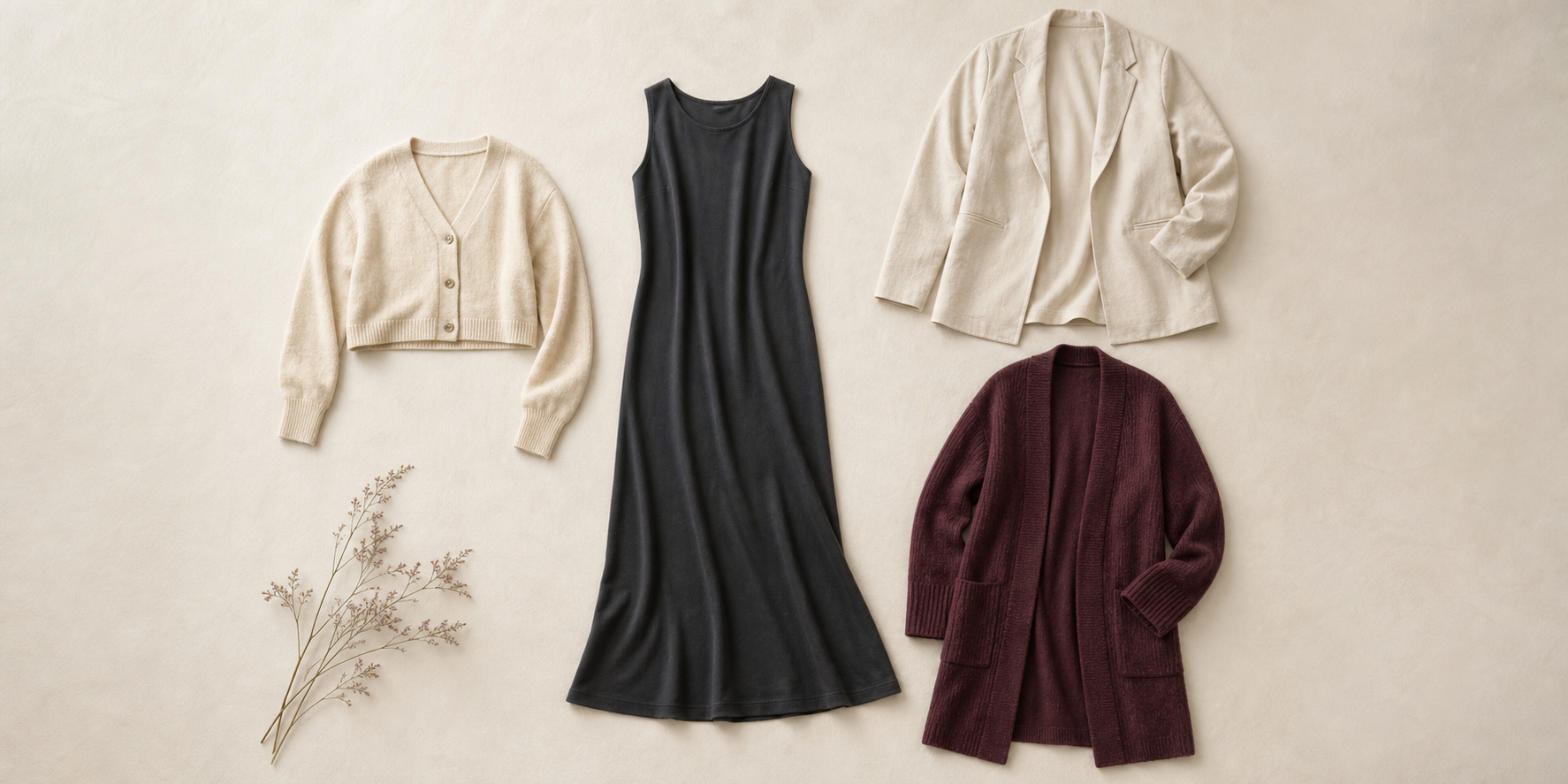
Key points
- Start with the dress as the reference point before choosing a layer.
- Decide which element should carry the main visual emphasis, then let the others support it.
- Use coordinated colors, textures, and details so the outfit feels edited rather than crowded.
- Check fit and structure, since a layer that sits cleanly reads more intentionally.
- If the dress already has noticeable detail, a simple or neutral layer often reduces visual competition.
- Treat exact dress-and-layer combinations as Editorial examples only, not universal formulas.
When you layer over a dress, the easiest place to start is the dress itself. From there, the next question is not simply *what can I add?* It is *what should the outfit be doing visually?* Some outfits work best when the dress remains the main point of emphasis. Others work better when the layer takes a more structured role. The key is to keep the result coordinated, so the pieces support one another instead of competing for attention.
This is not about following one universal formula. It is about reading the dress in front of you, then choosing a layer that fits the setting, the level of formality, and the amount of detail already present. In that sense, layering over a dress is less about adding more and more pieces, and more about deciding what should stay quiet.
What competing focal points mean in a layered outfit
A layered outfit can feel crowded when two or more elements are asking for equal attention at the same time. That can happen through strong color, noticeable texture, detailed construction, or accessories that all compete at once. The result is usually less clear than an outfit where one element leads and the others stay supportive.
A simple way to think about it is this: one part of the outfit should do the main visual work, while the rest helps it read cleanly. The dress may be the lead. The layer may be the lead. A small accessory may be the accent. What matters is that the outfit does not try to make every piece equally loud.
Coordination helps here. Colors, textures, and details are easier to manage when they complement one another instead of pulling in different directions. A neutral or subdued palette can make this easier, and so can a simpler silhouette or less busy accessory choice. The goal is not to remove personality. It is to place that personality in one clear direction.
If you want a more detailed way to think about layering texture and structure, see our related guide: How to Use Texture in an Outfit Without Making It Feel Busy.
Start with the dress as the supplied reference
Before you add anything, treat the dress as the starting point. That means looking at it first and asking what it already communicates visually. A dress can be simple, or it can already contain enough detail to set the tone on its own. Once you know that, you can choose a layer that either supports that tone or shifts the outfit toward a more structured reading.
This approach is consistent with the idea that a dress can function as the foundation item in an outfit and can be worn on its own or with another piece over it. In practice, that means the dress is not just a background item. It is the reference point for the rest of the styling decision.
A helpful question is: does the dress already have enough presence for the outfit, or does it leave room for the layer to take on more visual weight? There is no universal answer. The point is to look at the dress first, then make the next choice intentionally.
Choose which element carries the main visual emphasis
Once the dress is your reference point, decide what should carry the main visual emphasis.
If the dress already has noticeable detail, a simpler layer often works better because it reduces visual competition. In that case, the layer stays supportive and the dress remains the focus. If the dress is simple, a more defined layer can take on a larger role without making the outfit feel overloaded.
This does not mean the supporting piece has to disappear. It just means the other elements should not fight for equal attention. A layered outfit generally reads more clearly when one item leads and the others are intentionally quieter.
Accessories follow the same idea. A small accent can be enough if the dress-and-layer pairing already creates interest. The more visually active the outfit becomes, the less helpful it is to keep adding additional attention-grabbing details.
Use proportion and line without body-shape rules
Fit and structure matter because they change how the layer reads over the dress. A piece that sits cleanly will usually look more deliberate than one that pulls, gaps, or appears awkwardly loose. That is especially relevant with tailored pieces, where shape and structure are part of the effect.
A blazer is a good example of a structured layer. It can make a dress read as more polished and composed. By contrast, simpler casual layers tend to feel more relaxed. The difference is not only in formality; it is also in how much structure the added piece brings to the outfit.
The important point is to check whether the layer sits well over the dress and whether it keeps its shape in a way that suits the overall look. If it looks too tight or too loose, it can disrupt the clarity of the outfit even when the color palette is coordinated.
Coordinate colour, texture and detail without universal formulas
Coordination is a practical styling decision, not a rigid rule. In many cases, neutral tones, simple forms, and controlled texture make layering easier to read. That is especially useful when the dress already has strong color, print, or decorative detail.
A simple or neutral layer can lower visual competition and let the dress remain the focus. Likewise, when the layer itself has a little more structure or texture, it helps to keep the rest of the outfit calm enough that the look still feels unified.
This is where “less busy” does not mean “plain.” It means the outfit is edited. The colors work together. The texture choices feel intentional. The details are limited enough that the eye knows where to land first.
If you are looking for another related styling principle, you may also like: Versatile Layers for a Smart-Casual Wardrobe.
Editorial examples using generic garments
The combinations below are Editorial examples only. They are not universal formulas, and they are not meant to imply what anyone should wear in a specific situation.
Editorial example: a simple solid dress with a neutral blazer and minimal accessories, so the outfit has one clear point of emphasis.
Editorial example: a dress with noticeable print paired with a plain outer layer, so the dress remains the main visual feature.
Editorial example: a structured blazer over a dress for a more polished reading of the outfit in a formal setting.
Editorial example: a softer, looser layer over a dress for a more relaxed reading in an everyday context.
Editorial example: a dress with one small accent, such as a single scarf or piece of jewelry, while the layer stays visually quiet.
These examples show the same principle in different directions: either the dress leads and the layer supports, or the layer becomes more structured while the rest stays restrained.
A context-first layering checklist
Use the following as a practical sequence, not as a fixed rule set.
- Look at the setting first. The right layering choice depends on context, including the expected level of formality.
- Assess the dress. Decide whether it already has strong color, print, texture, or decoration.
- Choose the main emphasis. Decide whether the dress or the layer should carry the stronger visual role.
- Check the fit of the added piece. Make sure it sits cleanly and does not look too tight or too loose.
- Keep coordination in mind. Use colors, textures, and details that complement each other.
- Limit extra elements when needed. If the dress-and-layer pairing already has enough presence, keep accessories quieter.
- Match structure to the context. More tailored layers tend to read more polished, while simpler layers tend to feel more relaxed.
The value of a checklist like this is that it slows the decision down just enough to make the result more coherent. You do not need to force a formula onto every dress. You only need a sensible sequence for deciding what the outfit is doing.
When a simple layer is the better choice
A simple or neutral layer is often useful when the dress already carries detail. It can help the outfit feel more balanced because it reduces the number of active visual elements at once.
That does not mean the layer has to be invisible. It only needs to avoid competing. A quiet layer can still contribute structure, polish, or a relaxed finish depending on the piece you choose and the context you are dressing for.
In the same way, if the dress is simple, the layer has a little more room to define the overall reading of the outfit. Even then, it usually works best when the rest of the outfit stays controlled rather than introducing several separate focal points.
The short version
If you want the simplest possible approach, start with the dress, decide what should lead visually, and let the other pieces support that choice. Keep colors and details coordinated. Pay attention to fit. And when the dress already has plenty going on, choose a quieter layer rather than adding more attention-grabbing elements.
That is usually enough to keep a layered dress outfit clear, composed, and easy to read.
FAQ
How can I tell what the focal point of a dress outfit is?
Look at which element has the strongest visual presence. If the dress already has the most color, texture, or detail, it will usually be the focal point. If the layer is more structured or noticeable, it may take the lead instead. The main idea is to avoid letting every piece compete equally.
What helps a layer support a dress instead of competing with it?
A supportive layer is usually simpler, more neutral, or less visually demanding than the dress. Coordinated color choices, restrained texture, and limited extra detail all help the outfit stay readable. Fit matters too, because a layer that sits cleanly tends to look more intentional.
Does layering need to be very structured to look polished?
No. Structure changes the reading of the outfit, but it is not the only option. A blazer can create a more polished effect, while simpler casual layers usually read as more relaxed. The better choice depends on the setting and the level of formality you want the outfit to reflect.
Is there one correct way to layer over a dress?
No. The sources support context-based decision-making rather than one universal formula. The best approach depends on the dress, the added layer, the amount of detail already present, and the setting. Editorial examples can show the principles, but they are not fixed rules.
What if the dress already has a lot of detail?
A simple or neutral layer is often the easier option because it helps reduce visual competition. That keeps the dress from having to compete with another strong element. In general, the more detail the dress has, the more helpful a quiet layer can be.
A calm way to choose your next layer
If you are standing in front of a dress and wondering what to add, begin with a simple question: what should be most visible here? Once you answer that, the rest becomes easier. The layer can support the dress, the dress can support the layer, or a small accessory can finish the idea without taking it over.
That is the heart of balanced layering: not more, just clearer.
Questions readers often ask
How can I tell what the focal point of a dress outfit is?
Look at which element has the strongest visual presence. If the dress already has the most color, texture, or detail, it will usually be the focal point. If the layer is more structured or noticeable, it may take the lead instead. The main idea is to avoid letting every piece compete equally.
What helps a layer support a dress instead of competing with it?
A supportive layer is usually simpler, more neutral, or less visually demanding than the dress. Coordinated color choices, restrained texture, and limited extra detail all help the outfit stay readable. Fit matters too, because a layer that sits cleanly tends to look more intentional.
Is there one correct way to layer over a dress?
No. The guidance here is context-based rather than universal. The best choice depends on the dress, the added layer, the amount of detail already present, and the setting. Editorial examples can illustrate the principle, but they are not fixed rules.
Explore Smart Wardrobe
Use Smart Wardrobe to compare dress-and-layer options that you explicitly add for your own context.
Explore Smart Wardrobe