
How to Interpret Casual Friday Without Guessing at a Uniform
Casual Friday is best understood as a context question: start with written workplace guidance, then use the day’s activities and the visible workplace norm to choose how formal to dress.
Key points
- Start with written workplace guidance before interpreting casual Friday.
- Use the day’s tasks and practical demands to judge how structured or relaxed the outfit should be.
- Watch the actual workplace norm to understand how casual Friday works in that setting.
- Use fit, restraint, neat construction, and understated accessories as business-style principles.
- Treat outfit ideas as editorial examples, not as universal rules or employer expectations.
Why casual Friday is a context question
The approved sources support a context-first approach: start with available written workplace guidance, then use the day’s stated activities to identify an appropriate formality range. In other words, casual Friday is not a hidden universal uniform. It is a question about boundaries.
That means three things matter most:
- what the workplace has stated in writing
- what the day requires from you
- what the workplace culture visibly looks like on similar days
This approach keeps the decision practical. It also avoids turning casual Friday into a one-size-fits-all rule that may not match the setting.
Check written workplace guidance first
The first boundary is the written dress code, policy, or manager guidance supplied for the workplace. The approved source recommends assessing the dress code first and deciding whether the workplace allows a more casual approach. That is the most reliable starting point because it tells you what is actually permitted.
If the guidance is clear, follow it. If it is brief or leaves room for judgment, treat that as a sign to look at the rest of the context rather than inventing a standard.
A useful mindset is this: the written guidance controls the range, and your outfit choice sits somewhere inside that range. Casual Friday does not override the policy; it sits within it.
Identify the activities and practical constraints for the day
Once you know the written boundary, think about the day itself. The approved source says the day’s activities and job responsibilities matter when choosing what is appropriate.
That can include questions such as:
- Are there meetings or external interactions?
- Will you be moving around more than usual?
- Does the day involve tasks that call for a more structured look?
- Is there anything in the schedule that suggests a more conservative choice?
This is not about guessing a perfect answer. It is about aligning the outfit with the practical demands of the day. A casual Friday outfit can still be neat and business-like if the day calls for that level of structure.
Observe the actual workplace norm
The approved sources also support looking at the people around you. Observing colleagues and adapting to company culture can help clarify what casual Friday means in that workplace.
That does not mean copying anyone exactly. It means noticing the visible norm:
- how formally people dress on similar days
- whether the atmosphere is relaxed or still fairly structured
- whether supervisors and coworkers tend to stay close to business style
This is especially useful when written guidance is broad. If the policy leaves room for interpretation, the workplace culture often shows where the practical middle ground sits.
Separate business-style principles from invented rules
The sources support a business-style approach built on fit, restraint, and neat construction. They do not support a single fixed outfit formula for casual Friday.
The recurring principles are consistent:
- garments should fit well
- pieces should be neat and carefully constructed
- the overall look should feel polished rather than random
- modesty and non-revealing presentation remain part of the professional frame
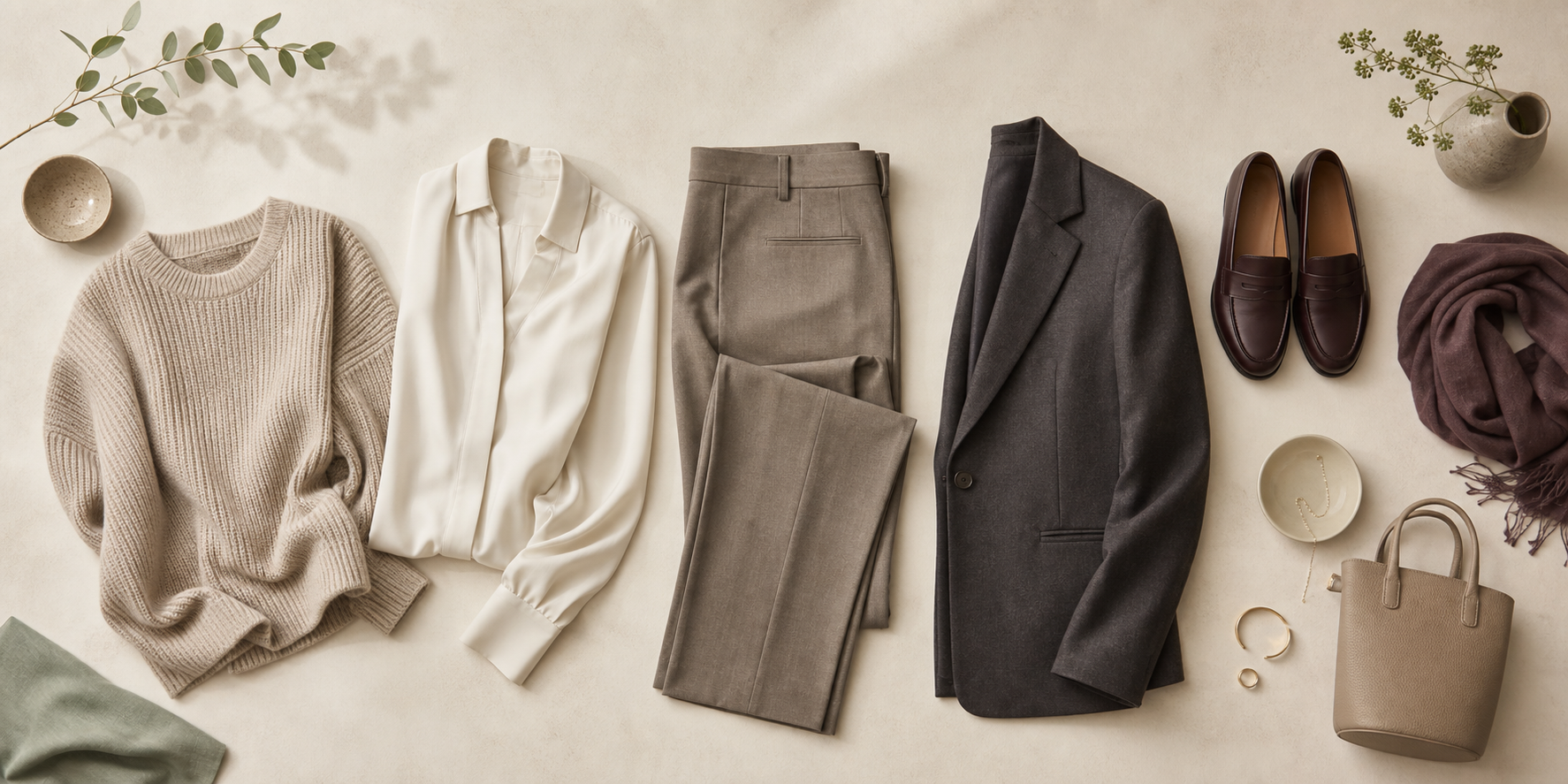
The approved materials also mention classic business-style elements such as blazers, trousers, blouses, loafers, flats, simple jewelry, and structured bags. These are not rules in themselves. They are useful building blocks that can be combined in different ways.
That is the key distinction: business style gives you principles and materials, not a single uniform.
Build a range of formality rather than one uniform
A practical way to approach casual Friday is to think in ranges.
At the more structured end of the range, options can use tailored pieces and simple layering. At the more relaxed end, you may use fewer structured elements, but still within the limits of your workplace guidance.
The approved sources support this kind of balanced composition. They describe professional dressing as combining tailored pieces, layered tops, and versatile combinations, while classic business style emphasizes simplicity, restraint, and neutral palettes.
That means the goal is not to find the one correct outfit. It is to choose a combination that fits the day and the workplace without drifting outside the allowed range.
Editorial examples using generic garments
The following outfit ideas are editorial examples only. They are not rules, and they should not be read as workplace expectations.
Editorial example: a tailored blazer with a simple top and straight-leg trousers.
Editorial example: a structured jacket with a blouse and a knee-length skirt.
Editorial example: a neat knit top with tailored trousers and understated shoes.
Editorial example: a simple blouse with dark jeans only if written guidance or workplace context clearly allows that level of casualness.
Editorial example: a blazer worn over a casual top to sit between formal and relaxed within the stated guidance.
What these examples have in common is not a single formula. They show how structured pieces, simple tops, and understated accessories can be arranged at different levels of formality.
A context-first casual Friday checklist
Use this short checklist as a decision aid, not as a universal rule.
- Check the written guidance first.
- Consider the day’s tasks, meetings, and practical demands.
- Look at how people in the workplace actually dress on similar days.
- Choose pieces that fit well and look neat.
- Keep the overall composition restrained and coordinated.
- If the situation is unclear, choose the more conservative option that still fits the guidance.
This order matters. Written guidance comes first, then the day’s activities, then visible workplace norms. That keeps the decision grounded and helps you avoid inventing a uniform that may not exist.
How to avoid guessing at a uniform
A common mistake is to treat casual Friday as if it automatically means the same thing everywhere. The approved sources point in the opposite direction. Casual Friday is shaped by context.
To stay on track:
- do not assume relaxed means informal in every workplace
- do not assume a single outfit formula applies to everyone
- do not treat editorial examples as employer rules
- do not ignore written guidance in favor of vague habit
A better approach is to ask, “What does this workplace allow, and what does today require?” That question keeps the decision practical and aligned with the setting.
When a more structured choice makes sense
Sometimes the most suitable option is still fairly structured. That can happen when the written guidance is conservative, when the schedule includes meetings, or when the visible workplace norm stays close to business style.
In those cases, pieces like a blazer, tailored trousers, a blouse, or simple loafers can sit comfortably inside the casual Friday range. The point is not to look formal for the sake of it. The point is to stay within the workplace boundary while still using a slightly more relaxed Friday approach if it is allowed.
When a more relaxed choice may fit
In workplaces where the written guidance and visible norm both allow more ease, a casual Friday outfit may move toward simpler combinations. Even then, the same principles still apply: fit, neatness, restraint, and a polished overall composition.
That is why the sources are useful. They do not force a rigid outfit. They give you a way to judge formality while keeping the result orderly and professional.
How Smart Wardrobe can help organize the decision
If you like to plan outfits in advance, Smart Wardrobe can be a useful way to organize workwear options the user explicitly adds and compare them against the day’s context. That can make it easier to sort structured, relaxed, and in-between combinations without turning casual Friday into a fixed uniform.
For a related approach, see: How to Build a Smart-Casual Work Wardrobe That Looks Coordinated and Feels Comfortable
FAQ
What written workplace guidance controls a casual Friday decision?
The written workplace guidance is the first boundary. The approved source supports assessing the dress code first and deciding whether the workplace allows a more casual approach. If the guidance is unclear, use the day’s activities and the visible workplace norm to narrow the range.
How can I tell what formality level is appropriate without inventing a uniform?
Use a three-step approach: check the written guidance, consider the day’s tasks, and observe the workplace culture. The sources support both the practical demands of the day and the way colleagues and supervisors dress as helpful clues.
Which outfit ideas are editorial examples rather than rules?
Any exact outfit configuration in this article should be treated as an editorial example only. The examples are generic combinations such as a blazer with trousers, a structured jacket with a skirt, or a simple blouse with dark jeans if the workplace context clearly allows it.
What business-style principles are supported by the sources?
The approved sources support fit, modesty, neat construction, restraint, and a polished overall composition. They also mention simple structured pieces and understated accessories such as blazers, trousers, blouses, loafers, flats, simple jewelry, and structured bags.
What should I do if the dress code is still unclear?
If the written guidance is vague, ask the appropriate workplace contact for clarification or choose an option within the clearly stated guidance and the day’s practical demands. That is the safest context-first approach when you do not have enough information to define a uniform.
Questions readers often ask
What written workplace guidance controls a casual Friday decision?
The written workplace guidance is the first boundary. The approved source supports assessing the dress code first and deciding whether the workplace allows a more casual approach. If the guidance is unclear, use the day’s activities and the visible workplace norm to narrow the range.
How can I tell what formality level is appropriate without inventing a uniform?
Use a three-step approach: check the written guidance, consider the day’s tasks, and observe the workplace culture. The sources support both the practical demands of the day and the way colleagues and supervisors dress as helpful clues.
Which outfit ideas are editorial examples rather than rules?
Any exact outfit configuration in this article should be treated as an editorial example only. The examples are generic combinations such as a blazer with trousers, a structured jacket with a skirt, or a simple blouse with dark jeans if the workplace context clearly allows it.
What business-style principles are supported by the sources?
The approved sources support fit, modesty, neat construction, restraint, and a polished overall composition. They also mention simple structured pieces and understated accessories such as blazers, trousers, blouses, loafers, flats, simple jewelry, and structured bags.
What should I do if the dress code is still unclear?
If the written guidance is vague, ask the appropriate workplace contact for clarification or choose an option within the clearly stated guidance and the day’s practical demands. That is the safest context-first approach when you do not have enough information to define a uniform.
Explore Smart Wardrobe
Use Smart Wardrobe to organize workwear options that you explicitly add after checking your workplace guidance.
Explore Smart Wardrobe