
Context-First Checklist for Choosing What to Wear
A practical, body-neutral way to choose an outfit is to start with context: the occasion, activity, environment, weather, and practical needs. This guide turns that approach into a repeatable checklist, with clearly labeled editorial examples.
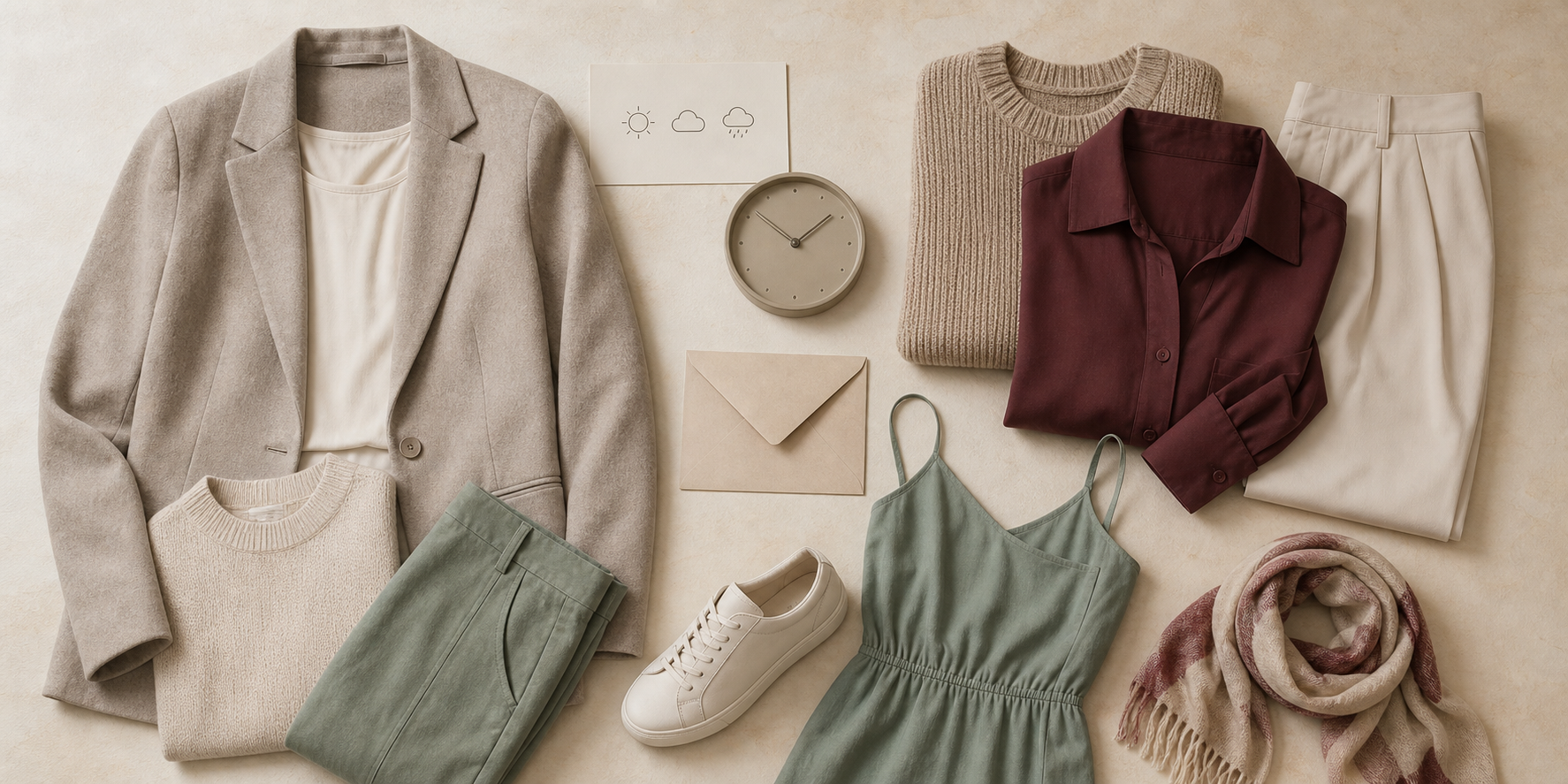
Key points
- Start with the occasion, activity, environment, and expectations before picking clothes.
- For work, consider dress code, job responsibilities, and workplace culture.
- Weather, comfort, mobility, and footwear are part of the decision, not afterthoughts.
- Versatile wardrobe roles are more useful than universal must-have lists.
- Personal style belongs in the process, but after the practical context is clear.
Why context comes before outfit selection
A useful way to choose what to wear is to start with context, not with a fixed outfit formula. The occasion, the activity, the environment, and any stated expectations give you the first frame for deciding what makes sense.
That approach is more flexible than universal must-have lists because clothing can serve different roles in different situations. A piece may be useful in more than one setting, and the right combination depends on what the day asks of you.
For that reason, it helps to think in terms of function: what the setting requires, what the day involves, and where personal style can be added after the basic needs are clear.
Define the occasion and activity
The first question is simple: what is the setting asking for?
If the outfit is for work, the context includes the dress code, job responsibilities, and the culture of the workplace. The sources support observing how people dress in that environment and aligning choices with the setting rather than assuming one standard answer for every office.
The same idea applies beyond work. A quiet dinner, a day of errands, a travel day, or a more formal event can each call for different levels of structure, ease, and polish. The activity matters too: sitting for long periods, walking, commuting, or moving between locations can change what feels practical.
Check duration, weather, and practical constraints
Clothing choices are also shaped by practical conditions.
Weather matters, including temperature changes and the need for outerwear. The sources support considering comfort, mobility, and suitable footwear or layers for the conditions. A longer day can also make those details more important, especially if the environment changes over time.
This is where context becomes more useful than rules. Instead of asking, “What is the correct outfit?” it is often better to ask, “What will I need to stay comfortable and appropriately dressed for the full situation?”
Use wardrobe roles rather than universal must-have lists
A more adaptable way to plan clothing is to think in roles.
The sources describe versatile pieces that can serve multiple situations and be combined in different ways. That framing is more helpful than treating any fixed list as universal. A garment can be selected because it plays a useful role: structure, comfort, weather protection, or flexibility across settings.
This also makes room for seasonal adaptation. A wardrobe can shift with temperature, schedule, and lifestyle demands without needing a single formula for everyone.
Editorial examples
Editorial example: For a workplace meeting, begin by checking the dress code and the level of formality in the setting, then choose pieces that fit that context.
Editorial example: For a longer day with changing temperatures, add a layer or outerwear option that can be adjusted to the weather.
Editorial example: For a more expressive setting, keep the context requirements in place and then add a personal style detail that still fits the occasion.
Editorial example: A neutral way to think about the wardrobe is by role: one layer for structure, one layer for comfort, one layer for weather, and footwear that fits the day’s demands.
Editorial example: A repeatable sequence could be: identify the occasion, review the activity, check the environment, consider weather and duration, then combine garments that serve those needs.
A repeatable context-first checklist
If you want a simple sequence, use this one as a working draft:
- Identify the occasion.
- Review the activity and how much movement, sitting, or travel the day involves.
- Check the environment, especially for work settings where dress code and workplace culture matter.
- Consider weather, temperature shifts, and the need for outerwear or suitable footwear.
- Choose garments by role, not by a universal list.
- Add personal style only after the practical requirements are covered.
- Review the combination one more time and ask whether it still fits the situation.
That sequence is not a universal rule. It is an editorial example of how to move from context to clothing choice in a way that stays flexible.
Build a context note before selecting garments
The source-backed principle is that context comes first: occasion, activity, environment, and stated expectations shape the clothing decision. That principle can be used without assuming anything about the reader's plans. The details have to be supplied by the person making the choice.
Editorial example: Write a short context note using only known details: “daytime event, mostly seated, short outdoor walk, cool weather.” This is an editorial planning aid, not a universal formula. A different situation can produce a completely different note.
Editorial example: If the context is still unclear, leave the outfit decision open rather than inventing a dress code, workplace expectation, weather condition, or activity. Confirming the missing context is more accurate than treating a generic outfit as automatically suitable.
Separate requirements from preferences
The approved sources support respecting the setting while still allowing personal style. Those are related but separate parts of the decision. Requirements come from known conditions, such as an explicit dress code, the planned activity, or weather. Preferences come from the person making the choice and must not be inferred.
Editorial example: Make two columns called “known requirements” and “stated preferences.” A requirement might be weather protection explicitly needed for the day. A preference might be a colour or silhouette the person has actually selected. If no preference has been stated, do not fill that space with an assumption.
Editorial example: When two options both meet the known requirements, compare them using the preference that was explicitly supplied. If no preference is available, keep both options open instead of ranking one as universally better.
Apply the work-context principle carefully
For work-related clothing, the approved sources support looking at the specific environment and job responsibilities. This does not mean every workplace has the same dress standard. It also does not justify guessing a reader's employer, role, schedule, or workplace culture.
Editorial example: If a workplace has provided a written dress code, use that document as a known constraint. Then consider only the tasks and interactions that have actually been described. Do not extend the example into a rule for other workplaces.
Editorial example: If the work environment has not been identified, ask for the level of formality and the practical tasks involved before suggesting a combination. This keeps the recommendation tied to supplied context rather than stereotypes about professions or seniority.
Recheck weather and duration as conditions change
Weather, comfort, mobility, outerwear, and suitable footwear are valid parts of clothing selection in the approved sources. Duration also matters as a contextual detail because a longer plan may involve more than one environment. The article does not need to prescribe a specific garment to make that principle useful.
Editorial example: For a plan that moves between indoor and outdoor settings, identify where temperature or weather protection changes. Then consider a removable layer as one possible response. This is an illustration, not a claim that layering is required for everyone.
Editorial example: For an activity involving walking, compare footwear options against the stated activity and conditions. Do not assume which shoes the reader owns, what feels comfortable to them, or what appearance they prefer.
Use roles to compare options without a must-have list
The source-backed idea of wardrobe roles focuses on versatility and adaptable use rather than a universal list of required pieces. A role describes what a garment needs to do in a known situation. It does not dictate one product, brand, colour, or silhouette.
Editorial example: A context may call for a weather-protection role, a movement-friendly role, or a more structured role. Multiple garments could serve each role. The person making the choice can compare only the items they explicitly provide.
Editorial example: If one item can serve more than one required role in the stated context, note that versatility without declaring it a universal essential. Another person or another day may call for a different combination.
Perform a final context check
The final check returns to the source-backed starting point: does the combination fit the known occasion, activity, environment, and expectations? Personal style can then remain part of the decision without overriding necessary conditions.
Editorial example: Read the context note again and test each known requirement against the proposed combination. Remove any requirement that was guessed rather than supplied. If a key detail is still missing, mark the choice as provisional instead of presenting it as a finished personal recommendation.
Editorial example: Keep alternative options when more than one combination meets the context. A context-first checklist narrows decisions; it does not need to manufacture a single winner or rank a person's appearance.
What the checklist cannot decide
A checklist can narrow the options, but it cannot tell you everything.
It cannot determine your preferences, your budget, your body, your wardrobe, or what any other person will do or think. It also cannot decide that one outfit is universally right for all situations.
That is why the most reliable version of outfit planning stays situational. Context sets the frame, practical needs set the boundaries, and personal style helps with the final selection.
FAQ
What should come first when choosing an outfit?
Start with the occasion and the activity. Then check the environment, expectations, weather, and practical demands before putting pieces together. The sources support this context-first approach rather than a fixed outfit formula.
How should work clothing decisions be made?
Work-related choices should account for the specific environment and job responsibilities. The sources recommend assessing the dress code, considering daily tasks and interactions, observing how colleagues and superiors dress, and aligning with company culture.
Why does weather matter so much?
Weather affects comfort, mobility, outerwear, and footwear. The sources support planning for suitable layers and seasonal adaptation rather than treating clothing as the same in every condition.
Is it better to build around must-have items or wardrobe roles?
Wardrobe roles are the more flexible framing tool in the sources. They describe adaptable pieces that can be combined in multiple ways and worn across different situations, which is more useful than a universal must-have list.
Can personal style still be part of the decision?
Yes. The sources support balancing personal style with the demands of the setting. In practice, that means adding style after the occasion, activity, and practical needs are clear.
Questions readers often ask
What should come first when choosing an outfit?
Start with the occasion and the activity. Then check the environment, expectations, weather, and practical demands before putting pieces together. The sources support this context-first approach rather than a fixed outfit formula.
How should work clothing decisions be made?
Work-related choices should account for the specific environment and job responsibilities. The sources recommend assessing the dress code, considering daily tasks and interactions, observing how colleagues and superiors dress, and aligning with company culture.
Why does weather matter so much?
Weather affects comfort, mobility, outerwear, and footwear. The sources support planning for suitable layers and seasonal adaptation rather than treating clothing as the same in every condition.
Is it better to build around must-have items or wardrobe roles?
Wardrobe roles are the more flexible framing tool in the sources. They describe adaptable pieces that can be combined in multiple ways and worn across different situations, which is more useful than a universal must-have list.
Can personal style still be part of the decision?
Yes. The sources support balancing personal style with the demands of the setting. In practice, that means adding style after the occasion, activity, and practical needs are clear.
Explore Smart Wardrobe
Use Smart Wardrobe to explore outfit combinations made from items you explicitly add.
Explore Smart Wardrobe