
How to Build a Smart-Casual Work Wardrobe That Looks Coordinated and Feels Comfortable
A smart-casual work wardrobe does not need perfect matching to look polished. Evidence points instead to moderation, coordination, and comfort: choose pieces that work together, keep colour relationships restrained, and make sure clothing supports long desk-based workdays.
Key points
- Smart-casual workwear is best understood as coordinated and flexible, not perfectly matched.
- Moderate colour matching tends to work better than extreme uniformity.
- Neutral base colours make outfits easier to mix and repeat.
- Repeatable outfit formulas reduce decision fatigue and help a wardrobe feel coherent.
- Comfort and ease of movement matter during long desk-based workdays.
- New purchases are easier to judge when they work with existing colours, silhouettes, and formulas.
What Makes Smart-Casual Workwear Feel Coordinated
A smart-casual work wardrobe is easiest to manage when you treat it as a system, not a set of isolated outfits. The strongest evidence here supports broad principles rather than a rigid formula: coordination matters, but so does flexibility. Fashion research suggests that colour matching works best at a moderate level, not through extreme uniformity, and workplace-attire research supports balancing presentation qualities rather than chasing one fixed rule for every setting.
For that reason, a smart-casual wardrobe is better described as coordinated and adaptable than perfectly matched. In practice, that means pieces should belong to the same visual family: similar levels of polish, compatible colours, and shapes that feel balanced together.
Smart casual is also context-dependent. A practical wardrobe system should reflect the workplace, the role, and the surrounding dress culture rather than assuming one universal standard. The aim is to look appropriate for the environment while still leaving room for personal style.
A useful mental rule
Instead of asking, “Does everything match?” ask:
- Do these pieces feel like they belong in the same workplace context?
- Do the colours sit well together?
- Does the silhouette look balanced rather than forced?
- Can I wear this comfortably through a normal workday?
That shift makes smart-casual dressing much easier to maintain over time.
Choose a Coordination Strategy
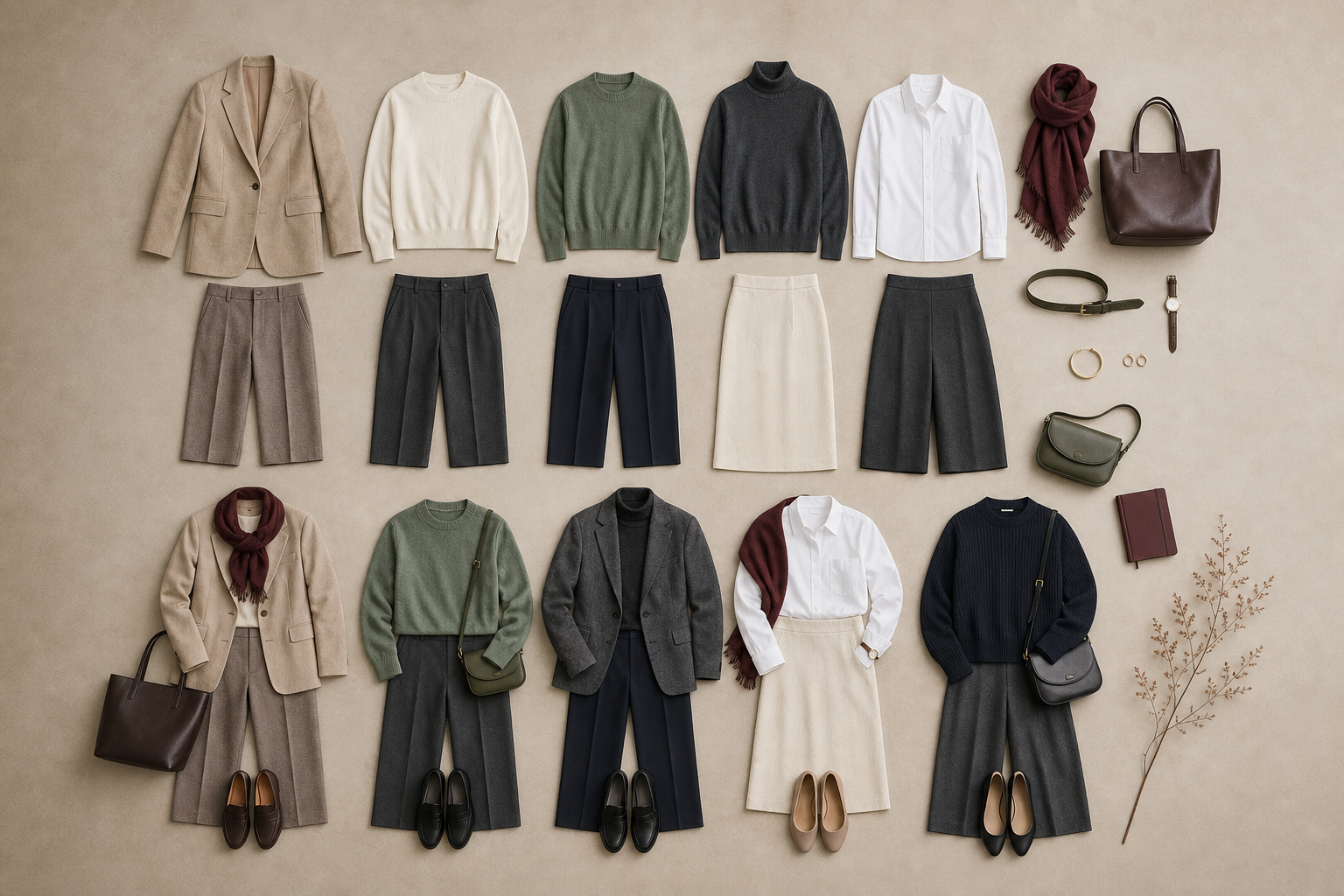
The most practical way to build a smart-casual work wardrobe is to start with a small, versatile base. Several wardrobe-planning sources point in the same direction: neutral foundations, timeless pieces, and easy mix-and-match relationships make coordination simpler.
A restrained colour strategy is especially helpful. The colour-coordination guidance in the research contribution suggests keeping the main outfit to two colours and adding a third only through an accessory if needed. That does not mean every outfit must follow a strict formula, but it does show why a limited colour range tends to look calmer and easier to combine.
Neutral shades are particularly useful because they are broadly mixable and timeless. Black, white, gray, navy, beige, and cream are repeatedly described as reliable foundations.
A simple way to think about colour
A practical coordination system can look like this:
- one neutral base colour
- one supporting neutral or muted colour
- one optional accent used sparingly
This approach keeps the wardrobe flexible without making it dull. It also fits the research point that moderation works better than excessive matching.
Build Outfit Formulas You Can Reuse
A coordinated wardrobe becomes much easier to use when you rely on repeatable outfit formulas. The supported wardrobe sources describe combining classic pieces in consistent ways so that a small set of items can produce multiple professional looks.
That is helpful because a formula reduces decision fatigue. You do not need a new combination every morning; you need a few combinations that feel reliable and work in more than one setting.
Examples of repeatable formulas
- blazer + simple top + tailored bottom
- simple dress + structured layer + streamlined shoes
- knit top + tailored trousers + clean-lined footwear
- blouse + skirt + understated layer
These are not rules, only examples of how coordination can be made repeatable without becoming rigid.
A useful styling principle is to keep the visual story clear. If one element already has texture, pattern, or interest, the rest of the outfit can stay quieter. That helps preserve polish while still allowing personality.
Keep one focal point
A calm smart-casual outfit often works best when it has one focal point:
- colour, or
- texture, or
- pattern, or
- a single accessory detail
Using all of them at once can make coordination harder, especially when the goal is a professional look.
Why Comfort Belongs in Smart-Casual Dressing
Comfort is not an afterthought in office dressing. EU office ergonomics guidance supports choosing clothing that does not restrict movement or create discomfort during seated work.
That does not mean clothing solves office ergonomics, and it certainly does not remove all workplace strain. But it does mean that workwear should not make sitting, reaching, walking, or changing posture more difficult than necessary.
For long desk-based days, the best wardrobe choices are usually the ones that feel easy to wear for several hours in a row. In practical terms, that means paying attention to:
- ease of movement at the shoulders, waist, and hips
- fabrics that feel comfortable through a full workday
- shoes that support a composed look without adding visual heaviness
- layers that can adapt to indoor temperatures and meetings
Clean-line footwear is often easier to coordinate across multiple outfits than busy, heavily embellished designs. The style guidance in the editorial guidance recommends streamlined shoes because they preserve the visual line of the outfit more easily.
How to Apply the Ideas in a Real Closet
The most useful wardrobe system is the one that works with the clothes you actually wear. Before adding anything new, it helps to ask whether the item fits existing colours, silhouettes, and outfit formulas.
A practical check before buying or keeping an item
Ask whether the piece:
- works with at least two existing outfit formulas
- fits your main colour family
- matches the level of formality of your workplace
- feels comfortable enough for a normal workday
- keeps the overall silhouette balanced
If the answer is yes to most of these, the item is more likely to earn its place in a coordinated wardrobe.
A wardrobe audit can also be helpful. Pieces that only work in one outfit, or that require special styling to feel coherent, often create more friction than value. Removing that friction makes the whole wardrobe easier to use.
A gentle way to refine the system
Rather than aiming for a complete overhaul, try one of these small adjustments:
- define two or three colour combinations you repeat often
- choose one or two reliable outfit formulas for workdays
- keep accessories restrained when the rest of the outfit is already doing enough
- adapt polish to the office, not the other way around
- use personal style through small accents instead of constant novelty
This balances professionalism and individuality, which the editorial guidances identify as an important part of workwear coordination.
A Calm Framework for Smart-Casual Work Dressing
If smart-casual dressing has felt vague, a structured approach can make it much easier:
- start with neutral, mixable pieces
- keep colour relationships moderate
- reuse a few dependable outfit formulas
- preserve balanced silhouettes
- choose comfort that works for a full workday
- check every new item against what already works
That is the central lesson from the evidence: a smart-casual work wardrobe does not need to be perfect. It needs to be coordinated, comfortable, and realistic for the life you actually live.
FAQ
What does a coordinated smart-casual wardrobe mean?
It means the clothes feel like they belong together, even if they are not identical or overly matched. The evidence supports moderate colour matching, flexible combinations, and a practical balance between professionalism and personal style.
Do all smart-casual outfits need the same colour palette?
No. The research supports moderate colour coordination, not rigid uniformity. A limited set of mixable neutrals is especially useful, but small accents can still work when they are used sparingly.
How can I make a work outfit look polished without making it stiff?
Use clean lines, balanced silhouettes, and repeatable formulas. Keep one focal point per outfit, and make sure the clothes are comfortable enough for a normal office day.
Questions readers often ask
What does a coordinated smart-casual wardrobe mean?
It means the clothes feel like they belong together, even if they are not identical or overly matched. The evidence supports moderate colour matching, flexible combinations, and a practical balance between professionalism and personal style.
Do all smart-casual outfits need the same colour palette?
No. The research supports moderate colour coordination, not rigid uniformity. A limited set of mixable neutrals is especially useful, but small accents can still work when they are used sparingly.
How can I make a work outfit look polished without making it stiff?
Use clean lines, balanced silhouettes, and repeatable formulas. Keep one focal point per outfit, and make sure the clothes are comfortable enough for a normal office day.
Plan a smarter work wardrobe, one combination at a time
If you want a calmer way to plan outfits, start by mapping the combinations that already work and then refine the colour relationships, silhouettes, and layers around them. A structured planning approach can make smart-casual dressing feel much easier to repeat.
Explore Wardrobe Planning