
How to Compare Rice, Pasta, and Potato Source Entries Safely
If you want to compare rice, pasta, and potato source entries, start with the exact label, keep preparation notes attached, confirm that a value is visible, and avoid turning the entries into personal diet advice or a ranking.
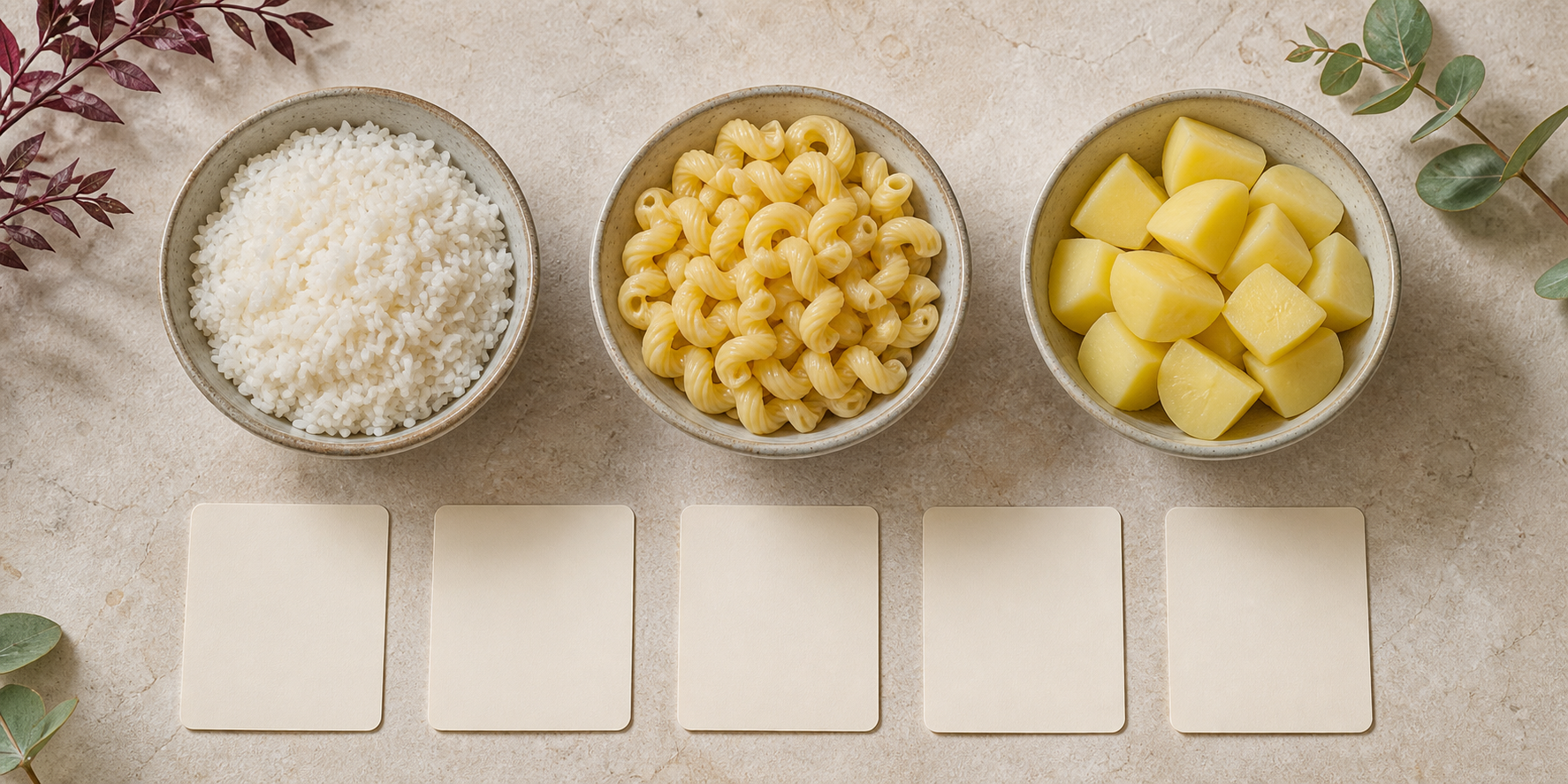
Key points
- Compare only the exact listed entries, not broad food categories.
- Keep preparation labels like "(Boiled)" attached to the item name.
- Confirm that a value is actually visible before using an entry.
- If a potato entry is missing from the retrieved source, leave it missing.
- A listed value supports observation, not personal diet advice or outcome prediction.
If you want to compare rice pasta and potato source entries, the safest approach is to read the entries exactly as written, keep preparation labels attached, and only compare items that are described in the same way. This article is for readers who want a short, non-diagnostic checklist for reading approved source entries without turning them into rankings or personal food rules. It shows what must match before a comparison is valid, how to handle a missing value, and why a listed GI value does not tell you what someone should eat or what will happen next.
The approved source material here includes several pasta-related entries and several rice-related entries with GI values. It also shows preparation labels in some entry names, such as "(Boiled)". A potato entry is not visibly present in the retrieved source content, so it should be treated as missing rather than filled in from memory or inference.
What this five-check process is for
This checklist is general education for source reading, not food ranking, personal meal planning, or an assessment or prediction of an individual health outcome. The source material supports observation of listed names and listed GI values, but it does not by itself determine what a person should eat, how much to eat, or what personal health result will follow.
A practical way to use the material is to move through five checks:
- Verify the exact food name.
- Keep the preparation form attached to the name.
- Confirm that a value is actually present.
- Compare only like-described entries.
- Separate what the source says from what you might infer.
That sequence keeps the comparison anchored to the text instead of to memory, assumptions, or broad category labels.
Check one: verify the exact food name
Start with the exact label in the source entry. The approved material includes multiple pasta-related entries and multiple rice-related entries, so the comparison needs to stay at the level of the listed item, not the food category in general. For example, the source lists Pasta, Brown Rice Pasta, Quinoa Pasta, Oat Pasta, and Barley Pasta as separate entries with GI values.
The same logic applies to rice-related entries. The source lists Brown Rice (Boiled), Wild Rice (Boiled), Rice Noodles, and Rice Vermicelli as distinct entries with GI values. If you collapse those labels into a single word like "rice," you lose the structure the source is giving you.
Why exact naming matters
Exact naming matters because the source is not presenting a single universal value for every pasta or every rice item. It is presenting individual entries. A careful reader compares the exact listed items rather than assuming one line stands for all similar foods.
Check two: retain the preparation form
In the retrieved source content, preparation form is part of the entry name in some cases. The clearest examples are Brown Rice (Boiled) and Wild Rice (Boiled). The presence of "(Boiled)" shows that the source distinguishes between prepared forms, so the label should stay intact when you compare entries.
That is not a small formatting detail. It is part of the identity of the entry as the source presents it. If the preparation label is removed, the entry no longer matches the source text exactly.
A simple rule for labels
If the source shows a preparation note, keep it. If the source does not show one, do not add one. That keeps the comparison tied to the source instead of to outside assumptions.
Check three: confirm that a listed value is present
Before you use an entry in a comparison, confirm that the value is actually visible in the retrieved text. The approved material contains many entries with GI values, but the retrieved excerpt also ends mid-entry for at least one item. That means a reader should not assume a missing or truncated value.
This matters because a comparison depends on visible data, not on what a reader expects to be there. If the value is not clearly shown, the safest note is that the value is not visible in the retrieved material.
What this protects you from
This check can help keep two common reading errors visible:
- treating an incomplete entry as complete
- filling in a missing number from memory or guesswork
Both would go beyond what the source actually provides.
Check four: compare only like-described entries
Compare entries only when they are described in the same way. That means you should not mix a prepared rice entry with an unlabeled rice entry if the source does not give both labels in the same form.
For example, Brown Rice (Boiled) should be kept separate from Rice Noodles, because they are not the same kind of entry description. Likewise, Pasta should be compared to other pasta-related entries only as the source presents them, not to every carbohydrate food under one broad heading.
A useful comparison rule
A valid source comparison answers this question: "Do these entries match in how they are named and described?" If the answer is no, the comparison should stop there.
Check five: separate source observation from interpretation
The source can tell you what is listed and what GI value is shown. It cannot tell you what that value means for a particular person, a particular meal, or a particular day.
That distinction is important. A source observation is a statement like "the entry lists a GI value." An interpretation is a statement like "therefore this food is the right choice for me." Those are not the same thing.
The approved source material does not provide individualized guidance, portion prescriptions, diagnosis, or outcome prediction. So the safest reading is to keep the entry-level observation separate from any personal conclusion.
A worked source-reading example
Here is a simple way to apply the checklist without turning the result into a ranking.
Suppose you are reading these source entries:
- Pasta — GI 48
- Brown Rice Pasta — GI 50
- Rice Noodles — GI 53
- Rice Vermicelli — GI 58
- Brown Rice (Boiled) — GI 68
- Wild Rice (Boiled) — GI 57
A careful reading would do three things:
- Keep each label as written.
- Notice that some entries include preparation form and others do not.
- Compare only the exact listed entries, not all rice foods or all pasta foods as one group.
That gives you a source-based comparison, but not a personal recommendation. It also avoids turning the numbers into a best/worst list.
What not to conclude from the example
Do not conclude that one item is universally better, healthier, or safer than another based on the listed value alone. Do not infer blood-glucose response, weight change, or any personal health outcome. The source does not support those claims.
What to do when the potato entry is missing
In the retrieved approved sources for this request, a potato entry is not visibly present. The correct way to handle that is to leave the absence visible.
That means writing something like: "potato entry not shown in the retrieved source." It does not mean guessing a value, replacing it with a similar food, or assuming the omission has a hidden meaning.
Why missing stays missing
A missing entry is not evidence of equivalence, error, or lower quality. It is simply missing from the material you can actually see. If a comparison depends on a potato entry, this source set does not provide one that is visibly retrievable here.
What the source entries cannot determine
The source entries support a narrow kind of reading: they let you observe names and GI values that are listed in the text. They do not determine personal suitability, ideal portion size, diagnosis, or treatment.
That limit applies to rice, pasta, and the missing potato entry alike. If a potato entry is absent, the source still does not allow you to fill the gap from memory. If a GI value is visible, that still does not justify a personal food rule or an outcome prediction.
Keep the boundary clear
A good source-reading summary stays inside the evidence:
- what is named
- what is prepared
- what value is visible
- what is missing
Anything beyond that is interpretation and should be labeled as such.
Quick summary
Use this sequence when you compare source entries:
- read the exact food name
- keep the preparation form attached
- verify that a value is visible
- compare only like-described entries
- separate observation from interpretation
For this approved source set, that means you can compare the listed pasta and rice entries as written, but you should not invent a potato entry or turn the values into personal diet advice.
Frequently asked questions
Can I compare pasta and rice entries directly?
Yes, but only as exact source entries. The approved material includes multiple pasta-related entries and multiple rice-related entries, so you can compare the listed items as written rather than as broad food categories.
Why does "(Boiled)" matter?
Because the source includes preparation form in the entry name for some rice items, such as Brown Rice (Boiled) and Wild Rice (Boiled). That label is part of the entry and should stay attached when you compare it.
What should I do if a value is not clearly visible?
Treat it as not confirmed. The checklist is to verify that a value is actually present before using the entry in a comparison.
Is there a potato entry in the retrieved source text?
No potato entry is visibly present in the retrieved content provided for this request. The safe response is to note that it is missing rather than fill it in from memory.
Can I use these entries to decide what I should eat?
No. The source entries support observation of listed names and GI values, but they do not determine what a person should eat, how much to eat, or what personal health outcome will follow.
Further reading
If you want a companion guide on the same topic, see How to Compare Rice, Pasta and Potato Options Without Rigid Rules and Rice, Pasta and Potato Comparison FAQ: Reading Source Entries Without Rankings.
Questions readers often ask
Can I compare pasta and rice entries directly?
Yes, but only as exact source entries. The approved material includes multiple pasta-related entries and multiple rice-related entries, so compare the listed items as written rather than as broad food categories.
Why does "(Boiled)" matter?
Because the source includes preparation form in the entry name for some rice items, such as Brown Rice (Boiled) and Wild Rice (Boiled). That label is part of the entry and should stay attached when you compare it.
What should I do if a value is not clearly visible?
Treat it as not confirmed. The checklist is to verify that a value is actually present before using the entry in a comparison.
Is there a potato entry in the retrieved source text?
No potato entry is visibly present in the retrieved content provided for this request. The safe response is to note that it is missing rather than fill it in from memory.
Can I use these entries to decide what I should eat?
No. The source entries support observation of listed names and GI values, but they do not determine what a person should eat, how much to eat, or what personal health outcome will follow.
Need a simple next step?
Visit the Health360 overview.
Visit the Health360 overview