
A Casual Friday Decision Guide Without Guessing at a Uniform
A practical, body-neutral way to interpret Casual Friday is to use the written dress code and the context actually provided—then treat anything missing as unknown instead of inventing a hidden uniform.
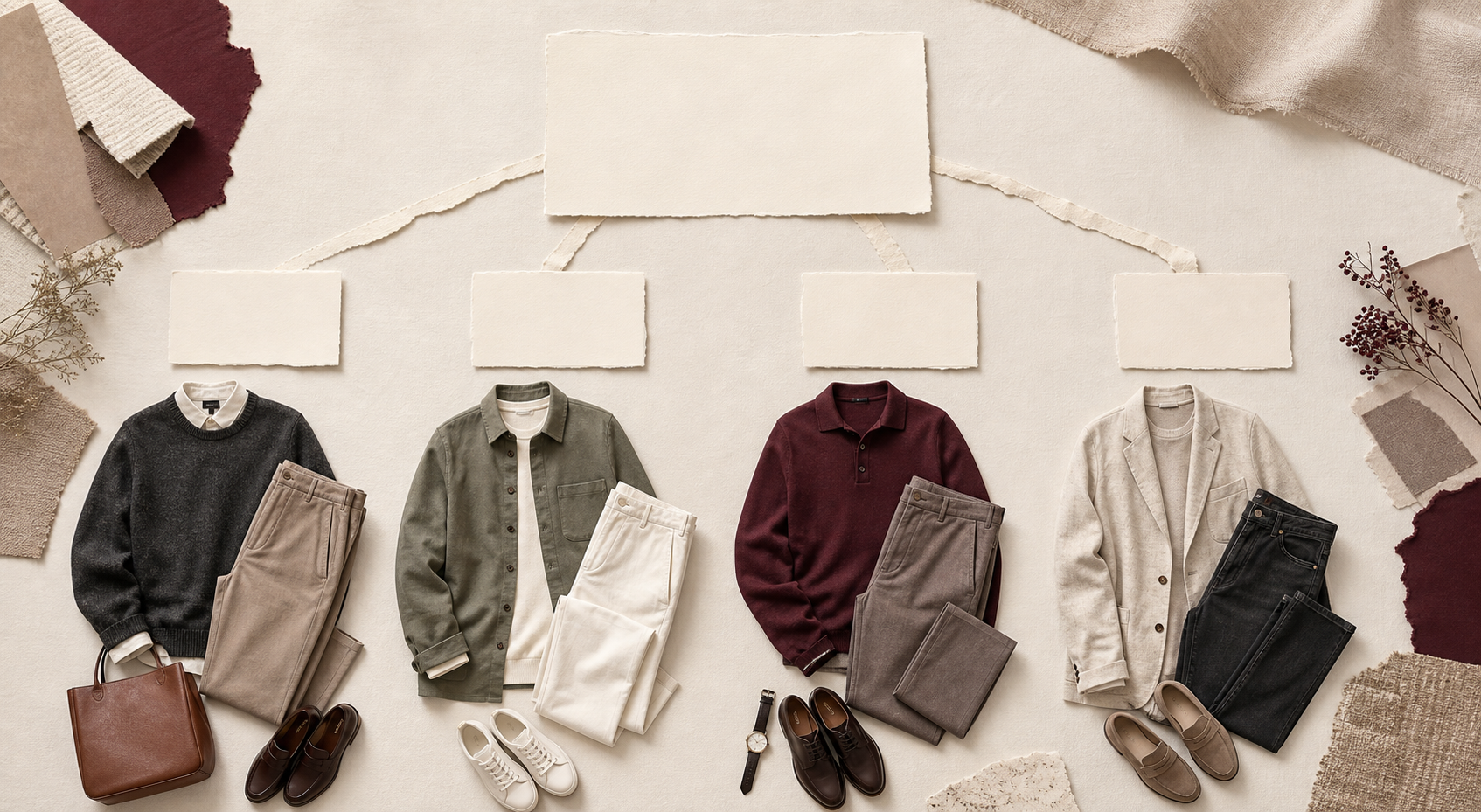
Key points
- Use the written dress code and the context actually supplied as the controlling boundary.
- Treat any missing workplace detail as unknown instead of guessing a hidden rule.
- Read business-casual and professional guidance as a range, not a single required outfit.
- Classic business style is described as simple, neutral, polished, and modest.
- Compare outfit options against the same stated context each time.
- Keep exact outfit combinations clearly labeled as editorial examples only.
Start with written workplace guidance
A useful casual Friday decision guide begins with a simple boundary: use the written workplace guidance and the user-supplied context that was actually provided. That means looking at the stated dress code, job responsibilities, observed colleague norms, and company culture before deciding what fits the day. In other words, the decision is made from the information that is present, not from an assumed office rule that was never written down.
This matters because workplace dress guidance is usually more flexible than a single fixed outfit formula. Business-casual or professional guidance can be read as a range that may include more relaxed pieces, but still within the overall workplace context. Classic business style also gives a clear reference point: it is described as simple, elegant, restrained, and built around polished, modest pieces.
The practical result is that casual Friday is not a hidden uniform. It is a question of where an outfit sits within the range your workplace has actually set.
Step 1: record only the context that was supplied
Before comparing outfits, write down only the details that were explicitly provided. The supported decision inputs are the stated dress code, job responsibilities, observed colleague norms, and company culture. Those are the pieces of context that should control the interpretation.
If the workplace guidance says business casual, that phrase should be treated as a range rather than a single outfit. If it points toward classic business style, then the reference point is a more restrained look with neutral colors, quality materials, and modest silhouettes.
What should not happen is filling gaps with assumptions. If a detail was not supplied, it is still unknown. That is a strength, not a problem. It keeps the guide honest and keeps a guess from becoming a rule.
Step 2: mark missing constraints as unknown
A clear casual Friday decision guide needs a place for uncertainty. If the written guidance does not specify a detail, leave that detail open instead of inventing it.
This is especially important when the guidance is broad. The sources support a context-based approach: choose clothes according to the environment, then adapt the pieces to the setting. That means the missing parts stay missing until they are actually supplied.
A simple way to do this is to separate the information into two lists:
- Known: the written dress code and any other supplied workplace context
- Unknown: anything not stated, such as narrower restrictions that were never given
That distinction keeps the decision grounded. It also makes it easier to see when the guidance is enough to work with and when it is too vague to interpret confidently.
Step 3: identify a formality range rather than a uniform
Once the known context is clear, the next step is to identify the range you are working within. Business-casual or professional guidance is not one fixed look. It allows more relaxed pieces while still staying within the workplace context.
Classic business style offers one end of that range. It is described as timeless, neutral, high-quality, and not overly tight or revealing. That gives you a reference point for a more polished side of the spectrum.
The point is not to find a secret Friday dress code. The point is to place clothing within the formality range the workplace context supports.
Editorial example: a slightly more relaxed combination can still be evaluated against the same stated workplace context instead of being treated as a separate hidden uniform.
Step 4: compare options against the same stated context
A practical workplace decision guide compares clothing options against one shared reference point: the same stated context.
That means each possible outfit is checked in the same way:
- Does it fit the stated dress code?
- Does it align with the job responsibilities that were actually supplied?
- Does it make sense with the observed colleague norms?
- Does it fit the company culture as described?
Using the same questions each time helps keep the decision consistent. It also avoids the common mistake of treating one option as “the real rule” and another as an exception.
The sources also support a sense of continuity across business wardrobes. Classic business style can be refreshed with subtle details, updated silhouettes, or texture variation while remaining in the same overall style family. That means you can compare options without leaving the workplace category altogether.
Editorial example: a refresh using a subtle accessory, updated cut, or texture difference can remain within the same overall professional style family.
Step 5: keep exact garment combinations as editorial examples
Exact garment combinations can be useful, but only when they are clearly labeled as examples rather than rules. That is especially important here, because the research does not support universal outfit formulas for casual Friday.
So if you include a specific combination, present it as an editorial example only. That keeps the article useful without implying that every workplace must follow the same template.
Editorial example: a simple, neutral, modest combination can illustrate how classic business style may appear in a more relaxed Friday context when the written guidance supports it.
Editorial example: another explicitly supplied combination can illustrate a slightly more relaxed point within the same stated range.
Editorial example: a subtle detail, updated silhouette, or texture difference can illustrate variation without being treated as a universal rule.
The key point is that the combination is illustrative, not prescriptive.
A compact casual Friday decision path
If you want a repeatable way to interpret Friday guidance, use this short sequence:
- Start with the written dress code.
- Add the job responsibilities, observed colleague norms, and company culture that were actually supplied.
- Treat any missing detail as unknown.
- Decide whether the context points to a business-casual range, a classic business range, or another range defined by that workplace’s own guidance.
- Compare each outfit option against the same context.
- Keep exact outfit combinations as editorial examples only.
This path works because it stays inside the evidence boundary. It does not assume a universal casual Friday rule, and it does not invent a hidden uniform.
Record the decision boundary
Before choosing between options, write a short boundary statement from the information already available. Begin with the written workplace guidance. Add only the responsibilities, observed norms and company context that were explicitly supplied. Then list every missing constraint as unknown.
This boundary makes the comparison easier to audit. Each option can be checked against the same stated context, and neither option receives an invented exception. The source-supported reference points remain the workplace guidance, the supplied context and the formality range described by that context. Exact garment combinations remain editorial examples rather than rules.
If the known information supports only a broad range, keep the conclusion broad. If it supports a narrower range, explain which supplied detail narrowed it. If it does not support a reliable comparison, pause and ask for clarification. The decision guide should show the difference between what the sources establish, what the user supplied and what is still unknown.
When to ask instead of guessing
There is a point where the written guidance may be too vague to interpret responsibly. If the supplied context does not tell you enough to judge the acceptable range, the safest move is to ask for clarification.
That is not overcautious. It is consistent with the evidence-based approach itself. The supported method depends on the stated dress code, the role context, colleague norms, and company culture. If those elements are missing or too broad, there simply is not enough information to narrow the range confidently.
Questions that may help are straightforward:
- Is the Friday guidance closer to business casual or classic business?
- Are there any stated restrictions that narrow the acceptable range?
- Which part of the guidance is written, and which part is still uncertain?
If those answers are not available, the best answer may be “unknown for now.”
A practical way to keep the decision calm and clear
A good casual Friday decision guide does not rely on guesswork. It starts with the written guidance, keeps missing details open, and compares options within the same stated context.
That approach is especially useful when the workplace language is broad. A more relaxed Friday look can still sit inside a professional range, while classic business style offers a more restrained reference point with neutral colors, quality materials, and modest silhouettes. Between those two, there is room to evaluate options without pretending that one hidden dress code exists for everyone.
Used this way, casual Friday becomes a simple comparison exercise: what does the written guidance say, what context was actually supplied, and where does the outfit sit within that range?
FAQ
What should control a casual Friday decision?
The supported approach is to check the stated dress code, job responsibilities, observed colleague norms, and company culture. Those are the workplace inputs that should guide the choice.
What if the workplace guidance is incomplete?
If the context is incomplete, missing constraints should remain unknown rather than being guessed. That keeps the guide from inventing a rule that was never supplied.
Is casual Friday a universal dress code?
No. The research supports treating casual Friday as a workplace-specific range within the written guidance, not as a universal hidden uniform.
What does classic business style look like in this context?
Classic business style is described as simple, elegant, restrained, and built around polished, modest pieces. It is also characterized by simplicity, neutral colors, quality materials, and modest silhouettes.
Can business wardrobes be updated without leaving the style family?
Yes. The supported sources say business wardrobes can be modernized with subtle details, updated silhouettes, or texture play while remaining in the same overall style family.
Questions readers often ask
What should control a casual Friday decision?
The stated dress code, job responsibilities, observed colleague norms, and company culture should control the decision.
What if the workplace guidance is incomplete?
If the context is incomplete, missing constraints should remain unknown rather than being guessed.
Is casual Friday a universal dress code?
No. The supported approach is to treat casual Friday as a workplace-specific range within the written guidance, not as a universal hidden uniform.
What does classic business style look like in this context?
Classic business style is described as simple, elegant, restrained, and built around polished, modest pieces, with simplicity, neutral colors, quality materials, and modest silhouettes.
Can business wardrobes be updated without leaving the style family?
Yes. Business wardrobes can be modernized with subtle details, updated silhouettes, or texture variation while staying in the same overall style family.
Explore Smart Wardrobe
Explore Smart Wardrobe.
Explore Smart Wardrobe