
How to Compare Garment Length Configurations Without Body-Ratio Rules
If you want to compare garment length configurations without using ideal-ratio language, start with what the garment visibly does: where it lands across the upper, middle, and lower areas, how much volume it creates, and where the eye meets a break or layer change. This guide is for readers who want a neutral way to describe and compare options without turning the discussion into body-ranking or flattering rules.
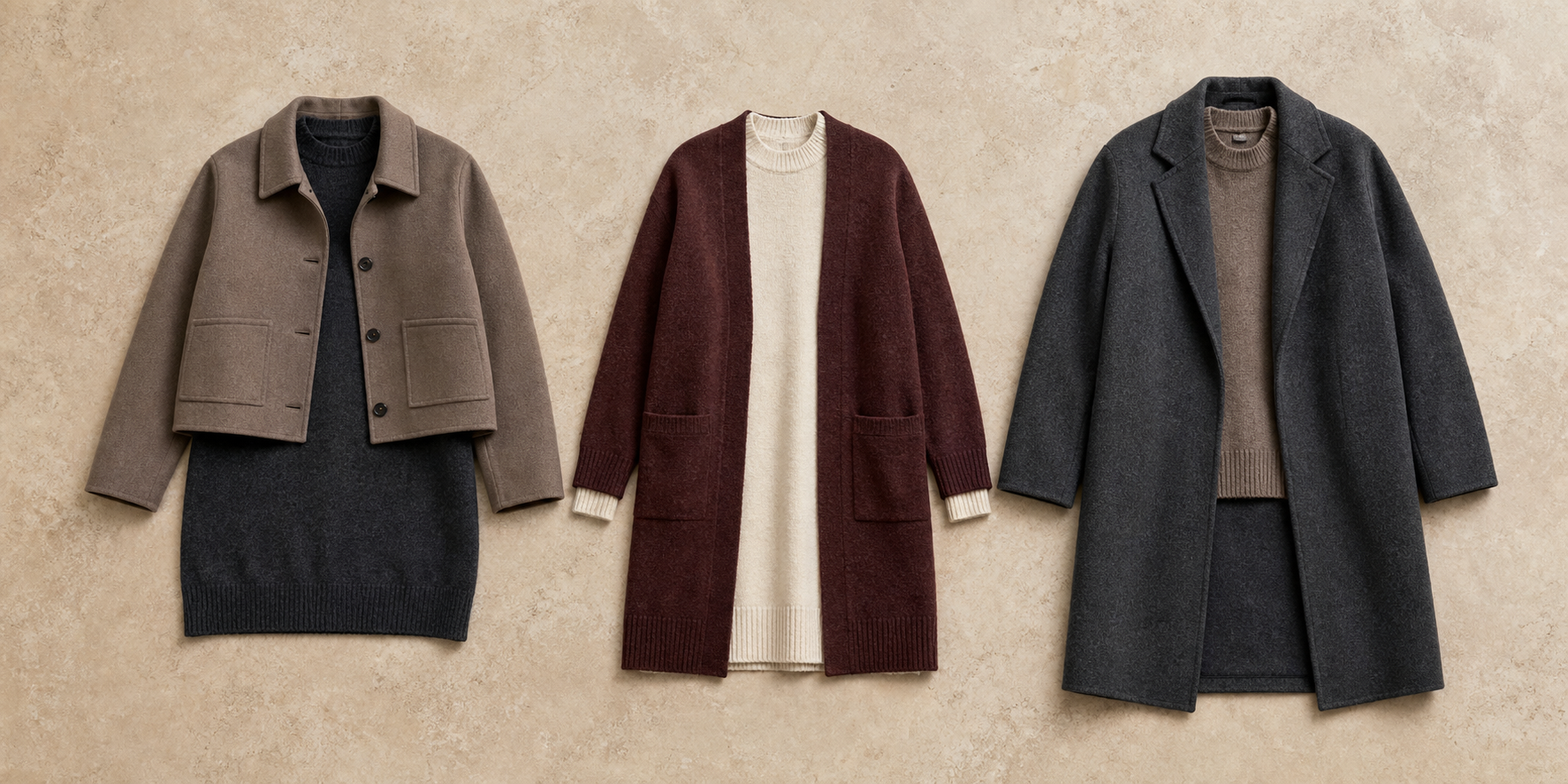
Key points
- Compare garment-length configurations by visible composition: upper, middle, and lower area; length; volume; line; and breaks.
- Start with the supplied context only and do not infer body shape, size, workplace, occasion, or preferences.
- Use descriptive language instead of flattering, slimming, or ideal-ratio claims.
- Editorial examples are optional and should be treated as examples, not rules.
Direct answer: how to compare garment-length configurations
To compare garment length configurations in a body-neutral way, describe the garment as visible composition rather than as a judgment on the wearer. Start with the supplied context only, then compare three things: where the garment sits across the upper, middle, and lower areas; how much volume it creates; and where the eye encounters a line break.
That approach keeps the analysis descriptive. It helps you compare configurations without assuming a body type, without ranking bodies, and without treating one proportion as universally ideal. In practical terms, you are asking: what does this configuration visibly do, and where does it change the line of the outfit?
If you want a simple working rule, use this order:
- Define the context that was actually provided.
- Describe the garment by upper, middle, and lower area.
- Note volume in neutral terms.
- Trace the line and any visible breaks.
- Separate observation from preference.
Step 1: define the supplied context without inventing details
A neutral comparison begins with the information you actually have. The approved source material supports gathering context before making style decisions, rather than filling in missing details with assumptions.
For an article, that means you only compare what is in front of you: the garment configurations being discussed and any explicit situation details that were supplied. You do not need to infer body shape, size, posture, workplace, weather, occasion, budget, or personal taste.
This matters because garment-length analysis can be useful even when you keep the framing narrow. The aim is not to guess who is wearing the clothes. The aim is to describe the visible structure of the garment in the context given.
A useful comparison habit
When you write or think through a comparison, ask:
- What exact configuration is being compared?
- What is actually visible in the upper, middle, and lower areas?
- What details are present in the supplied context, and what details are not?
This keeps the comparison limited to the visible garment information and supplied context.
Step 2: describe garment length by upper, middle, and lower area
The approved material supports a three-area framework: upper, middle, and lower. For garment-length comparison, that gives you a clear neutral structure for describing where the garment appears to sit.
Use the same sequence for every configuration so the comparison stays consistent:
- Upper area: what the garment does near the shoulders, bust, chest, or upper torso area.
- Middle area: what happens through the central portion of the garment.
- Lower area: where the hem, lower edge, or final layer lands.
This is not a body-ranking system. It is a visible-structure framework. The point is to say where the garment ends, where it overlaps, and how it occupies space across the outfit.
What to notice in each area
A neutral description can include:
- Length: where the garment lands relative to itself and the rest of the outfit.
- Volume: whether the fabric reads as compact, moderate, or expansive.
- Line: whether the silhouette looks continuous, interrupted, layered, or stepped.
A helpful habit is to keep each observation local. For example, instead of saying a look is “better balanced,” describe what is visible: “The hem ends higher,” “the lower layer extends farther,” or “the middle section creates the most visual activity.”
Step 3: compare visible volume without body judgment
Visible volume is one of the most practical ways to compare garment configurations neutrally. Volume here means how much visual space the garment occupies, not the size of the body underneath.
A configuration can read as compact if the layers sit close together and the line stays relatively tight. It can read as moderate if the garment moves through the frame without much interruption. It can read as expansive if there is more fabric, more layering, or more visible width in the composition.
The key is to describe volume without attaching value. More volume is not automatically better or worse. Less volume is not automatically better or worse. The comparison only becomes useful when you connect volume to the visible structure of the garment and the context being discussed.
Simple volume checklist
Use the same questions for each configuration:
- Does the garment look compact, moderate, or expansive?
- Where is the most visible concentration of fabric?
- Does the volume sit mostly in one area or move across several areas?
- Does the volume create a clear shape or a layered one?
That is enough to compare the visual field without slipping into body-based interpretation.
Step 4: trace visual line and breaks
Line is the path the eye follows across the garment. Breaks are the moments where that path changes: a hem, waistband, jacket edge, overlap, or layer transition.
The approved sources support discussing proportions and balance through visible line and breaks. In a body-neutral article, that means you can say where the eye moves and where it pauses, without claiming anything about the wearer’s body.
A configuration with fewer visible interruptions may read as more continuous. A configuration with more layer edges may read as more segmented. Neither is inherently superior. They are simply different visual structures.
What to compare
When comparing two or more configurations, note:
- Where the first major break appears.
- Whether the line continues smoothly after that break.
- Whether the eye moves vertically, horizontally, or in steps.
- Whether the garment creates one strong line or several smaller ones.
This is especially useful when you want to compare similar lengths that still look different. Two garments can have the same approximate overall length and still read differently because one has a straighter line while another creates more visible transitions.
Step 5: separate observation from preference
A useful neutral comparison distinguishes three things: what is observed, what is preferred, and what is being ruled out.
Observation is the visual fact. For example: “The lower edge ends at a shorter point,” or “the layer creates a second visible line.”
Preference is optional and only belongs in the article if a preference was actually supplied. If no preference was given, do not invent one.
What should be ruled out is the idea that one configuration is universally ideal. The source material includes balance and ideal-look language, but this article must keep those ideas descriptive, not prescriptive.
A clean writing pattern
A helpful pattern is:
- I observe: describe the visible length, volume, or line.
- I compare: note how the configuration differs from another one.
- I do not claim: ideal proportions, flattering effects, slimming effects, or body ranking.
That structure keeps the analysis precise and avoids turning style description into a rule.
Step 6: reject ideal-ratio and flattering rules
For this topic, it is important to say plainly what is not being used. This article does not use universal ratios, ideal proportions, or body-ranking rules.
That exclusion matters because garment-length comparison can be helpful without implying that one configuration is “correct” for everyone. The approved sources support proportion and balance as analytic ideas, but they do not support turning them into universal standards.
So the right question is not, “Which length is best for this body?” The better question is, “What does this garment configuration visibly do, and how does it compare with another one in the same context?”
That shift keeps the article aligned with a body-neutral approach and makes the comparison easier to use across different situations.
Three clearly labelled editorial comparisons
The following are optional editorial examples, not rules. They are only meant to show how neutral comparison language can sound.
Editorial example: shorter top with longer lower layer
Editorial example: A shorter top with a longer lower layer can be described as creating one break at the hem and a second visible line at the layer edge. The composition places attention on the transition between the two lengths and makes the lower section more visually prominent.
Editorial example: longer top over shorter lower layer
Editorial example: A longer top over a shorter lower layer can be described as moving the main visual break lower in the outfit and reducing the number of visible transitions. The line may read as more continuous if the overlap is smooth and the edges are simple.
Editorial example: same total length, different line
Editorial example: Two configurations with the same total length can still read differently if one has a straighter line and the other has more layered volume. In that case, the comparison is less about length alone and more about how the garment occupies space.
A final body-neutral decision checklist
If you are deciding between garment-length configurations, use this checklist instead of an ideal-ratio rule:
- Which configuration has the clearest visible line?
- Where does each configuration place its main break points?
- Which one creates the most layered composition?
- Which one looks most compact, moderate, or expansive in volume?
- Which comparison uses the supplied context most faithfully?
This checklist works because it stays tied to visible composition. It does not require you to guess body type, assume preferences, or make outcome claims.
Short summary
To compare garment length configurations neutrally, describe the garment across the upper, middle, and lower areas, then compare length, volume, line, and visible breaks. Begin with the supplied context, separate observation from preference, and avoid ideal-ratio language. That gives you a practical framework for comparing options without turning the discussion into a judgment about bodies.
Frequently asked questions
How can I compare garment lengths without saying one is flattering?
Use visible structure instead of outcome language. Describe where the garment ends, how much volume it creates, and where the eye meets a break or layer change. That keeps the comparison descriptive rather than evaluative.
What does upper, middle, and lower mean in this context?
It is a three-area way to describe how a garment is distributed across the outfit. Upper refers to the top portion, middle to the central portion, and lower to the hem or final layer. The framework helps you compare composition without ranking bodies.
Are there ideal garment-length ratios I should follow?
Not in this article. The approved sources support proportion and balance as descriptive tools, but they do not support universal ideal ratios or rules that one configuration is always correct.
Can two configurations with the same length still look different?
Yes. A configuration can have the same approximate overall length and still read differently because line, volume, and break points change how the eye moves across the garment.
Questions readers often ask
How can I compare garment lengths without saying one is flattering?
Use visible structure instead of outcome language. Describe where the garment ends, how much volume it creates, and where the eye meets a break or layer change.
What does upper, middle, and lower mean in this context?
It is a three-area way to describe how a garment is distributed across the outfit. Upper refers to the top portion, middle to the central portion, and lower to the hem or final layer.
Are there ideal garment-length ratios I should follow?
Not in this article. The approved sources support proportion and balance as descriptive tools, but they do not support universal ideal ratios or rules that one configuration is always correct.
Can two configurations with the same length still look different?
Yes. A configuration can have the same approximate overall length and still read differently because line, volume, and break points change how the eye moves across the garment.
Want a calmer way to plan style comparisons?
Consider using this framework as a neutral way to compare garment-length configurations.
Explore Smart Wardrobe