
How to Talk About Clothing Proportions Without Flattering Rules
A body-neutral way to discuss clothing proportions focuses on garment lengths, volumes, and visual lines—not body correction, ranking, or flattering language.
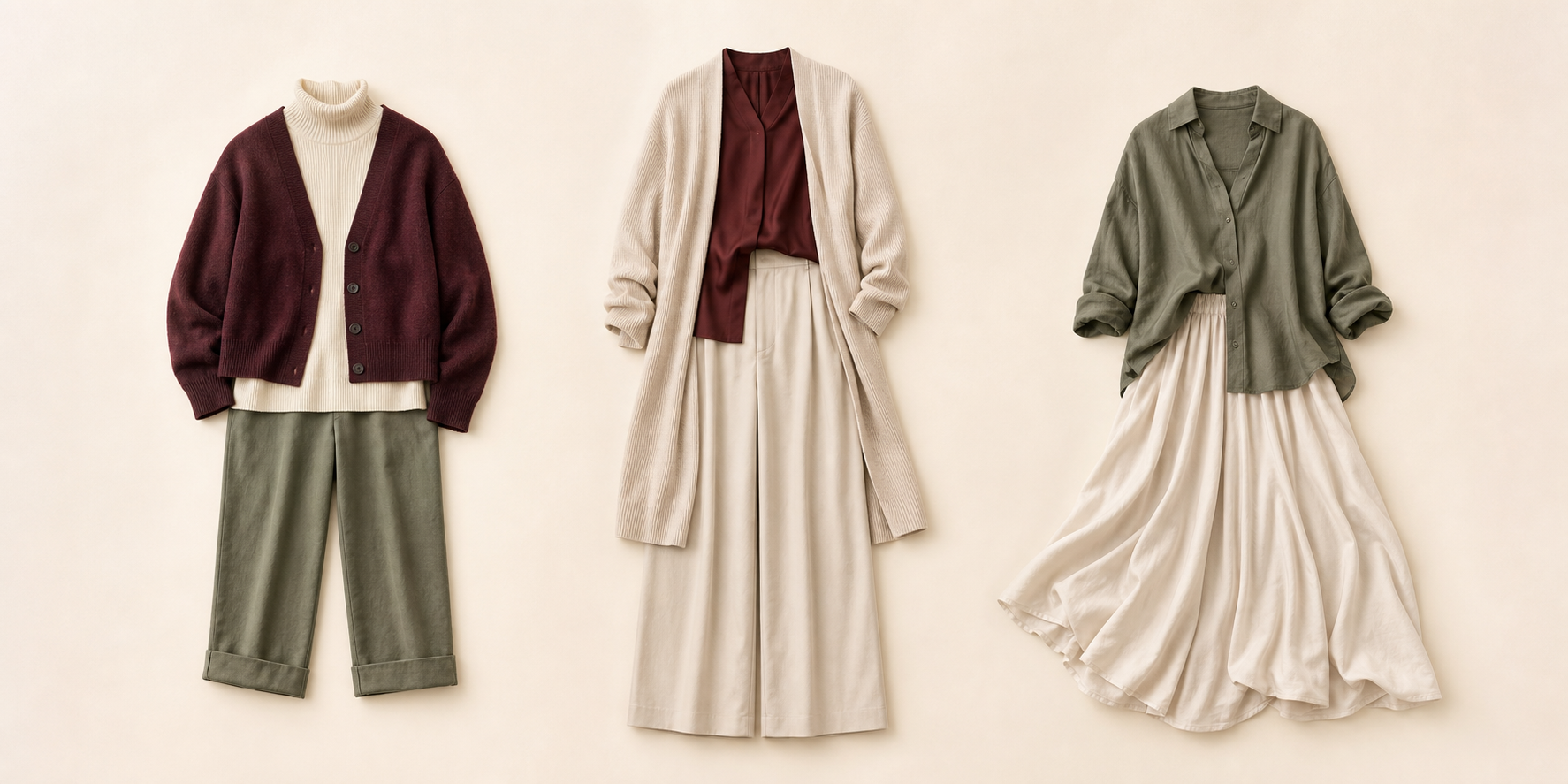
Key points
- In a body-neutral guide, clothing proportions are described as relationships among lengths, volumes, and visual lines.
- Talk about garment placement, silhouette, and outfit zones instead of body correction.
- Use context and personal preference to guide proportion choices; do not treat one arrangement as universal.
- Replace flattering, balancing, and correcting language with plain descriptions of the outfit’s visible effect.
- Label examples as editorial examples so they are clearly optional and not rules.
What clothing proportions mean in a body-neutral guide
When people talk about clothing proportions, the conversation often slips into flattering language, balance language, or body-correction language. A body-neutral approach does something different: it describes what the outfit does visually.
A body-neutral, context-first framework explains clothing proportions without flattering rules by describing garment relationships. It compares length and volume, placement and visual line without turning those observations into rules about a person’s body.
In this guide, proportions mean the relationships among garment lengths, volumes, and visual lines. That may include where a hem lands, how much volume appears in one part of the outfit, or how a line travels from one piece to another. The point is not to judge a body or decide whether it needs improvement. The point is to observe the outfit clearly.
That distinction matters because source material on styling and figure analysis often uses terms like balance, ideal proportions, or a perfect image. Those phrases are evaluative, and they can imply that a body must be corrected. A neutral article should leave that framing behind and focus on visible relationships instead.
Describe garments and relationships, not bodies
A useful way to keep proportion language neutral is to describe the garment itself and the relationship between pieces.
For example, you can talk about:
- hem length
- sleeve length
- where a waistband sits
- how much volume appears in one layer
- whether a silhouette reads as compact, elongated, structured, or relaxed
- how accessories or outer layers affect the overall outline
This approach keeps the subject on styling choices, not on body type labels. It also makes the language more precise. Instead of saying a look “needs balance,” you can say that the outfit has more visual weight in the upper part, lower part, or center. Instead of saying a piece is “flattering,” you can describe how it changes the outline or line of the outfit.
That is especially useful when you want to talk about proportion in a way that works across different contexts. Styling is not only about a body category; it is also about garment placement and configuration.
A simple way to organize the discussion
One practical method is to think in three outfit zones:
- upper area
- middle area
- lower area
These zones are not a way to rank bodies. They are simply a clear way to describe where the visual emphasis sits in an outfit. A cropped layer, a defined waistband, or a long hem can all change how those zones relate to each other.
Compare length, volume, and visual line without ranking
A neutral proportion discussion often becomes clearer when you compare three things at once: length, volume, and visual line.
Length tells you where a garment ends or how far it extends. Volume tells you how much space the garment appears to occupy. Visual line tells you how the eye moves through the outfit.
When these elements are described together, the language stays descriptive instead of judgmental. For example, a long outer layer creates a vertical line through the outfit. A wide hem adds volume toward the lower area of the look. A more fitted layer can create a clearer outline around the middle area.
This is also where accessories can matter. A belt, scarf, bag, or shoe choice may shift where the eye rests, but the point is to describe the effect on the outfit, not to evaluate the person wearing it.
You do not need a universal formula for this. In fact, the source material does not support a one-size-fits-all rule. What it does support is observation: look at the garment relationships, notice where the visual weight sits, and describe that plainly.
Use context and personal preference instead of flattering rules
Proportion choices are not only technical; they are contextual.
The source material includes gathering client preferences and setting goals before styling decisions are made. That supports a simple editorial principle: proportion is not a fixed rule, and it is not separate from personal preference. It depends on the look someone wants to build, the outfit’s purpose, and the visual relationships they prefer.
That makes the conversation more realistic and more respectful. A person may prefer a clearer waistline, a straighter silhouette, a longer line, or more volume in one part of the outfit. None of those preferences require a body-based explanation.
If you are writing or speaking about clothing proportions, it helps to treat context as part of the sentence. For example:
- the outfit reads more structured because the waistband is defined
- the outer layer adds a long vertical line
- the lower part of the look carries more volume
- the accessories create a stronger visual emphasis in the middle area
Those are observations, not instructions. They leave space for personal preference without turning the discussion into a rulebook.
Editorial examples of neutral proportion language
The following are optional, clearly labeled examples of garment configurations. They are not prescriptions and do not describe what any body should do.
Editorial example: a cropped top with a high-rise bottom creates a short upper visual section and a longer lower visual section.
Editorial example: a longer outer layer over a simple base layer creates a vertical line through the outfit.
Editorial example: a wide hem paired with a more fitted layer nearby shifts the visual weight toward the lower part of the look.
Editorial example: a defined waistband marks a clear transition between upper and lower outfit zones.
Editorial example: a voluminous layer can be described by noting where the volume is concentrated, rather than by evaluating the body underneath.
These examples are useful because they show how to talk about clothing proportions without turning the discussion into body correction. They focus on configurations, not on personal attributes.
Phrases to replace and body-neutral alternatives
A lot of styling language has inherited a ranking mindset. If your goal is body-neutral writing, some common phrases need to be translated carefully.
Here are a few examples:
- Instead of “flattering,” try “shows a clear visual line” or “changes the outline of the outfit.”
- Instead of “balance your proportions,” try “describe how volume is distributed across the outfit.”
- Instead of “minimize flaws,” try nothing at all; the phrase should be removed, not softened.
- Instead of “ideal proportions,” try “one possible arrangement of lengths and volumes.”
- Instead of “perfect image,” try “the overall outfit effect.”
- Instead of “correcting the body,” try “adjusting garment placement or silhouette.”
The safest editorial move is often not to find a prettier version of the same phrase, but to replace it with a plain description of what is visible.
That principle also helps when source material uses balance language. Balance can be translated into visible distribution across the outfit, rather than a statement that the body needs to be fixed. If a phrase suggests ranking, concealment, or improvement of the person, it should be removed or rewritten.
A body-neutral proportion checklist
Use this short checklist when you want to describe an outfit without drifting into flattering rules:
- What garment lengths are visible?
- Where is the volume concentrated?
- Which lines are strongest in the outfit?
- Is there a clear upper, middle, or lower visual area?
- What part of the outfit changes when an accessory, hem, or layer is added?
- Is the language describing the clothes, or is it judging the body?
- Does the wording leave room for preference and context?
If the answer to the last two questions is no, the phrasing probably needs revision.
This checklist is not a universal styling formula. It is a way to keep your language grounded in observation and choice.
How to keep the tone useful and neutral
A body-neutral proportion article should feel practical, not clinical.
A few habits help:
- name the garment or line you are talking about
- describe where it sits in the outfit
- explain what changes visually when the garment changes
- avoid labels that rank or correct bodies
- keep examples optional and clearly marked as examples
This is the simplest way to preserve clarity without importing judgment. It also makes the writing easier to reuse across different outfit contexts, because the focus stays on the configuration rather than the person.
If you want a simple summary, it is this: talk about lengths, volumes, and visual lines. Talk about outfit zones. Talk about placement and preference. Leave body-ranking language behind.
For a related style resource, you can also see the Body Shape Guide, though the approach in this article stays focused on garment relationships rather than body labels.
A compact way to rewrite flattering language
When you edit your own copy, this pattern can help:
- identify the body-based claim
- restate the visible garment relationship
- remove any implication of correction
- keep the example optional
For instance, instead of writing that a certain hem “flatters,” you can say the hem creates a shorter upper visual section. Instead of saying a jacket “balances the figure,” you can say the jacket adds a longer vertical line. Instead of saying an accessory “fixes proportions,” you can say it changes where the eye travels.
That is the difference between evaluative styling language and neutral proportion language. One tells people what their body should do. The other tells them what the outfit does.
When you want a broader styling context
If you are also thinking about how proportions relate to everyday dressing, a broader wardrobe reference can be useful. For a related article on outfit coordination, see Smart-Casual Work Wardrobe. The key idea remains the same: describe the visual relationships in the outfit and keep the language grounded in the clothes themselves.
FAQ
What is the most neutral way to talk about clothing proportions?
Describe proportions as relationships among lengths, volumes, and visual lines. Focus on where garments sit and how they relate to one another instead of referring to body correction or body ranking.
Can I still talk about balance?
Yes, but translate it into visible distribution across the outfit. The safer approach is to describe where the visual weight sits rather than saying a body needs balancing.
Are proportion rules universal?
No. The approved source material supports observation and styling context, not a universal rule for every person. Preference, goals, and outfit purpose all belong in the discussion.
What should I say instead of “flattering”?
Use plain descriptive language: outline, line, length, volume, placement, or visual effect. If a phrase implies improvement of the body, rewrite it around the garment instead.
Why use outfit zones like upper, middle, and lower areas?
Because they give you a clear way to describe visual structure without naming or judging body types. They are a practical language tool, not a body category system.
Do editorial examples become rules?
No. Editorial examples are only demonstrations of garment configurations. They show how proportion language can work without suggesting that any single arrangement is universally correct.
Questions readers often ask
What is the most neutral way to talk about clothing proportions?
Describe proportions as relationships among lengths, volumes, and visual lines. Focus on where garments sit and how they relate to one another instead of referring to body correction or body ranking.
Can I still talk about balance?
Yes, but translate it into visible distribution across the outfit. The safer approach is to describe where the visual weight sits rather than saying a body needs balancing.
Are proportion rules universal?
No. The approved source material supports observation and styling context, not a universal rule for every person. Preference, goals, and outfit purpose all belong in the discussion.
What should I say instead of “flattering”?
Use plain descriptive language: outline, line, length, volume, placement, or visual effect. If a phrase implies improvement of the body, rewrite it around the garment instead.
Why use outfit zones like upper, middle, and lower areas?
Because they give you a clear way to describe visual structure without naming or judging body types. They are a practical language tool, not a body category system.
Do editorial examples become rules?
No. Editorial examples are only demonstrations of garment configurations. They show how proportion language can work without suggesting that any single arrangement is universally correct.
Explore Smart Wardrobe
Use Smart Wardrobe to compare proportions between garments and outfit options that you explicitly add, based on your own context and preferences.
Explore Smart Wardrobe