
How to Build a Small Shoe Rotation Around Real Contexts
Start with the contexts you actually supplied, then let each shoe do a clear job. This body-neutral method helps you compare overlap without turning footwear into a universal list.
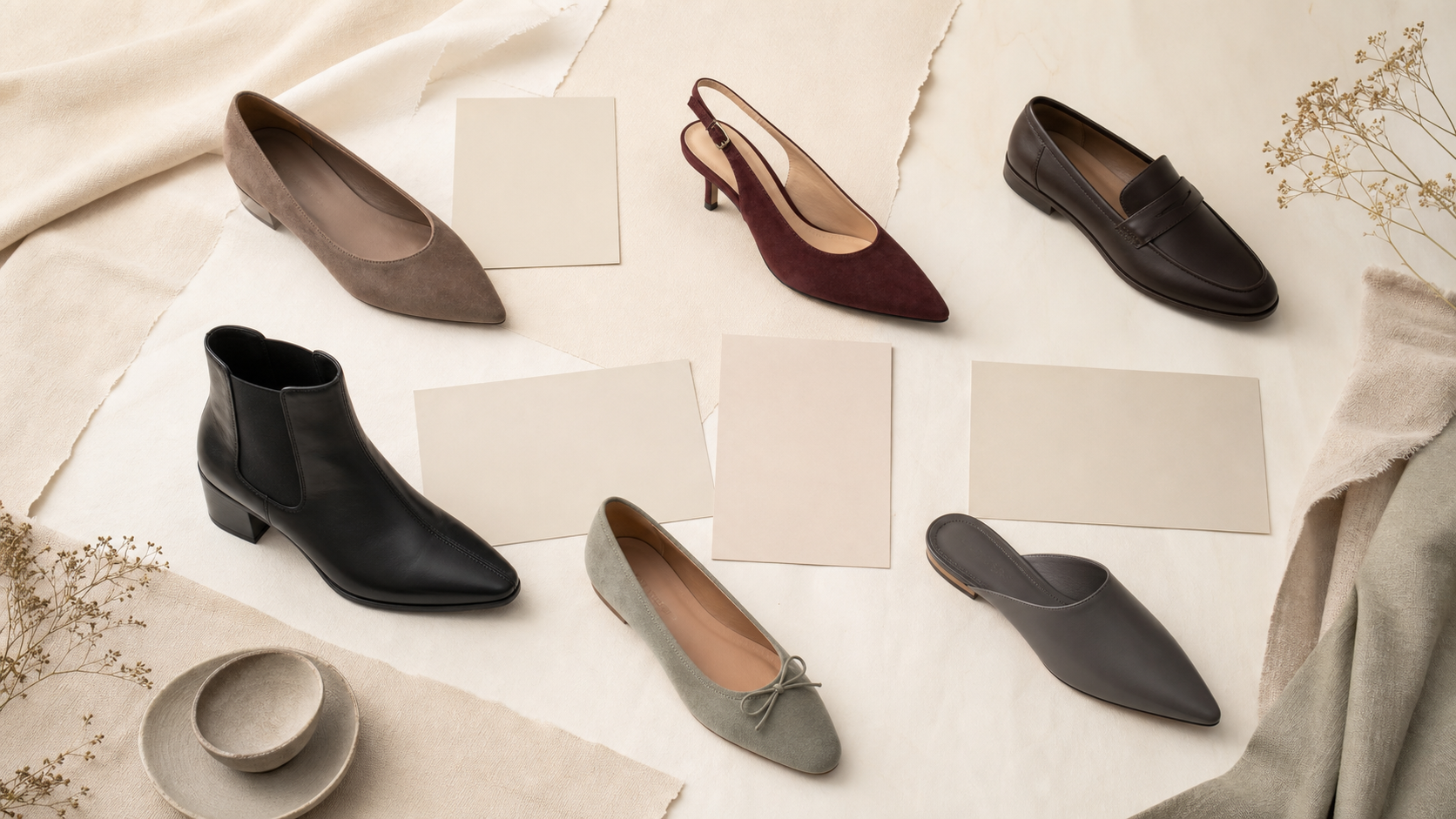
Key points
- Start with the contexts the user actually supplied, not a universal shoe list.
- Treat shoes as role-based items: formal, casual, or context-specific.
- Look for overlap, but do not force a fixed rotation size.
- Coordinate only with garments that were explicitly supplied.
- Use simple lines, restrained detailing, and coordinated color choices when shoes need to work across more than one context.
- Label exact shoe-plus-garment-plus-context pairings as editorial examples unless they were directly supplied.
If you want to build a small shoe rotation around real contexts, the most useful place to start is not a fixed shopping list. Start with the situations you actually supplied: work, everyday use, evening plans, or any other setting that matters in your article or outfit plan. The goal is to let context define the footwear role first, then check whether one shoe can serve more than one role.
That approach stays flexible, body-neutral, and practical. It also keeps the method aligned with the sources available here: shoes can be matched to context, simple or detailed styling choices can be used intentionally, and wardrobe change can happen gradually rather than all at once.
Start with the contexts you supplied
A rotation makes more sense when it begins with real settings rather than a universal shoe list. One context may call for a professional look, another for casual everyday use, and another for evening wear. The point is not to guess what a reader owns or needs. It is to work only with the contexts that were actually provided.
For professional settings, the source material supports checking the workplace dress code and the environment before deciding how formal the shoe should be. For casual everyday settings, it supports keeping footwear simple, neutral, and easy to integrate into ordinary life. For evening wear, the shoe guide distinguishes that as a separate context rather than treating all occasions the same.
This means the same rotation can be planned in different ways depending on the supplied context set. There is no universal list to copy from here.
This context-first method translates real contexts into footwear functions. It has no fixed count, and it compares only user-supplied shoes rather than assuming what is owned or needed.
Translate each context into a footwear role
Once the context is clear, translate it into a job for the shoe.
A workplace context may call for a more formal shoe role. The business wardrobe source supports matching formality to the setting and gives examples such as classic pumps, comfortable flats, or ankle boots, depending on the environment.
A casual context may call for a simpler, more relaxed role. The casual-style source describes casual dressing as simple, neutral, and comfortable, and lists sneakers, light sandals, moccasins, espadrilles, or ballet flats as typical footwear in that style family.
An evening context may call for a more specific or polished role. The shoe guide distinguishes daywear and evening wear, which is enough to show that a shoe can be assigned to a context without turning that context into a universal rule.
The useful question is not “Which shoes are required?” It is “What does this shoe need to do in this particular context?”
Look for overlap without forcing a fixed count
A small rotation works best when you check overlap. If one shoe can cover more than one context you supplied, that can make it part of the rotation. But no fixed number is necessary, and no universal minimum is supported by the sources.
Overlap can happen in two broad ways:
- a shoe may be appropriate for more than one setting because its formality sits in the middle
- a shoe may be simple enough to support different outfits without pulling attention away from the rest of the look
The shoe guide notes that simple, elegant designs are versatile and can complement various outfits and styles. It also says shoes can help set the color direction for an outfit. That means a shoe may either stay visually quiet or act as the point that helps coordinate the rest of the look.
For casual dressing, gradual change is also supported. Instead of changing everything at once, the source encourages step-by-step wardrobe changes. In practice, that means you can test one footwear role at a time and see whether it genuinely overlaps with the contexts you supplied.
Coordinate shoes only with garments you actually supplied
Shoe coordination should stay tied to the garments that were actually given. If the article or styling brief includes a blazer, tailored trousers, or a casual denim item, then those can be used in the example. If no garments were supplied, the example should stay general.
The shoe guide supports this kind of coordination. It says shoes can serve as the foundation of an outfit’s color scheme, and it recommends simple lines, restrained detailing, and coordinated color choices when shoes are part of a broader outfit plan.
It also suggests that elaborate straps or heavy embellishment can add visual volume, which means more detailed shoes may work better as context-specific choices rather than as the default for every outfit. That does not make them “better” or “worse.” It simply means the visual role is different.
Use this as a styling principle, not a universal rule: the more you want a shoe to work across several supplied contexts, the more useful simple lines and restrained detailing tend to be as an editorial styling choice.
Keep comfort, mobility, and weather outside the method
This article does not infer comfort needs, mobility needs, weather conditions, or budget. Those details should come from the reader’s own situation or from another source.
That boundary matters because the method here is about styling logic, not personal assessment. A shoe rotation can be organized around context, formality, and coordination without assuming anything about the wearer’s body, walking needs, or environment.
So if you are writing or editing a rotation, keep these questions separate:
- What contexts were actually supplied?
- Which shoe roles are supported by those contexts?
- Which garments were explicitly provided for coordination?
- Which details are only editorial examples?
That separation keeps the article accurate and body-neutral.
Editorial examples of different context sets
The following examples are editorial only. They are not universal rules, and they should be read as examples of how a context-based rotation might be described.
Editorial example: For a supplied set of office, casual, and evening contexts, one shoe can be described as the more formal option, another as the more relaxed option, and a third as the context-specific evening option.
Editorial example: If the supplied workplace context is more formal, the rotation can be described in relation to classic pumps, comfortable flats, or ankle boots, depending on the environment.
Editorial example: If the only supplied context is everyday use, the rotation can stay simple and gradual, with footwear roles defined by simplicity and versatility rather than by a fixed number.
Editorial example: If the user supplied a shoe with strong detailing, it can be presented as a context-specific accent instead of the default choice for every outfit.
Editorial example: If the user supplied both a blazer and a casual denim item, the article can show how shoe coordination might differ across the professional and casual sets, without implying that either set is mandatory.
These examples show the method in action: context first, overlap second, coordination third.
Avoid must-have and investment language
A context-based rotation is an optional method, not a universal shopping rule. The sources support contextual dressing, simple-versus-detailed footwear choices, and gradual change, but they do not support a claim that everyone needs a specific shoe count or a “must-have” list.
That is why this approach works best when it is framed as a decision aid:
- start with the context
- map the shoe’s role
- check for overlap
- coordinate only with supplied garments
- label exact combinations as editorial examples
This keeps the article useful without turning it into a rigid formula.
A body-neutral shoe-rotation checklist
Use this checklist when you want to compare shoes against real contexts without assuming anything else:
- List the contexts that were actually supplied.
- Decide what each shoe needs to do in those contexts.
- Check whether one shoe can cover more than one context.
- Keep the rotation flexible; do not force a fixed number.
- Coordinate the shoe only with garments that were explicitly supplied.
- Use simple lines and restrained detailing when you want a shoe to stay adaptable.
- Treat any exact shoe-plus-garment-plus-context pairing as an editorial example unless the user supplied it directly.
- Keep comfort, mobility, and weather questions separate from this styling method.
If you are working on a mixed brief, this checklist can help you stay precise without becoming prescriptive.
Related guidance
If you want to see another angle on coordination, you can also read Footwear for a Smart-Casual Wardrobe. It complements this article by focusing on how shoes and outfits work together in a smart-casual setting.
FAQ
Do I need a fixed number of shoes for this method?
No. The supported sources do not justify a universal shoe count. This method is about checking whether the shoes you are already discussing can cover the supplied contexts, not about enforcing a required number. [C1, C6]
What if my context is only everyday use?
Then keep the rotation simple and gradual. The casual-style source supports everyday dressing that is simple and versatile, and it also recommends step-by-step wardrobe change rather than an all-at-once approach.
Can one shoe work for more than one context?
Yes, if the shoe’s role fits the contexts you supplied. The shoe guide supports versatility, and the method here encourages overlap only where it is actually supported by the brief. [C1, C2, C6]
How should I handle exact shoe-and-outfit combinations?
Treat them as editorial examples unless the user supplied them directly. That keeps the article from turning a styling example into a universal rule.
What if I only have a workplace context and no garment details?
You can keep the description general. The business wardrobe source supports matching shoe formality to the workplace setting, but without supplied garments, the article should avoid inventing a specific outfit. [C4, C6]
Questions readers often ask
Do I need a fixed number of shoes for this method?
No. The supported sources do not justify a universal shoe count. This method is about checking whether the shoes you are already discussing can cover the supplied contexts, not about enforcing a required number.
What if my context is only everyday use?
Then keep the rotation simple and gradual. The casual-style source supports everyday dressing that is simple and versatile, and it also recommends step-by-step wardrobe change rather than an all-at-once approach.
Can one shoe work for more than one context?
Yes, if the shoe’s role fits the contexts you supplied. The shoe guide supports versatility, and the method here encourages overlap only where it is actually supported by the brief.
How should I handle exact shoe-and-outfit combinations?
Treat them as editorial examples unless the user supplied them directly. That keeps the article from turning a styling example into a universal rule.
What if I only have a workplace context and no garment details?
You can keep the description general. The business wardrobe source supports matching shoe formality to the workplace setting, but without supplied garments, the article should avoid inventing a specific outfit.
Want to compare shoes against real contexts?
Use this method as a calm next step: list the contexts you actually have, then check which shoes and garment pairings fit them best. If you want more styling guidance, explore the related footwear article linked above.
Read the related footwear guide