
How to Style an Outfit Around One Statement Piece Without Making It Feel Busy
A calm way to build an outfit around one standout item is to keep the rest of the look more restrained: limit the main colours, use clean lines, and repeat only a small amount of colour or pattern when it helps the focal piece stay central.
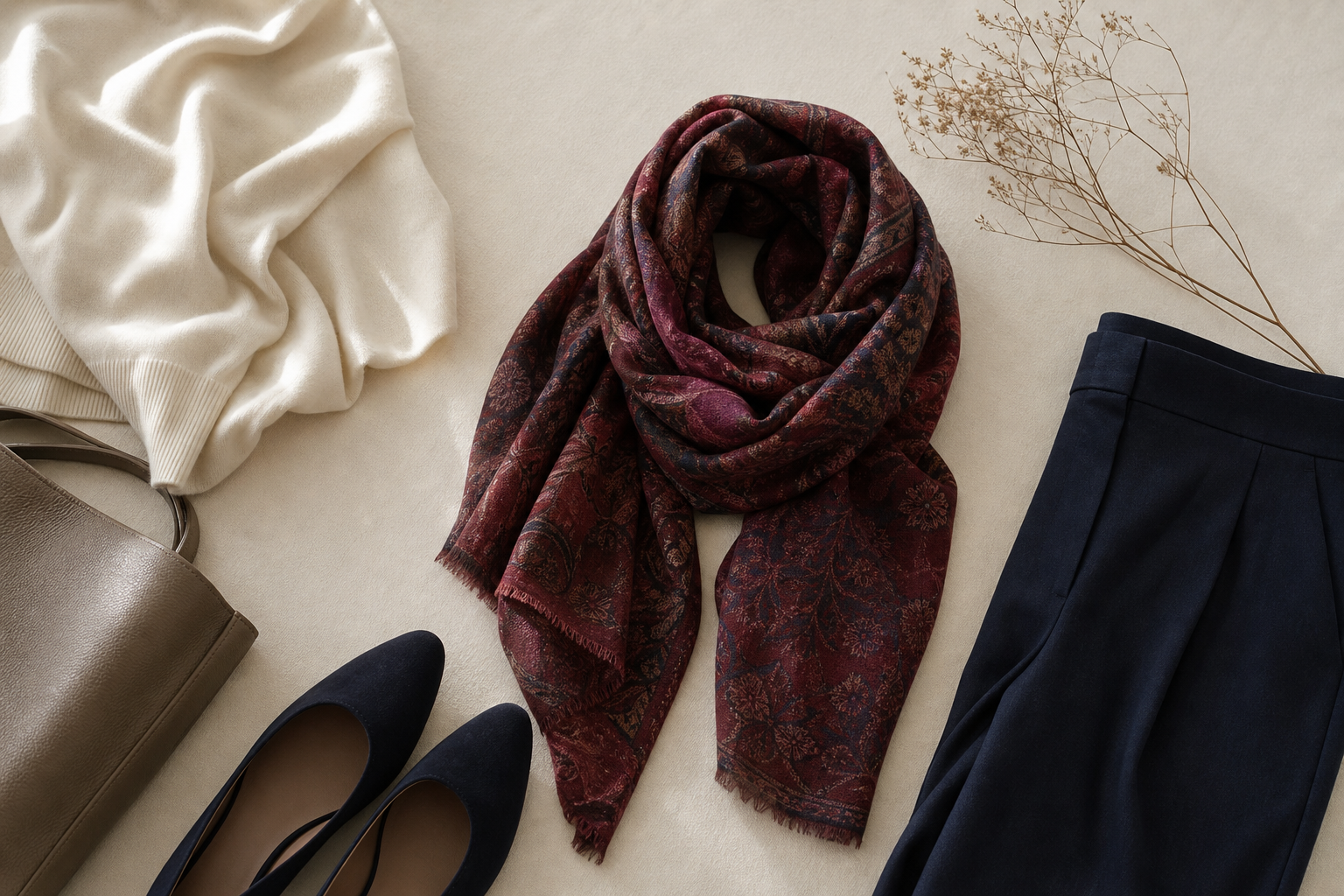
Key points
- Build around one focal item, then keep the rest of the outfit more restrained.
- Use a limited main colour palette and lean on neutrals when helpful.
- Prefer clean lines and limit extra straps, embellishments, or heavy texture.
- If the focal item is printed, repeat only a small amount of colour elsewhere.
- Fit, quality, and the setting still matter, and a belt can add structure in layered looks.
What the sources support
The approved sources support a simple idea: if one item is meant to lead the outfit, the rest of the look can be more restrained.
That restraint shows up in a few specific ways:
- keep the main outfit to a limited colour palette
- use neutral colours as flexible supporting elements
- prefer simple or clean lines when another item is more detailed
- avoid piling on several high-detail elements at once
- repeat only a small amount of colour from a printed focal item, rather than spreading the print across large areas
- consider fit, quality, and the setting when putting the outfit together
- in layered looks, a belt can add structure when worn on the outermost layer
These are the principles the sources support. Everything more specific is styling judgment, not a universal rule.
What remains editorial guidance
The sources do not give one single formula for every outfit. They do not say that a standout piece must be the only interesting item in a look, and they do not support assumptions about who will notice it or how it will be received.
So when you see a combination below, treat it as an Editorial example: a practical illustration of the sourced principles, not a rule that applies to every person or every outfit.
For a broader look at colour pairing, you can also read How to Combine Colors in an Outfit Without It Feeling Busy.
Choose one focal element
A coordinated outfit can be built around one standout item by treating that item as the anchor and keeping the other elements more restrained.
The colour-coordination source supports limiting the number of colours in the main outfit. It also allows one additional colour for accessories, which is useful when the focal item is already doing most of the visual work.
That means the central item can guide the rest of the outfit, while the supporting pieces stay quieter in colour and overall presence.
Keep supporting elements quiet
When one piece is visually prominent, neutral colours can act as stable support around it. Black, white, and gray are identified as flexible coordinating colours, and the wardrobe sources also position neutral tones as versatile foundations.
Simple or clean lines help keep the supporting pieces from competing with the focal item. The sources also note that straps, embellishments, intricate weaving, knitted textures, and bulky platforms can add visual weight or volume, so it makes sense to limit those details when the goal is a calmer overall balance.
A useful way to think about this is hierarchy: one piece leads, and the rest of the outfit provides structure rather than extra emphasis.
Use colour and pattern with restraint
The sources support restraint in two related ways.
First, they support limiting the number of colours in the main outfit.
Second, if the focal item includes a print or pattern, the sources support repeating only a small amount of that colour elsewhere. They also advise against repeating a bold print in large areas.
That leaves room for a subtle echo rather than a second focal point.
Editorial example:
A patterned focal item can be paired with a neutral top and a simple bottom so the print remains the main point of interest.
Editorial example:
If one piece is already strong in colour, the rest of the outfit can stay in black, white, gray, beige, or another subdued shade from the approved palette.
Editorial example:
If a focal item includes a print, one small accent in the same colour family can be repeated once in an accessory rather than across multiple garments.
Adapt for context and comfort
The approved business sources emphasize that fit, quality fabrics, and the intended setting matter.
That keeps this approach grounded. An outfit around one prominent piece still needs to suit the work environment, dress code, and occasion. In casual settings, the same principle can sit alongside simplified silhouettes and minimal accessories. In more structured settings, it can be paired with tailored items and restrained details.
If the outfit is layered, a belt can also function as a structural coordinating element when it is worn on the outermost layer.
Editorial example:
In a layered outfit, one belt can be used on the outermost layer to add definition while the surrounding layers stay visually quiet.
Editorial example:
For a more formal setting, a prominent piece can be balanced with tailored items and restrained accessories, provided the outfit still suits the dress code.
If you want a related overview of easier layering choices, see Versatile Layers for a Smart-Casual Wardrobe: What to Look For.
A simple way to apply the principles
When you are building an outfit around one statement piece, use this sequence:
- Pick the focal item.
- Keep the main outfit to a limited colour palette.
- Use neutrals or other quiet elements to support the focal piece.
- Prefer clean lines over multiple competing details.
- Repeat only a small amount of colour or pattern if the focal item calls for it.
- Check fit, quality, and the setting before finishing the look.
That is the most direct reading of the approved sources: one lead piece, a restrained supporting cast, and enough coordination to keep the outfit cohesive.
For a related workwear angle, you may also find How to Build a Smart-Casual Work Wardrobe That Looks Coordinated and Feels Comfortable useful.
FAQ
Can the supporting pieces be neutral?
Yes. The sources identify black, white, and gray as neutral colours that can be combined with other colours, and they position neutral tones as versatile foundations.
How many colours should the main outfit use?
The colour-coordination source supports a two-colour rule for the main clothing items, with one additional colour allowed for accessories.
What if the focal item is printed?
The shoe guide supports repeating only a small amount of colour from a print elsewhere in the outfit, and it advises against repeating a bold print in large areas.
Do clean lines really matter?
The sources support clean or simple lines when balancing a more detailed or visually prominent element, because extra detail can add visual weight.
Can a belt help with the overall shape of the look?
Yes. The belt source says belts can add structure and definition, and that they should be worn on the outermost layer in layered outfits.
Should the outfit always be very minimal?
No. The sources support restraint, but not a universally minimal outfit. Supporting elements can remain quieter when one item is intended to lead.
Closing note
A statement-piece outfit works best when the main item has room to lead and the rest of the look supports it with clarity, not competition. The approved sources back that approach through colour limits, neutral foundations, clean lines, limited texture, and attention to fit and setting.
Questions readers often ask
Can the supporting pieces be neutral?
Yes. The sources identify black, white, and gray as neutral colours that can be combined with other colours, and they position neutral tones as versatile foundations.
How many colours should the main outfit use?
The colour-coordination source supports a two-colour rule for the main clothing items, with one additional colour allowed for accessories.
What if the focal item is printed?
The shoe guide supports repeating only a small amount of colour from a print elsewhere in the outfit, and it advises against repeating a bold print in large areas.
Do clean lines really matter?
Yes. The sources support clean or simple lines when balancing a more detailed or visually prominent element, because extra detail can add visual weight.
Can a belt help with the overall shape of the look?
Yes. The belt source says belts can add structure and definition, and that they should be worn on the outermost layer in layered outfits.
Should the outfit always be very minimal?
No. The sources support restraint, but not a universally minimal outfit. Supporting elements can remain quieter when one item is intended to lead.
Explore outfit combinations with a calmer visual balance
If you want to test how different items work together, use Smart Wardrobe to explore combinations with a single focal piece and supportive basics.
Explore Smart Wardrobe