
Footwear for a Smart-Casual Wardrobe: How to Choose Shoes That Coordinate Well
A practical guide to choosing smart-casual footwear by setting, simplicity, colour and outfit context—without treating any one shoe as universal.
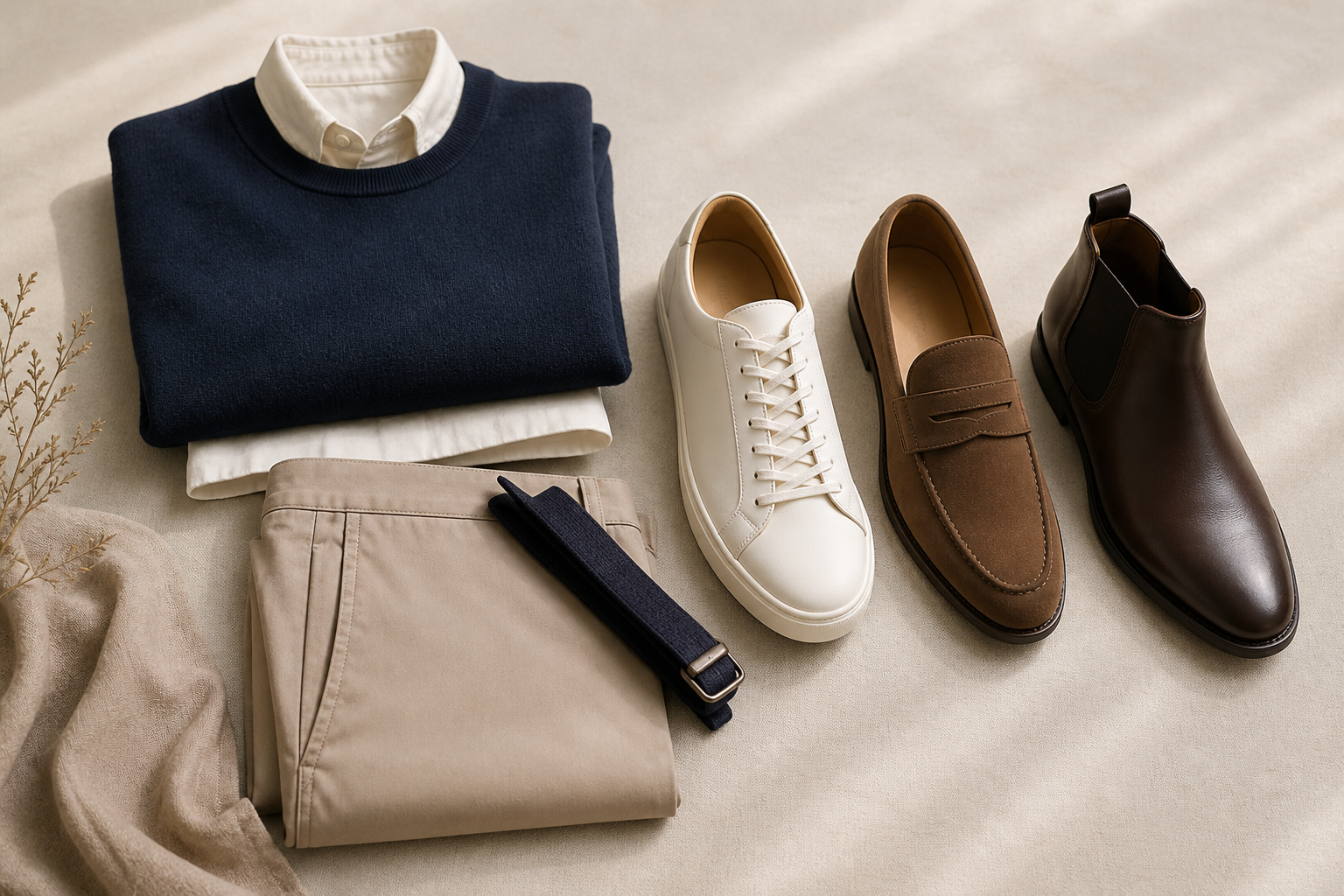
Key points
- Versatile footwear is best understood as shoes that coordinate across outfits and occasions, not as one universal option.
- Setting and dress code should be the first filter for smart-casual footwear choice.
- Clean lines and simpler designs are described as more streamlined and more versatile.
- Neutral colours are a reliable base because they are easy to combine with other colours.
- Decorative details can change visual emphasis, so simplicity and embellishment should be balanced intentionally.
- Shoe categories should be compared by context rather than treated as universal must-haves.
What versatile footwear means
When people talk about footwear for a smart-casual wardrobe, versatility is often the real goal. In the approved sources, a versatile shoe is not described as a single universal answer. Instead, it is a shoe that can coordinate with different outfits and occasions.
That makes the idea more useful and more realistic. A shoe may be versatile because it has a simple shape, a neutral colour, or a style that sits comfortably between formal and relaxed dressing. The point is not to find one shoe that fits every situation. The point is to find shoes that work across a range of looks.
The sources also support looking at footwear as part of overall outfit coordination. In practice, that means the shoe is not chosen in isolation. It is chosen in relation to the rest of the look.
Start with setting and dress code
The first filter should be the setting. The approved business-wardrobe sources advise assessing the work environment, dress code, responsibilities and company culture before choosing footwear. That same idea transfers well to smart-casual dressing: the more clearly you read the occasion, the easier it is to narrow the options.
A shoe that feels appropriate in a formal context may not be the best fit for a more relaxed one, and vice versa. The sources present different footwear options for professional settings, including classic pumps, loafers, ballet flats and ankle boots, while the casual-style source also includes sneakers, light sandals, moccasins and espadrilles as casual options. These are best understood as context-dependent choices, not rules.
If you want a simple way to think about it, start by asking:
- How formal is the setting?
- Does the outfit need a polished finish, or a more relaxed one?
- Is the shoe meant to blend in quietly or play a more visible role?
Review visual simplicity and colour
One of the clearest source-backed principles is that clean lines and simpler shoe designs tend to look more streamlined and more versatile. The footwear guide explicitly recommends clean lines and simpler designs for that reason.
That does not mean decorative shoes are off-limits. It means that embellishment changes the visual effect. Straps, woven textures, stripes, colour transitions and other decorative details can add visual volume or alter apparent proportions. If the rest of the outfit is simple, an embellished shoe can still fit well. If the outfit already has a lot going on, a simpler shoe may create a calmer result.
Colour works the same way. The colour source recommends limiting the number of colours in an outfit, and notes that shoes can anchor the palette. It also describes black, white and gray as neutral colours that combine easily with other colours. In the professional wardrobe source, neutral-toned shoes are framed as appropriate options as well.
A practical approach is:
- use neutral shoes when you want easy coordination,
- keep the colour count modest,
- and, if the shoe is patterned or has noticeable colour transitions, echo one colour elsewhere in the outfit rather than repeating the entire pattern.
Consider proportion without body rules
The approved sources do mention visual balance and proportion, but they also touch on body-type language that is outside this article’s scope. So here the useful takeaway is narrower: shoe details can change the visual emphasis of a look.
That matters because a shoe’s shape, straps or decorative elements may make the outfit feel lighter, heavier, simpler or more detailed. Those are styling effects, not body rules.
Keeping that distinction clear is important. This guide is about coordination, not about assigning shoe styles to body types.
Compare categories without a must-have list
A helpful way to build a smart-casual footwear wardrobe is to compare shoe categories by context rather than treating any one category as essential.
The sources place classic pumps, loafers, ballet flats and ankle boots in professional wardrobes, while sneakers, light sandals, moccasins and espadrilles appear in casual-style guidance. That range shows why it is better to think in terms of outfit fit:
- a pump may feel more formal,
- a loafer often reads more polished and restrained,
- a ballet flat can soften the look,
- an ankle boot can suit cooler-weather coordination,
- a sneaker can work in a more relaxed setting,
- and lighter casual styles can suit low-key outfits.
None of these is presented as a universal must-have. Their usefulness depends on the setting, the clothes around them and the overall level of formality.
If you want a broader framework for outfit planning, see How to Build a Smart-Casual Work Wardrobe That Looks Coordinated and Feels Comfortable.
Editorial examples for outfit contexts
The examples below are illustrations only. They are not universal formulas.
Editorial example: For a smart-casual day with tailored trousers and a blazer, a clean neutral loafer can read more restrained than a heavily decorated shoe.
Editorial example: For a less formal outfit with simple separates, a minimal sneaker can feel more aligned than a shoe with multiple straps or bright colour transitions.
Editorial example: For a look that already includes texture or a print, a neutral shoe can help keep the outfit visually calm.
Editorial example: If a shoe already has a strong pattern or a noticeable colour change, repeating just one of its colours in another part of the outfit can create coordination without overdoing the match.
Editorial example: A classic pump can be used to illustrate a more formal smart-casual interpretation, while a ballet flat can show a softer alternative.
FAQ
How do I know whether a shoe fits a smart-casual setting?
Start with the setting and dress code. The sources recommend reading the environment, company culture and occasion first. From there, choose a shoe that matches the desired level of polish rather than assuming one style works everywhere.
Are neutral shoes always the easiest choice?
Neutral colours are described in the sources as flexible, classic and easy to combine with other colours. That makes them a reliable base when you want broad coordination. Black, white and gray are specifically identified as neutral colours that can pair with other colours.
Do embellished shoes always look too busy?
Not necessarily. The sources say decorative details can change the visual emphasis of a look by adding volume or altering proportions. That means embellishment is a styling choice: it can work well when the rest of the outfit is kept simple.
Should I think about body shape when choosing shoes?
This article does not use body-shape rules. The approved sources include some proportion-related language, but that material is outside the scope here. A safer and more useful approach is to focus on visual balance, outfit context and the overall effect of the shoe.
A calm way to choose better
If you want the shortest possible method, use this sequence:
- Start with the setting.
- Choose a shoe with a simple line when you want flexibility.
- Use neutral colours when coordination matters most.
- Let decorative shoes stay visually balanced by keeping the rest of the outfit calmer.
- Compare shoe categories by context, not by a must-have list.
That approach keeps footwear grounded in style logic rather than rigid rules. It is also easier to adapt as your outfits shift between formal, business casual and relaxed settings.
If you want to continue building that system, you may also like How to Build an Elegant Wardrobe with a Structured System.
Questions readers often ask
How do I know whether a shoe fits a smart-casual setting?
Start with the setting and dress code. The sources recommend reading the environment, company culture and occasion first. From there, choose a shoe that matches the desired level of polish rather than assuming one style works everywhere.
Are neutral shoes always the easiest choice?
Neutral colours are described in the sources as flexible, classic and easy to combine with other colours. Black, white and gray are specifically identified as neutral colours that can pair with other colours.
Do embellished shoes always look too busy?
Not necessarily. The sources say decorative details can change the visual emphasis of a look by adding volume or altering proportions. That means embellishment is a styling choice that can work well when the rest of the outfit is kept simple.
Should I think about body shape when choosing shoes?
This article does not use body-shape rules. The approved sources include some proportion-related language, but that material is outside the scope here. A safer and more useful approach is to focus on visual balance, outfit context and the overall effect of the shoe.
Compare footwear with the outfits you actually wear
If you want a steadier way to judge shoes, start by matching them to the setting, colour balance and overall outfit shape. That makes it easier to compare options without turning any one style into a rule.
Explore Smart Wardrobe