
Oats, Barley and Rye GI Questions: How to Compare the Table Entries Safely
If you are comparing glycaemic index entries for oats, barley and rye, the key question is not “which grain is best?” but “are these the same food form and context?” This article shows which entries are directly supported by the approved sources, why the same grain can appear more than once, and why a table value should not be used to predict your personal glucose response.
Key points
- Check the exact food form before comparing GI entries; oats, barley and rye-related foods are listed separately in the approved sources.
- Do not average distinct entries or turn them into one universal grain number unless a source explicitly provides that method.
- A table GI value is a source record, not a prediction of an individual person’s blood-glucose response.
- The approved sources do not support a universal ranking of oats, barley and rye as always better or worse foods.
If you are looking at glycaemic index (GI) entries for oats, barley and rye, the safest first step is to check the exact food form and label before comparing numbers. The approved sources here list several separate oat and barley entries, plus one rye-related entry, but they do not support collapsing them into one universal grain value, averaging them, or using the table to predict an individual person’s response. This article is for adults who want a careful, source-bounded way to read those entries and avoid overinterpreting them. A source-reported GI entry does not predict an individual's response and cannot establish dietary suitability.
What these three-grain questions can and cannot answer
The approved source material is a table of food entries, not a personal response chart. That matters because the table supports a limited comparison of specific records, but not a universal ranking of oats, barley, and rye. It also does not provide a basis for individual dietary decisions, because the source gives food-entry labels rather than person-specific testing or prediction rules.
A useful way to read the table is to ask three questions in order:
- What exact food is named?
- What form or preparation is attached to the name?
- Am I comparing like with like, or different records?
That approach stays within the evidence. It also avoids a common mistake: treating every oat, barley, or rye entry as interchangeable when the source itself separates them.
Which oat, barley and rye entries appear in the approved sources?
The approved sources include these directly supported entries:
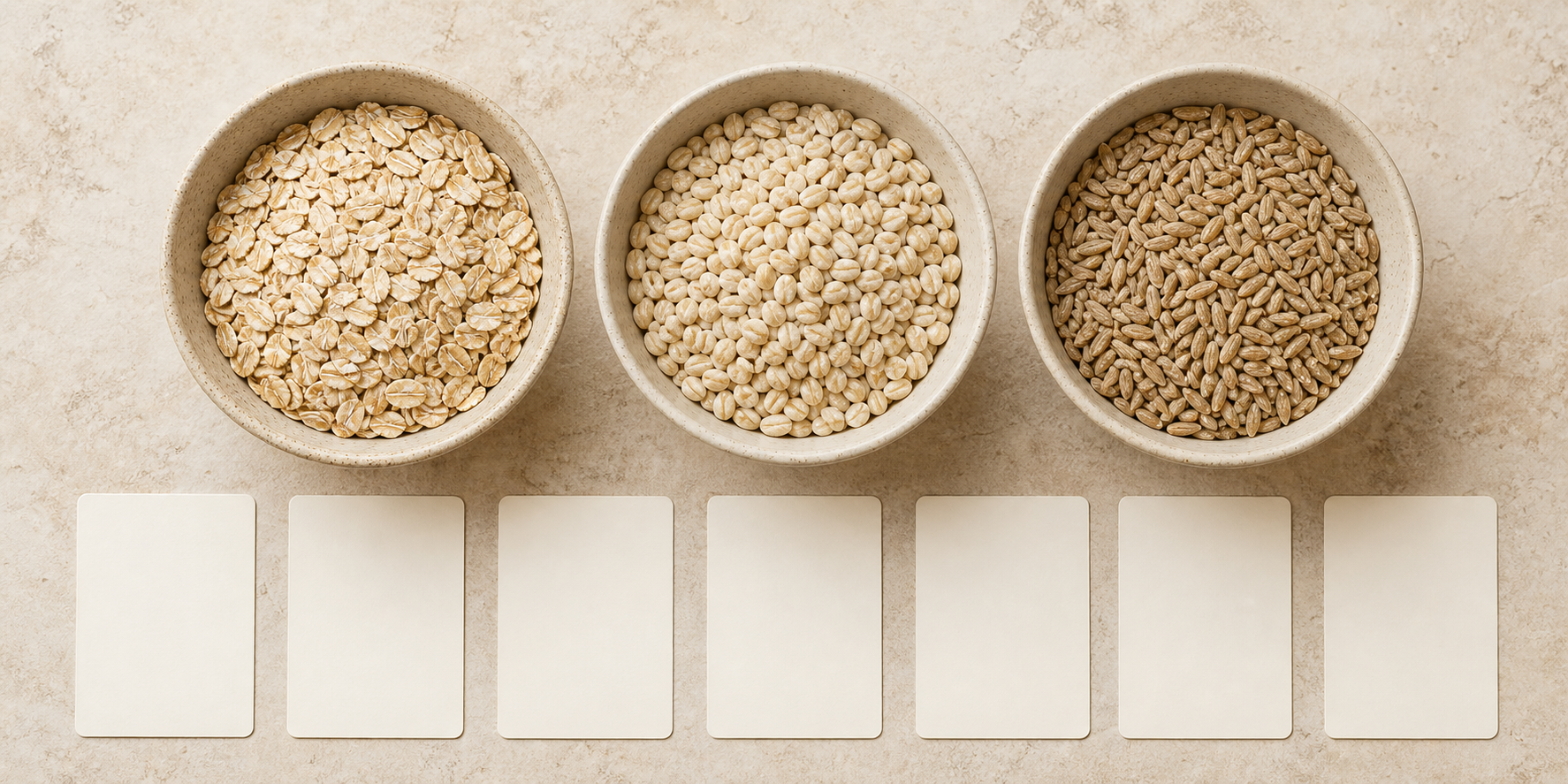
| Food entry | GI value | |---|---:| | Barley (pearl, boiled) | 28 | | Barley flakes | 66 | | Rolled oats (old-fashioned) | 55 | | Oat groats | 48 | | Oat bran | 55 | | Rye bread | 56 |
These are the specific records visible in the approved material. The source set here includes multiple oat and barley forms, but only a rye bread entry, not a plain rye grain entry. That means any rye discussion should stay limited to the retrieved rye bread record.
If you want a practical takeaway from this list, it is not “one grain wins.” It is “the same grain family can appear in more than one form, and each form is recorded separately.”
Editorial example
Comparing barley (pearl, boiled) with barley flakes is not comparing one generic barley value with another generic barley value. It is comparing two different source records.
Why can one grain have more than one reported value?
One grain can have more than one reported GI value because the approved sources record different forms separately. Oats appear as rolled oats, oat groats, and oat bran. Barley appears as pearl, boiled barley and barley flakes. The source does not merge these into one summary grain number.
That separation is important because a GI table entry is not just a grain name. It is a specific food record. When the label changes, the record changes too.
This is why the source supports a narrow comparison, not a broad one. If you compare rolled oats with oat groats, or barley flakes with boiled pearl barley, you are not comparing the same product in disguise. You are comparing different entries that the source keeps distinct.
Why check food form before comparing?
Food form is the first filter because intact grains, flakes, bran and bread are not interchangeable records. The approved table names them differently for a reason. Rolled oats, oat groats and oat bran are all oat-related, but they are not the same form. Likewise, barley (pearl, boiled) and barley flakes are not the same form.
That distinction matters even in a simple comparison question. If two entries do not match in form, they should not be treated as a single food with a single value. The source is more precise than that.
A helpful comparison rule is:
- Same grain name only: not enough for a direct one-to-one comparison.
- Same grain plus same form: closer to a valid comparison.
- Same grain, same form, same label details: best fit for careful reading.
Editorial example
It would be misleading to say “barley is 28” when the same source also lists barley flakes at 66. The source is not giving one universal barley number; it is giving separate barley entries.
Why check preparation and source context?
The approved sources attach descriptors to the entries, such as “boiled” for pearl barley and “old-fashioned” for rolled oats. These descriptors are part of the entry itself, so they limit direct comparison.
This is not a minor wording detail. Preparation and product context help define what the table is actually recording. A row marked “boiled” is not the same record as a row that does not include that preparation detail. A row marked “old-fashioned” is not the same as a generic oat label.
In other words, the source is not simply listing foods by grain category. It is listing named food records with context built in. That context is one reason the table should be read carefully and not compressed into a single grain-wide summary.
Quick context check
Before comparing two entries, ask:
- Does one entry include a preparation detail like boiled?
- Does one entry describe a product type like flakes or bran?
- Are the two rows describing the same kind of food record?
If the answer is no, a direct comparison is limited.
Can values from different entries be averaged?
No. The approved sources do not provide a basis for averaging the GI values across these different oat, barley or rye entries.
That is because the source presents separate records, not a single method for combining them into one summary number. Averaging would erase the very distinctions the table makes between rolled oats, oat groats, oat bran, barley flakes, pearl barley, and rye bread.
Averaging also creates a false impression of precision. A number built from mixed food forms can look neat, but it would not be the same as a source-reported entry. The approved material does not justify that step.
If you need a comparison for editorial or educational use, keep each record separate and label it clearly. Do not turn a set of distinct entries into a new “grain average” unless a source explicitly gives that method.
Does a table value predict an individual response?
No. A table value should not be treated as a prediction of an individual person’s blood-glucose response.
The approved source is a food-entry table. It does not contain person-specific testing, personal response rules, or a way to predict how any one adult will respond to a given meal. That means the table is useful for general education, but not for individualized assessment.
This distinction is important for safe interpretation. A GI entry can tell you what the source lists for that food record. It cannot tell you what will happen in your body, at your next meal, or in a particular health context.
If a blood-glucose question is the real concern, a qualified clinician or registered dietitian is the right source for personal interpretation.
Can the table rank one grain as universally better?
No. The approved sources do not support ranking oats, barley and rye as universally better or worse foods based only on these GI entries.
That is because the table does not describe one uniform version of each grain. It describes separate forms and preparations, and those differences make a blanket ranking too broad. A universal “best” or “worst” label would go beyond the source.
A careful reading is more limited:
- The source shows multiple oat and barley entries.
- The source shows one rye-related entry: rye bread.
- The source does not justify a whole-grain hierarchy from these rows alone.
This does not mean the table is useless. It means the table should be used for what it is: a record of specific foods, not a verdict on an entire grain family.
A cautious comparison checklist
Use this checklist when comparing entries in the table:
- Identify the exact food name.
- Example: rolled oats, oat groats, oat bran, barley flakes, barley (pearl, boiled), rye bread.
- Check the food form.
- Intact grains, flakes, bran and bread are different records.
- Look for preparation or product descriptors.
- Words like boiled or old-fashioned are part of the entry context.
- Compare only like with like when possible.
- Different grain forms should not be treated as interchangeable.
- Do not average distinct entries.
- The source does not provide a method for turning separate rows into one grain value.
- Do not use the table as a personal prediction tool.
- It is a source record, not an individual response measure.
- Avoid universal ranking language.
- The source does not support “always better” or “always worse” claims.
A simple decision path
If you are writing, editing, or reviewing a comparison, follow this sequence:
- Same exact food form? If yes, comparison is more meaningful.
- Different form or descriptor? Keep the entries separate.
- No method for averaging? Do not invent one.
- Personal health question? Use professional guidance, not the table alone.
What this means in practice
The main value of the approved sources is precision. They show that oats, barley and rye-related foods can appear as specific table entries with different labels and values. That precision is helpful, but it also sets a limit: the more the food form changes, the less appropriate it is to treat the entries as interchangeable.
So if you are answering the question “Which grain has the best GI?” the evidence here does not support that framing. A safer question is “Which exact entry is listed, and is it the same food form I am trying to compare?” That is the most reliable way to stay within the source.
Summary
The approved sources list several separate GI entries for oats and barley, plus rye bread. They show that one grain can appear in multiple forms with different values, so the exact food form and preparation matter before comparing anything. The sources do not justify averaging entries, predicting an individual response, or ranking oats, barley and rye as universally better or worse foods.
Frequently asked questions
Can I treat all oat entries as one oat GI number?
No. The approved sources list oat groats, rolled oats and oat bran as separate entries, so they should not be collapsed into one universal oat number.
Is barley always lower than oats in the approved table?
No. The approved sources include barley (pearl, boiled) at 28 and barley flakes at 66, while oat entries are also listed separately. The table does not support a single universal barley-versus-oats rule.
Why is rye discussed only as rye bread here?
Because the approved source set retrieved for this article includes a rye bread entry, not a plain rye grain entry. The discussion should stay limited to the retrieved rye-related record.
Can I use these values to predict my own response?
No. The table values are food-entry records, not personal predictions.
Why should I avoid averaging the numbers?
Because the source lists different foods and preparations as separate records. Averaging would mix non-equivalent entries and would go beyond the approved evidence.
Related reading
Questions readers often ask
Can I treat all oat entries as one oat GI number?
No. The approved sources list oat groats, rolled oats and oat bran as separate entries, so they should not be collapsed into one universal oat number.
Is barley always lower than oats in the approved table?
No. The approved sources include barley (pearl, boiled) at 28 and barley flakes at 66, while oat entries are also listed separately. The table does not support a single universal barley-versus-oats rule.
Why is rye discussed only as rye bread here?
Because the approved source set retrieved for this article includes a rye bread entry, not a plain rye grain entry. The discussion should stay limited to the retrieved rye-related record.
Can I use these values to predict my own response?
No. The table values are food-entry records, not personal predictions.
Why should I avoid averaging the numbers?
Because the source lists different foods and preparations as separate records. Averaging would mix non-equivalent entries and would go beyond the approved evidence.
Want a calmer way to read health tables?
Visit the Health360 overview.
Visit the Health360 overview