
Build a Hybrid-Work Capsule Around Real Weekly Needs
A hybrid-work capsule works best when it starts with your real weekly contexts, then translates each one into clothing functions. Here is a body-neutral, flexible method based on versatile pieces, easy coordination, and gradual adjustment.
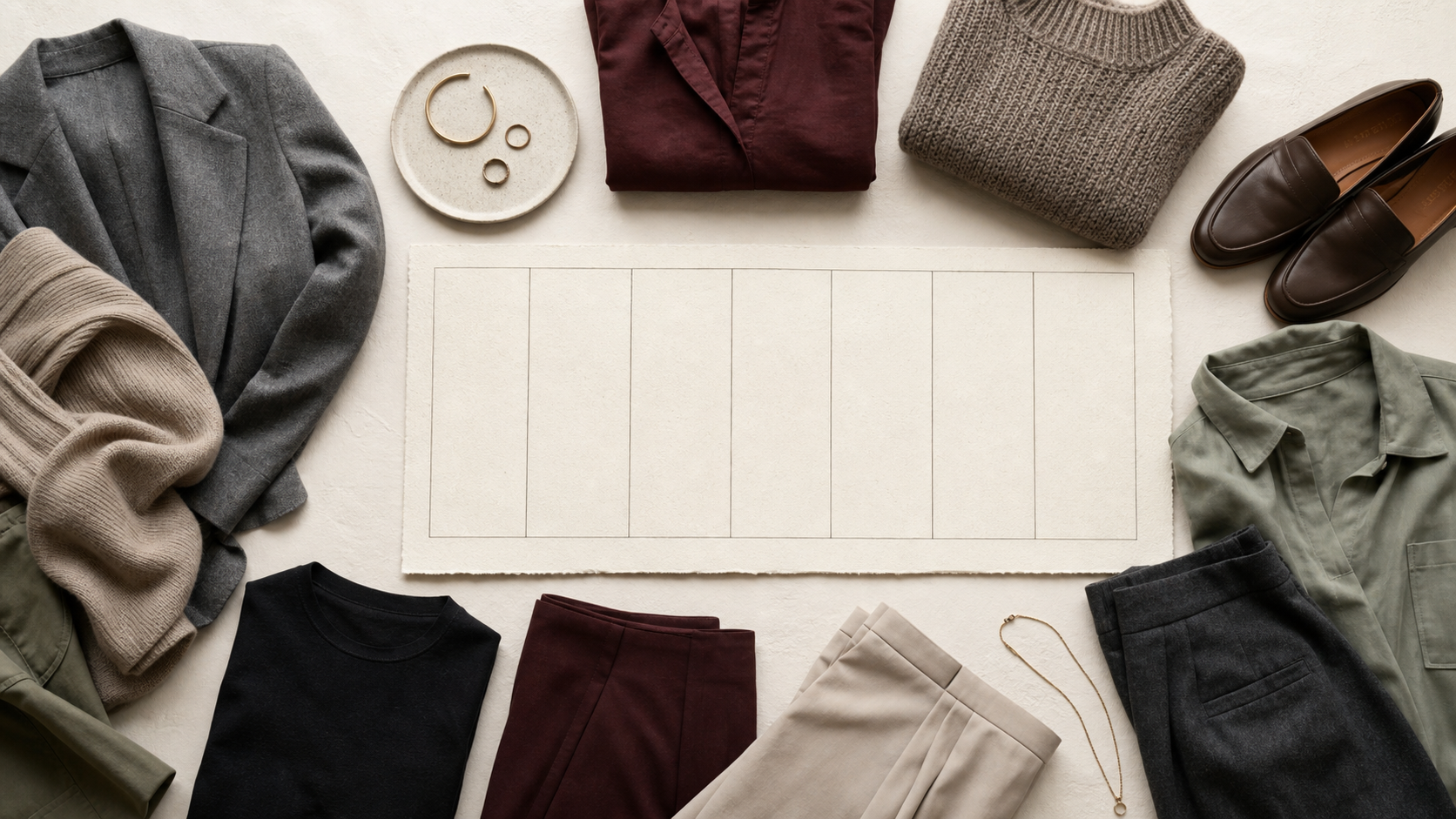
Key points
- Start with the user-supplied week, then translate each real context into garment functions.
- Use versatile pieces that pair well together; a rigid item count is not supported by the sources.
- Neutral, classic items can make coordination easier, but they are a foundation, not a rule.
- Comfort and simplicity are valid planning principles for everyday situations.
- If variety is needed, add it gradually rather than rebuilding the whole capsule at once.
Start with a user-supplied hybrid week
A useful way to think about a hybrid-work capsule is to begin with real weekly needs supplied by the user, not with a preset formula. The approved wardrobe sources support a capsule approach built from versatile pieces that work across different occasions and seasons, and they also support personalizing a wardrobe to lifestyle and style preferences rather than treating it as one fixed system.
That matters because a hybrid week can look different from one person to another. One week may include in-office time, home-based work, short commutes, virtual meetings, or more relaxed days. The method here is not to guess which of those applies to the reader, but to use the user-supplied schedule, context, or scenario as the starting point. The capsule is then shaped around those real contexts.
In practice, that means asking: what does each context need from clothing? A more formal setting may call for one kind of coordination, a more relaxed setting for another, and a mixed week for pieces that can move between both. The sources support this kind of planning through versatility, occasion-based selection, and lifestyle-based personalization.
Translate real contexts into garment functions
When you build a hybrid-work capsule this way, the focus shifts from labels like “office” or “home” to functions. A garment may need to feel more structured in one context, more relaxed in another, or easy to layer when the day changes. The sources support selecting clothing for different occasions and using basic wardrobe pieces that can serve ordinary everyday situations.
A simple way to work with a user-supplied week is to list the actual contexts first, then decide what each one asks of an outfit. For example, one context may need a cleaner outer layer, another may need comfort and simplicity, and another may need something that can be adjusted by adding or removing a layer. The point is not to predict the reader’s needs, but to translate the week they provide into garment functions.
This also makes it easier to avoid overbuilding. If several contexts share the same basic needs, one garment can often serve more than one of them. That is consistent with capsule thinking, which emphasizes versatile pieces that pair well together and work across different occasions.
Choose a small coordinated base without a fixed count
The approved sources support no fixed item count for a hybrid-work capsule. Instead, they support a small, coordinated base made from versatile items that can be mixed and matched. They also note that the composition of a basic wardrobe can vary according to personal preferences.
So the planning question is not “How many items should a hybrid-work capsule contain?” It is “Which pieces coordinate well with one another and serve the user-supplied week?” That keeps the method practical and avoids turning it into a universal formula.
Neutral colors and classic, understated items are presented as easy-to-coordinate foundations. If the goal is a flexible base, those qualities can make it simpler to combine pieces across different contexts.
This does not mean every item has to be neutral or minimal. It means that when coordination is the priority, easy-to-match foundations can be a sensible starting point. From there, the capsule can stay small and coherent without becoming rigid.
Use versatility and repetition without performance claims
A capsule wardrobe is built around repetition in a practical sense: pieces are meant to come back in different combinations. The approved sources describe capsule items as building blocks that can be mixed and matched, and they define a capsule collection as a core wardrobe of versatile pieces that pair well together.
That is enough to support repeated use as a planning principle. It is not enough to claim any outcome beyond versatility. The sources do not support promises about confidence, productivity, authority, competence, stress, social outcomes, or similar effects, so this article avoids those claims.
If a reader wants to think in terms of repeat use, the safest framing is simple: choose pieces that can appear in more than one context in the user-supplied week. That is a coordination strategy, not a promise about how the day will feel.
Keep workplace, comfort, and care constraints user-supplied
A hybrid-work capsule should be shaped by the constraints the user actually provides. That can include the structure of the week, the level of formality in each context, and any comfort or simplicity preferences the reader wants to include. The casual-style source defines casual style as comfort, simplicity, basic clothing items, and simple forms, and says it is suitable for everyday situations.
The important boundary is that none of those constraints should be inferred by the writer. The approved materials and brief explicitly warn against assuming wardrobe ownership, schedule, workplace, dress code, travel, laundry access, budget, body type, or preferences. So if those details matter, they need to come from the user.
That same boundary applies to care and maintenance. It is fine to plan around what the user says they can or want to manage, but not to assume anything about laundry frequency or travel. A practical capsule respects the actual brief instead of filling in the blanks.
Editorial examples of different hybrid weeks
The examples below are editorial examples only. They are not universal rules, and they should not be read as assumptions about the reader’s own schedule or wardrobe.
Editorial example: a week with two in-office days and three at-home workdays
This kind of week can be mapped into two outfit functions: one more structured for the in-office context and one simpler for the at-home context, with shared pieces that coordinate across both. The method follows the approved principles of versatility, lifestyle-based planning, and mixing and matching.
Editorial example: a week with a client meeting, a video call, and a casual commute day
In this scenario, a small coordinated base can support more than one context. One layer can be added or removed to fit the setting, and comfort and simplicity can remain part of the plan where they are relevant. The casual-style source supports gradual variation and blending one style direction with another, such as casual-chic or sport-casual.
Editorial example: a week with only one office day
A week with a single office day can still use the same method. Start with the exact context, identify the garment functions it requires, then choose pieces that can also work in the other contexts of the week. This is consistent with capsule planning as a flexible, context-based process rather than a fixed list.
Editorial example: a week that needs more variety over time
If more variety is wanted, the sources support making gradual changes rather than rebuilding everything at once. Start small, then add one element at a time. That approach fits the casual-style guidance on step-by-step adjustment and the idea that style combinations can be expanded by adding elements from other directions.
Avoid ideal capsule and productivity promises
It is easy to overstate what a capsule can do. The evidence here supports coordination, versatility, personal adaptation, and gradual change. It does not support claims that a hybrid-work capsule will automatically improve performance, reduce stress, save time, or create any other outcome.
It also does not support a single ideal capsule size, a universal item list, or one best formula for everyone. A realistic hybrid-work capsule is less about perfection and more about fit between the user-supplied week and the garments chosen for it.
That is a calmer standard to work with. Instead of asking whether a capsule is “right” in some abstract sense, ask whether it matches the actual contexts it is meant to serve.
A body-neutral hybrid-work capsule checklist
Use this checklist as a planning tool, not a rulebook:
- Start with the user-supplied week or scenario.
- List each real context before choosing any garments.
- Translate each context into garment functions, such as more structured, more relaxed, or easy to layer.
- Choose a small coordinated base rather than a fixed item count.
- Prefer versatile pieces that pair well together and can work across more than one occasion.
- Use neutral or otherwise easy-to-coordinate foundations when coordination is the main goal.
- Keep comfort and simplicity in view when the setting calls for everyday practicality.
- Add variety gradually if needed, one element at a time.
- Treat style blending as flexible, not mandatory.
FAQ
Do I need a fixed number of items for a hybrid-work capsule?
No. The approved sources support versatility, mixing and matching, and personalization, but they do not support a rigid item count or universal formula. A coordinated base can be small without being standardized.
What should I do first when planning for hybrid work?
Start with the actual week or scenario the user provides, then match each context to the clothing function it needs. That approach is supported by the sources on occasion-based selection and lifestyle-based capsule planning.
Are neutral colors required?
No. But neutral shades and timeless design are presented as easy-to-coordinate foundations, so they can be a practical starting point when coordination matters.
Can I add more variety over time?
Yes. The casual-style source supports gradual adjustment, starting small and adding elements step by step. It also supports blending casual with other style directions when flexibility is useful.
Is repetition a problem in a capsule wardrobe?
Not in this framework. Capsule planning is built around versatile pieces that can be mixed and matched across occasions, so repeated use is part of the method rather than a flaw.
Final note
A hybrid-work capsule does not need to be universal to be useful. When it starts with a user-supplied week, respects the functions each context requires, and uses a small coordinated base, it stays practical without becoming rigid. The approved sources support that kind of flexible planning — versatile, personal, and gradual.
Questions readers often ask
Do I need a fixed number of items for a hybrid-work capsule?
No. The approved sources support versatility, mixing and matching, and personalization, but they do not support a rigid item count or universal formula. A coordinated base can be small without being standardized.
What should I do first when planning for hybrid work?
Start with the actual week or scenario the user provides, then match each context to the clothing function it needs. That approach is supported by the sources on occasion-based selection and lifestyle-based capsule planning.
Are neutral colors required?
No. But neutral shades and timeless design are presented as easy-to-coordinate foundations, so they can be a practical starting point when coordination matters.
Can I add more variety over time?
Yes. The casual-style source supports gradual adjustment, starting small and adding elements step by step. It also supports blending casual with other style directions when flexibility is useful.
Is repetition a problem in a capsule wardrobe?
Not in this framework. Capsule planning is built around versatile pieces that can be mixed and matched across occasions, so repeated use is part of the method rather than a flaw.
Want a calmer way to compare outfit ideas?
Smart Wardrobe is an optional workspace for comparing only the garments and weekly contexts supplied by the user.
Explore Smart Wardrobe