
How to Build an Accessory Capsule That Supports Several Contexts
Use your own contexts—not a universal list—to plan a small, coordinated accessory capsule. Start with versatile pieces, keep the set minimal when needed, and add variation gradually.
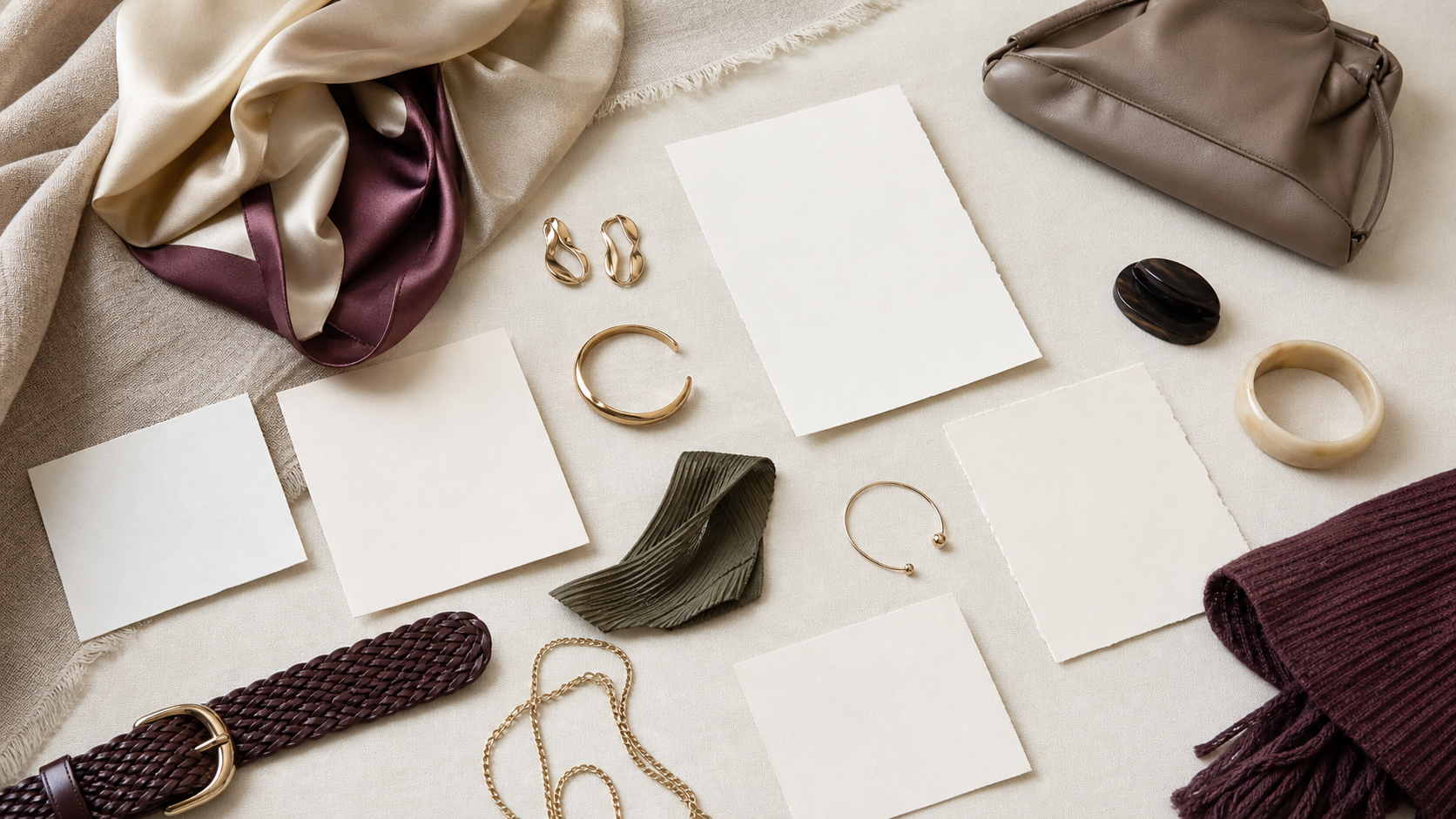
Key points
- Start accessory planning from the contexts the reader supplies, not from a universal list.
- A capsule is defined by versatility and coordination, not by a fixed number of items.
- A simpler style direction can stay minimal and unobtrusive.
- When extending from a simple baseline, adding variation one element at a time is supported.
- Exact combinations should be treated as editorial examples, not universal rules.
Start with user-supplied contexts
An accessory capsule works best when it begins with the situations you actually want it to support. The approved sources point to a wardrobe approach built around lifestyle and personal preferences, which means the planning input comes from your own contexts rather than from a universal accessory list.
That context-first approach keeps the method flexible. Instead of asking, “What accessories should everyone own?”, ask which settings matter for your use case: commuting, daytime casual wear, a more polished evening setting, or another context you define for yourself. The goal is not to assume anything about your wardrobe, budget, workplace, or preferences. It is to translate the situations you name into a small, workable set of accessories.
Translate contexts into accessory functions
A useful way to plan is to think in functions rather than in fixed item names. If a context needs a more coordinated look, the accessory function may be visual continuity. If a context changes temperature or formality, the function may be practical layering or a more restrained finish. If the same base is used in several settings, the function may be repetition with slight variation.
This keeps the capsule tied to purpose. A single accessory can serve more than one context when it pairs well with other pieces and fits multiple situations across seasons. That versatility is central to the capsule idea.
Choose a coordinated base without a fixed count
A capsule approach is built around pieces that coordinate well together and can be used for multiple occasions and seasons. In other words, the important principle is versatility and coordination, not a universal item count.
For accessory planning, that means the “base” can be small if a restrained style direction suits the context. The source on casual simplicity describes very few accessories, and when accessories are present, they are minimalistic and unobtrusive.
So the question is not how many accessories are required. The better question is whether the pieces you are considering work together across the contexts you supplied. If they do, the capsule can stay compact. If they do not, the set may need one more element or a different balance.
Use repetition and variation without performance claims
A coordinated base does not need to be replaced every time the context changes. The sources support mixing and matching across seasons and situations, which allows repeat use with variation instead of rebuilding the whole set.
If you are extending from a simpler style direction, it is reasonable to start small and introduce one element at a time. Variation can be added gradually rather than all at once.
That can look like repeating one core accessory across several settings and then changing only the detail that the new context requires. For example, the same base may be repeated in a casual setting and a more polished setting, while one accessory changes to reflect the different level of formality. The exact combination is always an editorial example, not a universal rule.
Keep workplace and event constraints user-supplied
Workplace and event requirements should come from the reader’s own situation, not from assumptions. The sources support using lifestyle and occasion needs as the planning input, which means work settings, social events, and other contexts should be named explicitly when they matter.
That makes the capsule easier to evaluate. If one context is more formal and another is more relaxed, the accessories can be compared by function: which piece keeps the set coordinated, which piece stays minimal, and which piece adds the needed variation without changing everything else.
Editorial examples of different context sets
The examples below are editorial only. They show how the method can work without implying ownership, a universal list, or a required number of accessories.
- Editorial example: a commute context, a casual daytime context, and an evening context all using the same coordinated base with only one accessory changed between them.
- Editorial example: a user-supplied workplace context and a separate event context, each translated into different accessory functions rather than a universal accessory list.
- Editorial example: a minimal accessory approach where a small number of unobtrusive pieces are repeated across several settings.
- Editorial example: one core accessory repeated across multiple outfits, with a second accessory added only when the context becomes more formal.
Avoid must-have and investment claims
It is helpful to stay away from universal “must-have” language. The capsule idea is about versatility, coordination, and context fit, not about a fixed set that everyone needs.
It is also better not to frame the capsule as a promise of a particular outcome. The supported sources describe how pieces can be selected and combined; they do not justify claims about guaranteed confidence, status, social outcome, or similar results.
Map several contexts before selecting a set
An accessory capsule becomes more specific when several contexts are written down before the set is assessed. The approved capsule source supports planning from lifestyle and occasion needs rather than from a universal list. In this article, those contexts must come from the user; they are not guessed from age, work, travel, events, or personal style.
Once the contexts are supplied, the next step is to describe the role an accessory would need to serve in each one. That role can stay abstract: level of formality, visual emphasis, ease of coordination, or whether the same role appears in more than one supplied context. The method does not choose an exact item on the reader’s behalf.
The overlap matters because capsule planning is based on versatile pieces that can coordinate across occasions and seasons. If the same accessory function appears in more than one context, one user-supplied item may be evaluated against both. That is a comparison opportunity, not a claim that the item will work automatically.
Editorial example: if a user explicitly supplies two contexts and one accessory for comparison, the article may describe how the same coordination criteria could be checked in both contexts. The example remains editorial because the exact combination is not a universal rule. It does not imply that the reader owns the item or attends either context.
Review overlap without forcing completeness
There is no fixed item count in this method. A coordinated base can be mixed and matched across situations, and a simpler direction may use few, minimal accessories. Neither source establishes a required total, a complete category list, or an ideal accessory capsule.
That means a review can end with a gap, an overlap, or an unanswered question. A gap does not automatically create a shopping instruction. It simply shows that the user-supplied items have not yet been matched to every supplied function. An overlap does not guarantee performance; it shows that one item is being considered against more than one context.
Variation can also remain gradual. The approved source supports introducing one element at a time from a simpler baseline rather than changing everything at once. In this article, that principle is descriptive and optional. It does not promise savings, confidence, convenience, sustainability, or a better social impression.
This boundary keeps the capsule small only when the supplied contexts and items support that result. The method does not make smallness the goal at the expense of the user’s actual brief, and it does not treat a larger or smaller set as a success or failure.
A body-neutral accessory-capsule checklist
Use this checklist as a calm review, not as a rulebook:
- Have I started from the contexts I actually need to support?
- Do the accessories coordinate with one another?
- Can the same base be used across more than one situation?
- Is the set minimal enough if a simpler style direction is the goal?
- If I am extending from a simple baseline, am I adding variation one element at a time?
- Have I treated each exact combination as an editorial example rather than a universal prescription?
Internal guide
If you want the wider wardrobe method that sits behind this approach, see the Capsule Wardrobe Guide.
FAQ
Do I need a universal accessory list to start?
No. The supported approach is to begin with the lifestyle and occasion contexts you supply, then translate those contexts into accessory functions. That keeps the capsule personal and avoids assuming a fixed list for everyone.
Can a small accessory set still be a capsule?
Yes. The sources support a minimal, unobtrusive accessory direction when that suits the style approach. A capsule is about coordination and usefulness across contexts, not about a universal count.
How should I add more accessories if my baseline is very simple?
Start small and add one element at a time. The approved source on casual simplicity supports gradual variation rather than changing everything at once.
Are exact outfit-and-accessory combinations universal rules?
No. Exact combinations should be treated as editorial examples only. The sources support the principles behind them, but they do not turn any one combination into a fixed rule for everyone.
Questions readers often ask
Do I need a universal accessory list to start?
No. The supported approach is to begin with the lifestyle and occasion contexts you supply, then translate those contexts into accessory functions. That keeps the capsule personal and avoids assuming a fixed list for everyone.
Can a small accessory set still be a capsule?
Yes. The sources support a minimal, unobtrusive accessory direction when that suits the style approach. A capsule is about coordination and usefulness across contexts, not about a universal count.
How should I add more accessories if my baseline is very simple?
Start small and add one element at a time. The approved source on casual simplicity supports gradual variation rather than changing everything at once.
Are exact outfit-and-accessory combinations universal rules?
No. Exact combinations should be treated as editorial examples only. The sources support the principles behind them, but they do not turn any one combination into a fixed rule for everyone.
Want a calmer way to compare contexts?
Use Smart Wardrobe as an optional reference point when you want to compare only the accessories, garments, and situations you choose to supply. It can support a more context-first review without assuming a fixed universal list.
Explore Smart Wardrobe