 By
·
5 minute read
By
·
5 minute read
Wardrobe Planning System: The Framework That Makes Style Easy
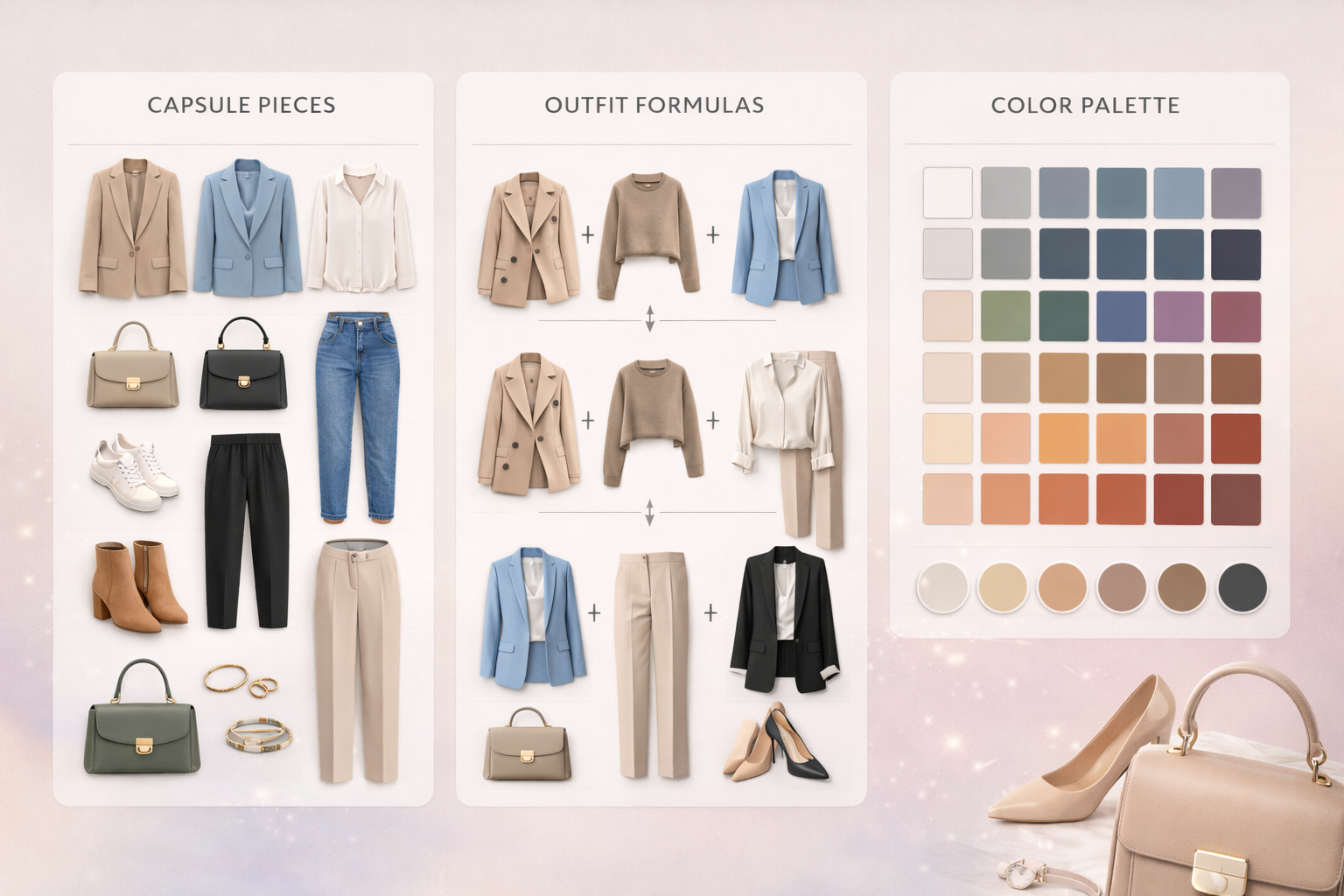
If your closet feels full but you still say “I have nothing to wear,” you do not have a wardrobe problem. You have a planning problem. A wardrobe planning system turns random clothes into a repeatable style framework. That is the difference between “I hope this works” and “I know exactly what to wear.”
Most women do not fail because they lack taste. They fail because the closet is built on impulse, not structure. A few beautiful pieces can still create chaos if they do not connect by color, silhouette, and lifestyle function. Planning fixes that, fast.
This post gives you a complete wardrobe planning system you can run every week: lifestyle categories, outfit formulas, capsule structure, color logic, body shape alignment, and a simple weekly plan. At the end, you will also see how to make the system even easier by digitizing your wardrobe and saving outfits inside an app.
Contents
- What a wardrobe planning system is
- Why most wardrobes fail
- Step 1: Define your real lifestyle
- Step 2: Build outfit formulas
- Step 3: Align body shape and proportions
- Step 4: Align color palette
- Step 5: Build a capsule structure
- Step 6: Organize visually
- Step 7: Plan weekly
- Comparison tables
- Make planning digital
- Shopping rules that stop mistakes
- Quick FAQ
- CTA
What a wardrobe planning system is
A wardrobe planning system is a repeatable framework that connects your clothes to your real life. It is not a closet clean-out. It is not “buying better basics.” It is a method that answers these questions:
- What environments do I dress for each week?
- What outfit formulas make me look polished with minimal effort?
- What silhouettes balance my proportions?
- What colors make my face look brighter and more rested?
- What pieces do I actually need, and what is just clutter?
- What am I wearing on Monday, Tuesday, Wednesday, not in theory, but in reality?
When those questions are answered, style becomes easy because decisions are reduced. You stop reinventing outfits daily. You start repeating your best looks on purpose.
Why most wardrobes fail
Most wardrobes fail because they grow without a plan. You buy a piece because it is pretty, on sale, trendy, or looks great on someone else. Then it sits unused because it does not connect.
- Impulse purchases without outfit context
- No outfit formulas, only individual items
- Too many unrelated colors, so nothing matches
- Ignoring body proportions, so clothes feel “off”
- No weekly planning, so mornings become stressful
Without structure, even expensive clothes feel chaotic. With structure, even a smaller wardrobe looks elevated.
Step 1: Define your real lifestyle
Your wardrobe must match your actual week. Not your dream week, not your vacation week, your real calendar.
Pick 3 to 5 lifestyle categories that repeat most weeks:
- Office or business
- Smart casual
- Events or dinners
- Travel or commuting
- Home days or errands
- Fitness or wellness
Now assign percentages. This is the part people skip and then wonder why the closet feels wrong. Example:
| Lifestyle category | How often (weekly) | Wardrobe priority |
|---|---|---|
| Office or business | 3 days | High |
| Smart casual | 2 days | High |
| Events or dinners | 1 night | Medium |
| Home days and errands | 1 to 2 days | Medium |
That table becomes your shopping compass. If “office” is 60 percent of your life, your wardrobe should not be 60 percent party dresses.
Step 2: Create outfit formulas
Outfit formulas remove daily stress. A formula is a reliable template you can repeat with different colors and textures. Think of it as your style autopilot.
Three executive formulas that always work
- Blazer + top + tailored trousers (meeting-proof, photo-proof)
- Dress + structured jacket (one-and-done with polish)
- Fine knit + straight trousers + coat (soft power, minimal effort)
Three smart casual formulas
- Knit + straight jeans + loafers (clean and modern)
- Shirt + wide-leg trousers + sneakers (relaxed, still intentional)
- Midi skirt + fitted top + cardigan (feminine balance)
Your job is to pick 2 to 3 formulas per lifestyle category. That is enough. Too many formulas becomes a new kind of chaos.
If you want to explore the app angle, this is connected to: AI Outfit Planner for Professionals.
Step 3: Align body shape and proportions
Fit is non-negotiable. A wardrobe planning system fails instantly if your core pieces do not suit your proportions. This is why two women can wear the same blazer and one looks sharp while the other looks boxed.
Use body shape logic to choose silhouettes that create visual balance. Example rules:
- Pear: add structure to shoulders, keep bottoms clean and elongating.
- Apple: create vertical lines, avoid tight waist compression, choose smart layering.
- Rectangle: create shape with belts, contrast, and intentional layering.
- Inverted triangle: keep shoulders simple, add volume and interest below.
- Hourglass: define waist, avoid adding bulk at hips or shoulders.
Start here: Body Shape Guide.
Step 4: Align color palette
Color consistency is the shortcut to “expensive-looking” outfits. If your closet has ten unrelated colors, planning is hard. If your closet has a clear palette, outfits build themselves.
Simple palette method:
- Choose 2 to 3 neutrals you love and actually wear (example: navy, charcoal, cream).
- Choose 1 to 2 accent colors that flatter your undertone (example: burgundy, teal).
- Add one light neutral for freshness near the face (example: ivory, soft white, light beige).
Then apply a rule: every new purchase must match at least one neutral and one accent.
Start here: Color Analysis.
Step 5: Build a capsule structure
A capsule is not “30 items only.” A capsule is a structure where pieces match each other and support your formulas.
The easiest capsule rule:
Every item must match at least three other items.
Here is a strong executive capsule backbone:
- 2 blazers (one dark, one light)
- 3 trousers (tailored, relaxed, seasonal)
- 2 skirts or 1 skirt + 1 dress
- 5 tops (mix of knit and structured)
- 2 layering pieces (cardigan, trench, coat)
- 2 shoes for work (loafers, low heel) + 1 casual sneaker
- 1 structured bag
Learn: Capsule Wardrobe.
Step 6: Organize visually
If you cannot see it, you cannot plan it. Visibility is not aesthetic, it is strategy.
Organize by:
- Category first (blazers, tops, trousers, dresses)
- Then color gradient inside each category
- Then frequency zones (daily vs occasional)
System: Wardrobe Organization.
Step 7: Plan weekly
This is the step that makes everything click.
Weekly planning means you assign outfits to days. You do it once, then mornings become calm.
The 10-minute weekly method
- Open your calendar for the next 7 days.
- Mark your environments (office, casual, dinner, travel).
- Pick an outfit formula for each day.
- Swap in colors based on your palette.
- Save 1 backup outfit for weather or mood changes.
Tool: Style Calendar.
Comparison: Planning System vs Random Shopping
| Wardrobe Planning System | Random Closet |
|---|---|
| Repeatable formulas | Outfit stress |
| Intentional buying | Impulse buying |
| Consistent color logic | Clashing colors |
| Fewer but better pieces | Overcrowded wardrobe |
Mini checklist: “Does this belong in my system?”
| Question | If YES | If NO |
|---|---|---|
| Matches my palette? | Keep or buy | Skip |
| Supports a formula? | Keep or buy | Skip |
| Works with 3 items? | Keep or buy | Skip |
Make planning digital
Here is the reality: physical closets hide things. You forget items, you buy duplicates, you waste time “trying on chaos.” Digitizing your wardrobe fixes that.
When your wardrobe is digital, you can:
- see what you own instantly, even while shopping
- test outfit combinations without making a mess
- save winning outfits and repeat them confidently
- plan outfits by day, like a style calendar
This is exactly why Smart Wardrobe: Style & Try-On exists. It supports the planning system inside one place: digital wardrobe, outfit building, and a visual way to plan what you wear next.
Try it here: Download on Google Play.
Shopping rules that stop mistakes
Planning is how you stop buying “almost right” items. Use these rules:
Rule 1: Never buy a single item, buy a role
Before purchase, name the role: “This completes my blazer + trousers formula,” or “This upgrades my smart casual knit formula.” If you cannot name a role, it is likely an impulse purchase.
Rule 2: Build outfits before you buy
Make a quick mental test: can I style this in three outfits with what I already own? If not, skip it or buy the missing link first.
Rule 3: Do not fight your palette
Random colors create random wardrobes. If your best neutrals are navy, charcoal, cream, do not suddenly buy bright orange unless it is a planned accent you can repeat.
Rule 4: Fit first, trend second
If a trend does not support your proportions, it will not become a staple. It will become clutter. Body shape always wins.
Rule 5: One in, one out
This keeps the wardrobe clean. If you buy a new blazer, an old blazer leaves. Your closet stays curated instead of bloated.
Quick FAQ
How long does it take to build a wardrobe planning system?
You can build the first version in one focused hour: define lifestyle, choose formulas, pick palette, then plan the week. Refinement happens over the next month.
Do I need a tiny capsule wardrobe for this to work?
No. You need structure, not a number. A larger wardrobe can work if it follows formulas and palette logic.
What if my week is unpredictable?
Use flexible formulas and plan “outfit blocks.” Example: 2 office formulas, 2 smart casual formulas, 1 dinner formula. Then assign them as needed.
How do I make planning easier when I am busy?
Digitize your wardrobe and save your best outfits. When the outfit is already saved, planning becomes quick and calm.
CTA
Style becomes easy when structure exists. A wardrobe planning system removes emotional shopping, reduces stress, and creates everyday elegance.
Download Smart Wardrobe: Style & Try-On and turn your outfits into a repeatable, polished system.