 By
·
7 minute read
By
·
7 minute read
Color Analysis Guide: Find the Colors That Make You Glow
Color analysis helps you look fresher, more expensive, and more confident without buying more clothes. When your outfit colors match your undertone and contrast level, your skin looks clearer, eyes look brighter, and your face becomes the focus. If you are over 35 and suddenly feel like “something is off” in photos, very often it is not your face. It is your colors.
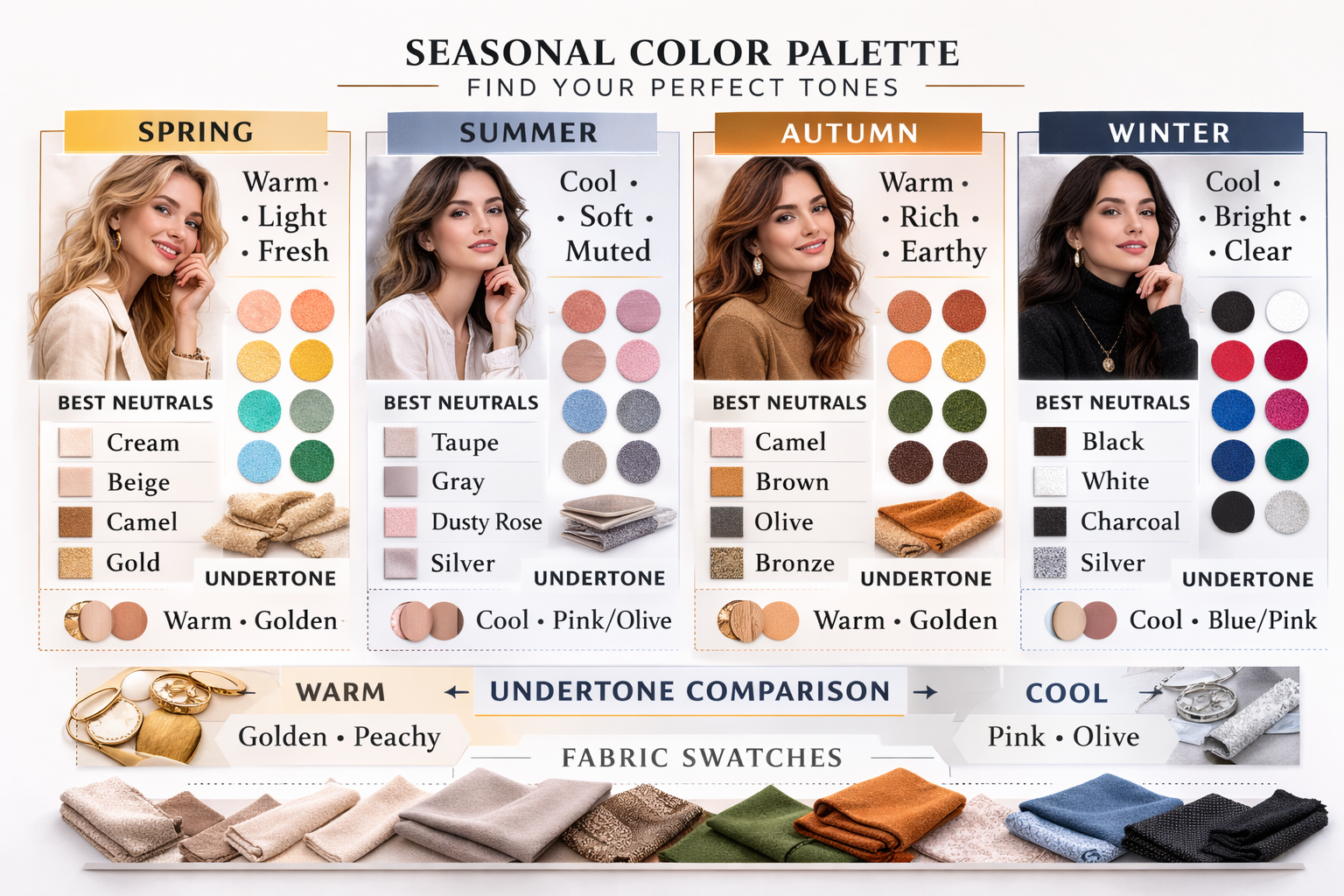
In this guide, you will learn how to identify your undertone, find your color season, choose flattering neutrals, build a capsule wardrobe by color, and avoid the most common “age adding” mistakes. At the end, you will also see how to test outfits digitally using Smart Wardrobe: Style & Try-On.
Contents
- Why color matters after 35
- Step 1: Determine your undertone
- Step 2: Identify your contrast level
- Step 3: Find your seasonal palette
- The best neutrals for each undertone
- Hair color, makeup, and your season
- Common color mistakes that age you
- Build a color based capsule wardrobe
- Digitize and test your colors with Smart Wardrobe
- Quick FAQ
- Download Smart Wardrobe
Why Color Matters After 35
After 35, the wrong color can emphasize shadows, redness, and fatigue, while the right color restores brightness. This happens because skin tone and contrast often shift with lifestyle, hormones, stress, and sun exposure. A shade that looked “fine” at 25 might suddenly look harsh or dull at 38.
- Right colors visually lift the face by increasing perceived clarity
- Wrong colors create a gray cast, highlight under eye shadows, and make skin look uneven
- When colors harmonize, outfits look more expensive even if they are simple basics
- Color strategy reduces impulse shopping because everything mixes
Here is the honest truth. Most “style problems” are not about body shape or trend knowledge. They are about random color choices. Once your palette is controlled, everything feels easier.
Step 1: Determine Your Undertone
Your undertone is the subtle color underneath your skin, and it is the foundation of color analysis. Undertone is not the same as surface skin tone (light, medium, deep). You can be deep and cool, light and warm, or anything in between.
Three undertones
- Cool: pink, red, or bluish base
- Warm: golden, peach, or yellow base
- Neutral: balanced mix of both
Undertone test 1: Jewelry
If silver looks cleaner and more “right,” you are likely cool. If gold makes you glow, you are likely warm. If both look good, you might be neutral.
Undertone test 2: Veins
Blue or purple looking veins often point to cool. Green looking veins often point to warm. Mixed veins often point to neutral. This test is not perfect, but it is a useful hint.
Undertone test 3: White vs cream
Hold a pure white fabric and a warm cream fabric near your face in daylight. If white makes you look crisp and bright, you lean cool. If cream looks more harmonious, you lean warm.
If you are still unsure, do not panic. Neutral undertone is common, and contrast level will become the “decider” in the next step.
Step 2: Identify Your Contrast Level
Contrast level is the difference between your hair, skin, and eyes, and it tells you how soft or bold your colors should be. Two women can share the same undertone and still need different palettes because one has high contrast and one has low contrast.
Low contrast
Hair, skin, and eyes are close in depth. Think soft transitions. Low contrast women usually look best in blended, tonal outfits and softer colors (often Summer or Spring families).
Medium contrast
There is visible difference, but not extreme. Most women are here. Medium contrast can handle both soft and some deep shades depending on undertone.
High contrast
Strong difference between hair and skin, or bright eyes against deep hair. High contrast women look powerful in clear, saturated colors (often Winter family, sometimes Autumn if warm).
Quick test: convert your selfie to black and white. If your features “pop” strongly in grayscale, you have higher contrast. If your face looks soft and blended, you have lower contrast.
Step 3: Identify Your Seasonal Palette
Your season is the combination of undertone and contrast. Seasonal color analysis groups people into four families: Spring, Summer, Autumn, Winter. Each family has a distinct temperature (warm or cool) and intensity (soft or clear).
Spring
Warm and light. Spring palettes look fresh, sunny, and clear. Best colors include coral, peach, warm beige, light camel, fresh green. Spring usually shines in lighter, clearer shades rather than deep muted tones.
Summer
Cool and soft. Summer palettes look gentle and powdery. Best colors include dusty rose, lavender, soft blue, cool taupe, misty gray. Summer usually looks best when colors are muted, not too bright.
Autumn
Warm and deep. Autumn palettes look earthy and rich. Best colors include olive, rust, chocolate, terracotta, warm navy, mustard. Autumn usually shines in textured fabrics and deeper warm shades.
Winter
Cool and high contrast. Winter palettes look bold and crisp. Best colors include emerald, cobalt, burgundy, black, crisp white, icy tones. Winter usually looks stunning in strong contrast outfits.
Important note: seasonal analysis is a shortcut, not a prison. You can borrow colors from nearby families, but your best “core palette” will always follow undertone and contrast.
The Best Neutrals for Each Undertone
Neutrals are the real secret to expensive looking style. If your neutrals are wrong, every outfit looks slightly off even if the “colors” are correct.
Best neutrals for cool undertones
- Charcoal
- Cool navy
- Crisp white (or icy white)
- Cool gray
- Blue based black
Best neutrals for warm undertones
- Chocolate
- Espresso
- Cream
- Warm beige
- Warm navy
Best neutrals for neutral undertones
- Balanced navy
- Stone
- Mushroom taupe
- Soft white (not too yellow, not too icy)
If you only upgrade one thing, upgrade your neutral base. Neutrals sit closest to your face most days: coats, blazers, knitwear, turtlenecks, scarves. That is why they matter.
Hair Color, Makeup, and Your Season
Hair color can shift your contrast level, but it does not erase your undertone. If you dye your hair from blonde to deep brown, you may need deeper colors, but your warm vs cool foundation usually stays the same.
When hair color changes your “best” colors
- If you go darker, your palette can handle more depth (deeper neutrals, deeper lipstick)
- If you go lighter, very deep shades may overwhelm your face
- If you go warmer (golden highlights), warm shades can look more harmonious
- If you go cooler (ashy highlights), cool shades may look cleaner
Makeup and color harmony
Makeup should support your palette, not fight it. Example: if you are cool, very orange bronzer often looks “separate” from your skin. If you are warm, icy pink lipstick can look harsh.
The easiest strategy is matching your blush and lipstick temperature to your undertone, and keeping your wardrobe neutrals aligned.
Common Color Mistakes That Age You
Most “aging” color mistakes are not dramatic. They are small mismatches repeated daily. Here are the ones I see all the time.
Mistake 1: Pure black near the face (when it is not your neutral)
Pure black can drain warm and soft palettes. If black makes you look tired, swap it for charcoal, espresso, or navy.
Mistake 2: Neon or very bright colors with a soft palette
Soft palettes (often Summer) look better in muted shades. Neon creates harsh contrast and highlights shadows.
Mistake 3: Dusty muted tones on a clear high contrast palette
High contrast women (often Winter) can look “gray” in dusty shades. They usually need clearer, more saturated colors.
Mistake 4: Wrong white
Warm undertones often look healthier in cream. Cool undertones often look sharper in crisp white. The wrong white can instantly make you look dull.
Mistake 5: Buying “pretty colors” that do not mix
You can love a color and still not wear it because it does not match your wardrobe. This is how closets become chaotic.
Color Analysis vs Random Dressing
Color analysis is basically a decision reduction system. You eliminate 70 percent of “maybe” items and keep only what works.
| Color Analysis | No Color Strategy |
|---|---|
| Harmonious outfits, easier mixing | Clashing shades, “something feels off” |
| Brighter complexion, clearer eyes | Dull appearance, shadows look stronger |
| Intentional wardrobe, fewer purchases | Impulse shopping, closet chaos |
| Personal brand consistency | Random vibe from day to day |
Build a Color Based Capsule Wardrobe
A color based capsule wardrobe is the fastest way to look polished daily. You are not limiting yourself. You are building a system that works.
Step 1: Pick your neutral base
Choose 2 neutrals that flatter your undertone (for example: navy and charcoal for cool, espresso and cream for warm).
Step 2: Choose your core accent colors
Pick 3 to 5 colors from your best seasonal palette. These should mix with your neutrals and with each other.
Step 3: Choose a signature color
This is your “brand” shade. You repeat it in tops, scarves, bags, nails, or lipstick. It creates recognition.
Step 4: Keep prints controlled
Prints should include your neutrals or your accent colors. If a print has none of your palette, it will become a “lonely item” you never reach for.
Want the full capsule strategy next? Start here: Capsule Wardrobe Guide.
Digitize and Test Your Colors With Smart Wardrobe
Testing colors digitally helps you avoid the “mirror lie” and see combinations clearly. Some outfits look okay in a rushed morning mirror and suddenly feel wrong under office lighting or in photos. A digital wardrobe view makes color harmony obvious.
Smart Wardrobe: Style & Try-On is built around wardrobe organization, outfit planning, and color harmony workflows, including AI based styling tools and wardrobe digitization features.
What you can do inside the app
- Organize your wardrobe so you actually see what you own
- Build outfits with controlled palette logic (instead of random pairing)
- Plan looks for the week to reduce morning decision fatigue
- Use try-on style workflows to preview how combinations will look together
Simple weekly routine (10 minutes)
- Pick 2 neutrals for the week
- Pick 1 signature color
- Plan 5 outfits around those colors
- Repeat accessories so everything feels cohesive
This is how women look “effortless”. It is not luck. It is a system.
Quick FAQ
What is color analysis?
Color analysis identifies the clothing shades that complement your natural undertone and contrast. It helps you pick colors that brighten your face and create harmony.
How do I know if I am warm or cool toned?
Cool undertones usually look better in silver and blue based colors, warm undertones glow in gold and earthy tones. If both work, you may be neutral.
Can color analysis make me look younger?
Yes, because correct colors reduce the look of shadows and fatigue. The effect is subtle but powerful, especially near the face.
Does hair color change my season?
Hair dye can change contrast, but your undertone remains the foundation. A major hair change may shift which depth of colors works best.
Do I have to follow seasonal palettes perfectly?
No. Use seasons as a shortcut. Your real goal is harmony: temperature (warm vs cool) and intensity (soft vs clear).
Try This: Build Your Palette in One Week
Day 1: Identify undertone and contrast.
Day 2: Choose 2 best neutrals.
Day 3: Choose 3 accent colors.
Day 4: Declutter 5 items that fight your palette.
Day 5: Plan 5 outfits for next week.
Day 6: Take 2 photos in your best colors and compare.
Day 7: Lock your signature color and repeat it.
If you want the process to be faster and more visual, use the app: