 By
·
4 minute read
By
·
4 minute read
Outfit Planner Guide: Plan Your Week Like a Stylist
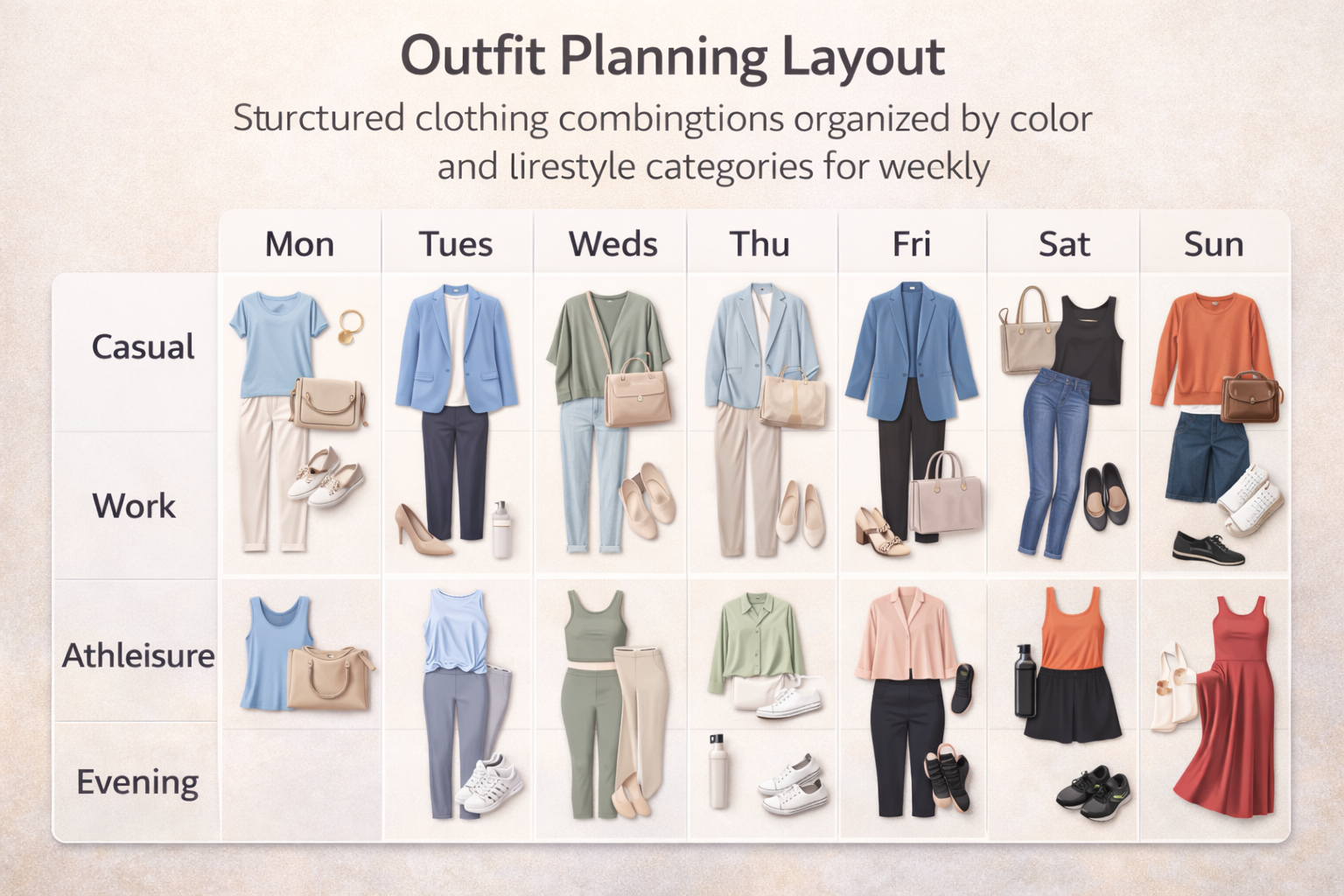
If you open your closet every morning and feel stressed, you do not need more clothes. You need a planning system. An outfit planner removes decision fatigue and creates consistent elegance. Instead of guessing daily, you build a small set of reliable outfits and rotate them with smart variations.
This is not about being “perfect.” It is about making your style automatic. When outfit planning becomes a habit, you stop wasting time, you stop impulse shopping, and you start showing up looking polished without effort.
In this guide, you will learn how to plan outfits like a stylist: create lifestyle categories, build outfit formulas, align body shape and color, structure your capsule, and plan your week with a simple calendar method. Then we will make it even easier by going digital.
Why outfit planning works
Outfit planning sounds like extra work until you try it. Then you realize it is the fastest way to get more value from what you already own.
- Reduces morning stress: you already know what you will wear.
- Prevents impulse shopping: you stop panic-buying for “nothing to wear” moments.
- Increases cost per wear: you repeat your best pieces intentionally.
- Makes you look consistently polished: your style becomes recognizable.
- Saves time: you stop trying on five outfits before leaving.
My opinion: consistency is what makes style look expensive. Not the logo, not the trend.
Step 1: Define your weekly categories
Stylists do not plan outfits around “vibes.” They plan around real life. Start with your calendar.
Choose 3 to 6 weekly categories that reflect your normal week:
- Business or office
- Smart casual
- Events or dinners
- Travel or commuting
- Relaxed home days
- Fitness or wellness
Now assign realistic percentages. Example: if you work in an office three days per week, business outfits deserve more wardrobe space than “special occasion” dresses.
| Category | Days/week | Planning focus |
|---|---|---|
| Business/office | 2 to 4 | High |
| Smart casual | 2 to 3 | High |
| Events/dinners | 0 to 1 | Medium |
| Travel/commuting | 0 to 2 | Medium |
Once you have categories, planning becomes logical instead of emotional.
Step 2: Build outfit formulas
Formulas create reliability. They are your “style templates.” You repeat them with small changes so you look fresh without reinventing the wheel.
Examples (strong, repeatable formulas)
- Blazer + blouse + tailored trousers (professional authority)
- Knit + straight jeans + coat (smart casual polish)
- Dress + structured jacket (one-and-done elegance)
- Shirt + wide-leg trousers + loafers (clean minimal chic)
- Midi skirt + fitted top + cardigan (soft feminine balance)
Pick 2 to 3 formulas for each category. That is enough to cover most weeks. Too many formulas becomes new chaos.
Pro tip: label each formula by its job: “client meeting,” “office day,” “travel day,” “dinner.” This makes weekly planning instant.
Step 3: Align body shape
Proportions determine polish. You can wear a beautiful outfit and still look “off” if the silhouette fights your body shape.
Basic body-shape logic:
- Pear: add structure on top, keep bottoms clean and elongating.
- Apple: create vertical lines, avoid tight waist compression, choose smart layering.
- Rectangle: create curves visually with belts, contrast, and layering.
- Inverted triangle: keep shoulders simple, add volume/interest below.
- Hourglass: define waist, avoid bulky layers.
Use: Body Shape Guide.
When your formulas match your shape, planning gets easier because fewer outfits fail.
Step 4: Align color palette
Color harmony makes outfits look expensive, even when the pieces are simple. A palette also makes mixing easier because you stop buying random shades that do not match anything.
Simple palette structure:
- 2 to 3 neutrals you actually wear (navy, charcoal, deep brown, cream)
- 1 to 2 accent colors that flatter your undertone
- One light neutral for freshness near the face
Rule: every new item must match at least one neutral and one accent.
Start here: Color Analysis.
Step 5: Structure your capsule
A capsule is not a number. It is a system. The rule that keeps it functional is simple:
Each item should combine with at least three others.
This prevents orphan pieces and impulse buys that do not integrate.
Learn: Capsule Wardrobe.
Step 6: Organize visually
If you cannot see combinations clearly, you will not use them. Visibility is strategy.
- Group by category (blazers, tops, trousers, dresses)
- Arrange by color gradient
- Separate daily wear from occasional wear
- Store off-season separately
System: Wardrobe Organization.
Step 7: Plan using a weekly calendar (20 minutes)
Here is the “stylist method” that makes outfit planning actually doable.
- Review your calendar for meetings, events, travel, and casual days.
- Assign a category to each day (office, smart casual, dinner).
- Choose a formula for each day (blazer formula, knit formula, dress formula).
- Select colors using your neutral base and accent palette.
- Adjust for weather by swapping layers without breaking the formula.
Tool: Style Calendar.
My favorite trick: plan one “backup outfit” for surprise weather or a mood change. You feel safer, so you stop overpacking or overthinking.
Comparison: Outfit Planner vs Random Dressing
| Outfit Planner | Random Dressing |
|---|---|
| Prepared combinations | Morning panic |
| Intentional color balance | Clashing pieces |
| Strategic purchases | Impulse buying |
| Consistent elegance | Inconsistent style identity |
Mini checklist (use this before you buy anything)
| Question | If YES | If NO |
|---|---|---|
| Matches my palette? | Consider it | Skip it |
| Supports a formula? | Consider it | Skip it |
| Works with 3 items? | Consider it | Skip it |
Make outfit planning digital
Planning becomes dramatically easier when your wardrobe is visible on your phone. Digitizing your wardrobe allows you to test combinations, save winning outfits, and reduce duplicates.
With a digital wardrobe, you can:
- see what you already own while shopping
- build outfits without creating closet mess
- save your best combinations and repeat them
- plan outfits for the week in minutes
Smart Wardrobe: Style & Try-On is built for exactly this: wardrobe digitization, outfit building, and planning. If you want your closet to feel effortless, this is the tool.
Try it here: Download on Google Play .
Conclusion
An outfit planner is not extra work. It is strategic simplicity. When your wardrobe follows a system, elegance becomes automatic. You stop guessing, you stop buying wrong things, and you start showing up consistently polished.
If you want the fastest way to make this real, digitize your wardrobe and save your best looks. Once your “winning outfits” are stored, planning becomes a habit, not a project.
CTA
Download Smart Wardrobe: Style & Try-On and plan looks like a stylist with less stress and more consistency.