By
·
7 minute read
By
·
7 minute read
AI Outfit Planner App to End Decision Fatigue
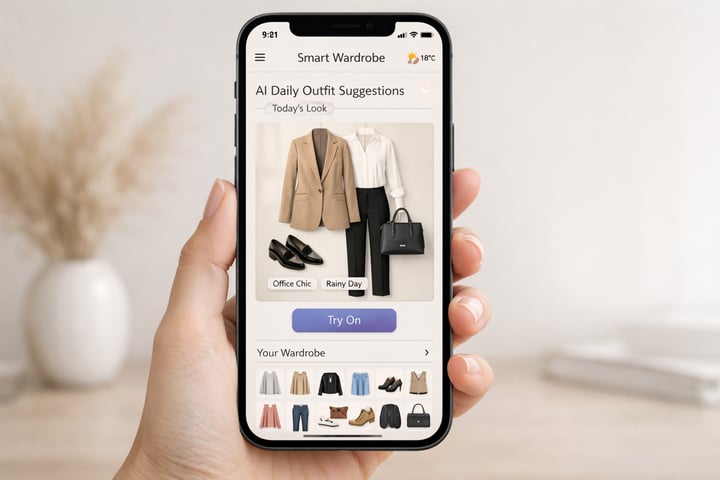
An outfit planner app is the fastest way to stop decision fatigue in the morning because it turns your closet into a simple yes or no choice. Instead of running 15 micro-decisions (top, bottom, shoes, weather, vibe), you get 3 ready-to-wear outfits in under 60 seconds, based on what you already own.
And yes, people really do lose time to this. One widely shared survey reported the average person spends about 17 minutes deciding what to wear, which adds up fast across the year. If you feel that daily drain, a smart what to wear app is not a luxury. It is a sanity tool. (Source)
What is decision fatigue and why does it hit hardest in the closet?
Decision fatigue is what happens when your brain gets tired of choosing, so your choices get slower, more random, or more emotional. That is why a full wardrobe can still feel like “nothing to wear.” You have options, but you do not have clarity.
Morning outfits are the perfect storm because you are choosing under pressure. Weather. Plans. Mood. Body image. Time. Comfort. Dress code. Even tiny questions stack up:
- Is this too warm or too cold?
- Does this look professional enough?
- Is it flattering today?
- Do these colors fight or work together?
- Will I regret these shoes after 30 minutes?
Some researchers describe decision fatigue as a real drop in decision quality when mental resources are strained, especially after making many choices. In plain language: by the time you are on outfit decision number 12, you are not “bad at style.” You are just mentally spent. (Source)
That is why I like outfit systems. Not because style should be robotic, but because your mornings should not steal your energy.
What is an outfit planner app, really?
An outfit planner app turns your wardrobe into a searchable, organized library and then helps you build outfits from it. The “good” apps go further: they recommend outfits, help you plan ahead, and reduce repeats.
Think of it like this: Pinterest gives you inspiration. A wardrobe app gives you storage. A true outfit planner app gives you decisions, already made, from your real closet.
Smart Wardrobe: Style & Try-On is built around that exact idea: digitize your wardrobe once, then get AI outfit combinations daily, plus planning tools like an outfit diary and a style calendar.
Want to see the product and features? Here is the public repo reference: GitHub project page.
If you are searching for a what to wear app because you feel overloaded every morning, the key is simple: does the app work with your own items, or does it just show random outfits? You want the first one.
How AI daily outfit suggestion saves time and mental energy
AI daily outfit suggestion works because it reduces your choice set from “everything” to “three good options.” That sounds small, but it changes your whole morning.
Instead of deciding from 80 items, you decide from 3 outfits. You still control the final choice, but you stop doing the heavy lifting.
Here is what most people actually want from a what to wear app
- A complete outfit, not just “a top idea”
- Color matching that does not feel childish
- Outfits that fit the weather and occasion
- Less repeating, more variety
- A plan for the week so mornings are calm
That is why the planning layer matters. If you can schedule outfits into a style calendar, your brain stops thinking about clothes at all during the week. Monday is done. Tuesday is done. You can focus on life.
How the outfit algorithm works (the simple version)
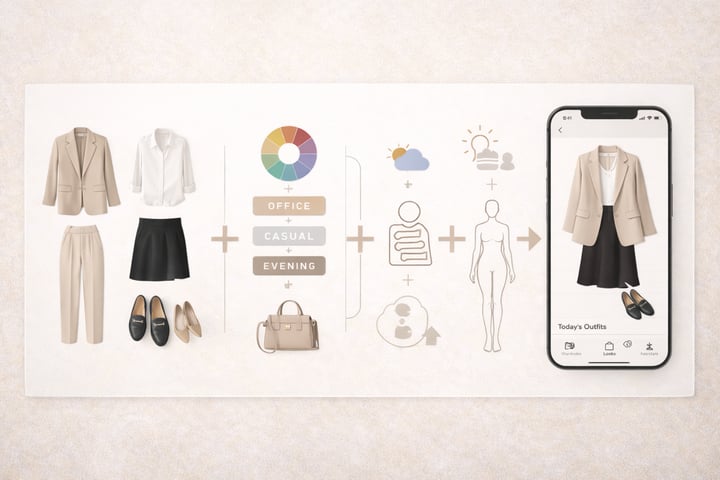
An outfit algorithm is basically compatibility rules plus your context. It is not magic. It is structure.
Smart Wardrobe style logic can be explained in three layers:
- Wardrobe data: your items, categories, colors, silhouettes, and notes.
- Matching logic: what pairs well (color harmony, proportion balance, seasonal weight).
- Context: occasion, weather, your preferences, and what you wore recently.
In my opinion, the biggest value is not “AI.” It is consistency. When your outfits are consistently good, you stop second-guessing yourself.
How to set up Smart Wardrobe in 10 minutes
You only need one short setup session to get value from an outfit planner app. Do not try to digitize your entire closet in one day. Start small and win fast.
Fast setup checklist (the lazy way that actually works)
- Add 15 core items you wear every week: 5 tops, 4 bottoms, 2 layering pieces, 2 shoes, 2 accessories.
- Tag basics (work, casual, evening) and season (all-season, winter, summer).
- Run outfit suggestions and save 5 outfits you like.
- Schedule 3 outfits into your style calendar for the next workdays.
- Expand slowly: add 5 new items per day for a week.
This pace is realistic. In 7 days, you will have 50 items digitized without feeling like you are doing homework.
If you want a deep wardrobe system later, explore: capsule wardrobe planning and color analysis basics.
How a style calendar keeps your week effortless
A style calendar is the feature that turns outfit suggestions into real life calm. If you only “generate outfits,” you still decide every day. If you plan your outfits once, your mornings become autopilot.
Here is how I recommend using it:
- Sunday: pick 3 work outfits + 1 flexible outfit.
- Mid-week: swap 1 outfit if weather changes.
- Friday: review what worked and save winners.
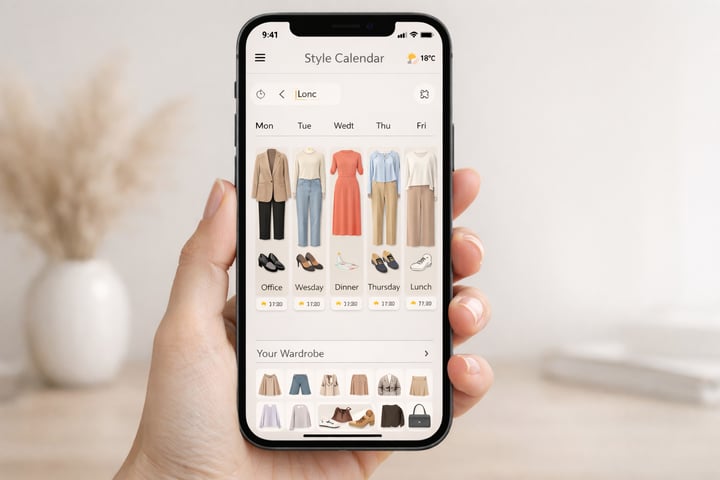
If you travel often, the style calendar also becomes a packing checklist. Plan 8 outfits for 4 days and pack only what is needed. No random “just in case” pieces.
Why virtual try-on reduces outfit regret
Virtual try-on reduces regret because you see the full vibe before you commit. The problem is not always the clothes, it is the combination. Two nice items can look wrong together.
Smart Wardrobe: Style & Try-On includes virtual try-on so you can preview garments on your photo. This helps you:
- Check proportions before you leave the house
- Avoid “cute on hanger, weird on me” moments
- Test a new color against your face
- Decide faster (and with less emotional drama)
If you want to go deeper on fit and proportion, this guide helps: body shape styling guide.
3 real examples with numbers (time saved, fewer repeats, better outfits)
Real-world results from an outfit planner app come from fewer decisions, fewer repeats, and less overbuying. Here are three realistic examples using simple math and typical wardrobe behavior.
Example 1: The “17 minutes a day” problem
If you spend 17 minutes deciding what to wear, that is 85 minutes per work week. Over 48 work weeks, that is 4,080 minutes, or 68 hours per year. Even if you cut that in half, you gain back an entire weekend of your life. (Source)
Example 2: The repeat trap (same 5 outfits on rotation)
Many people wear a small percentage of their wardrobe repeatedly. If you rotate 5 outfits but own 60 wearable items, you are underusing your closet. With AI outfit combinations plus a style calendar, a realistic target is 15 outfits in rotation (3x variety) without buying anything new.
Example 3: The “panic shopping” cycle
Decision fatigue often triggers shopping as an escape. If you do one “emergency purchase” per month at €40 to feel prepared, that is €480 per year. If planning reduces panic buying even by 50%, you save €240 and probably end up with a cleaner closet.
These are not promises, just realistic outcomes when you replace daily chaos with a weekly plan.
Outfit planner app vs manual planning (quick comparison table)
If you love style but hate daily decisions, an outfit planner app is simply the more scalable system. Here is the clean comparison.
Comparison table: outfit planner app vs manual styling
| Factor | Manual outfit decisions | Outfit planner app (Smart Wardrobe style) |
|---|---|---|
| Time spent | Daily decision loop, often 10 to 20 minutes | Weekly planning once, daily selection in under 60 seconds |
| Decision fatigue | High, especially under pressure | Lower, options are curated |
| Outfit variety | Repeats happen unintentionally | Rotation becomes visible and adjustable |
| Wardrobe clarity | You forget what you own | Digitized wardrobe, searchable, organized |
| Confidence | Depends on mood and time | More consistent because the logic stays consistent |
Video: how to build a capsule wardrobe that is easy to plan
If you want the best results from any outfit planner app, a capsule mindset helps. You do not need fewer clothes, you need more compatibility.
If you prefer reading: capsule wardrobe planning guide.
FAQ
What is an outfit planner app?
An outfit planner app helps you build, save, and schedule outfits. The best ones work with your real wardrobe and create AI daily outfit suggestions so you stop wasting time deciding.
Is a what to wear app the same as an outfit planner app?
Not always. A what to wear app focuses on outfit recommendations, while an outfit planner app usually includes planning tools like an outfit diary, a style calendar, and outfit history.
How accurate are AI daily outfit suggestions?
Accuracy grows with better wardrobe data. Start with your most worn pieces and add items gradually. Within a week, the suggestions usually feel noticeably more “you.”
Do I need a capsule wardrobe to use Smart Wardrobe?
No, but it helps. Capsule principles make outfit combinations easier because more pieces match. You can start with your current closet and improve over time.
Does Smart Wardrobe include virtual try-on?
Yes. Smart Wardrobe: Style & Try-On includes virtual try-on so you can preview garments on your photo and avoid outfit regret.
Can I plan outfits for the whole week?
Yes. Save your favorite outfits and schedule them inside the built-in style calendar so weekdays run smoothly.
Where do I download Smart Wardrobe: Style & Try-On?
Google Play. Use the button below and start planning your outfits today.
Ready to stop overthinking your outfits?
If decision fatigue is stealing your mornings, an outfit planner app is the fastest fix. Smart Wardrobe: Style & Try-On digitizes your wardrobe, generates AI daily outfit suggestions, and helps you plan looks in a style calendar so you can move on with your day.
Download Smart Wardrobe: Style & Try-On
Bonus: if you want to build a smarter wardrobe system, these are your next reads: color analysis, body shape styling, virtual try-on guide.
Sources and references
- Outfit decision time statistic: Allure (survey-based report)
- Decision fatigue overview: Frontiers in Psychology
- Smart Wardrobe project reference: GitHub repository