
How to Repeat Outfits at Work Without Losing Variety
A repeatable work outfit can stay polished when it starts with neutral, well-fitting basics, follows workplace dress code, and changes in small, coordinated ways through layers, belts, shoes, and accessories.
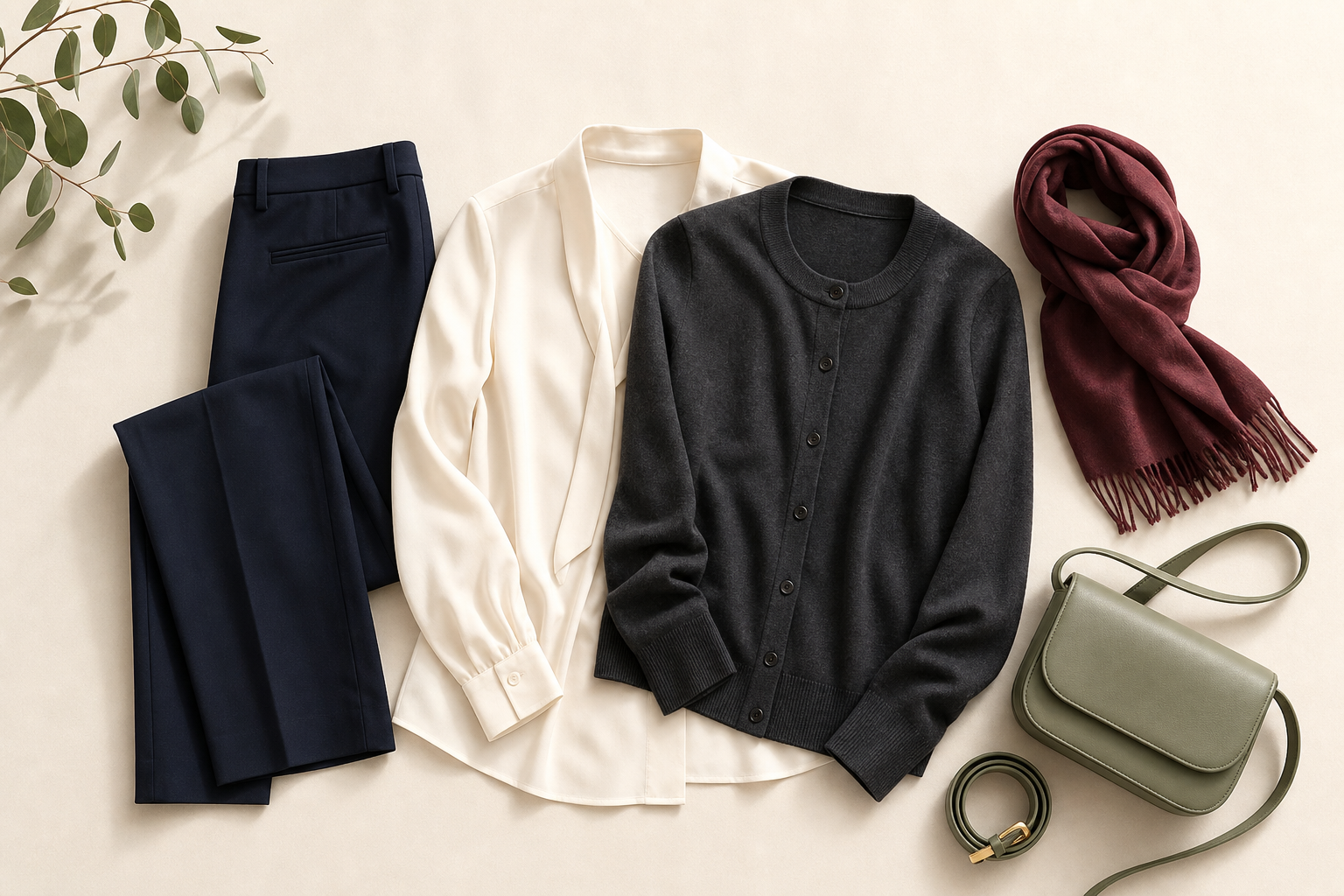
Key points
- A repeatable work wardrobe can be built from versatile basics that mix and match across occasions.
- Neutral colors provide a practical foundation for coordinated outfits.
- A simple two-main-colors-plus-one-accessory-color approach is source-supported.
- Fit, quality, and tailoring help repeated pieces look polished.
- Belts and simple shoes can add variation without changing the whole outfit.
- Workplace dress code and company culture should guide what is appropriate.
What sources support
A repeatable work outfit starts with a small set of pieces that coordinate well. The approved sources support a versatile business wardrobe built around blazers, tailored trousers, skirts, dresses, and blouses that mix and match across occasions. They also support a basic wardrobe made from timeless items that work across seasons, with a few trendier additions if desired.
Neutral colors are a practical foundation for this kind of rotation. Black, white, gray, beige, and navy are described as versatile and easy to combine, and the business wardrobe source recommends starting with neutral tones such as black, navy, or gray.
The sources also support a simple coordination method: use two main clothing colors and add one additional color through accessories. That keeps combinations controlled without requiring every piece to match exactly.
Fit and quality matter too. The business wardrobe source emphasizes proper fit, quality fabrics, construction, and tailoring for pieces that should look polished and keep their shape.
What remains editorial guidance
Some styling tactics are useful ways to apply the source-backed principles, but they are not universal rules from the research. The examples below are editorial examples, not factual claims about what everyone should do.
Belts are one way to add structure and definition, especially over layered outfits or outer layers. Shoes can also help coordinate an outfit, and simpler shoe designs are described as more versatile.
Build a repeatable base
A practical base for repeatable workwear can begin with one blazer, one or two tailored bottoms, and several tops that work with both. Because the sources support a neutral palette and timeless pieces, the goal is to make the main items easy to combine rather than individually dramatic.
The strongest foundation is usually the one that fits well and suits the workplace context. The business wardrobe source advises assessing dress code, responsibilities, and company culture, then adapting the wardrobe accordingly.
If some items need it, tailoring can help the overall look stay polished. That matters especially for key pieces that are likely to be repeated.
Editorial examples for variation
Editorial example: change one layer, keep the base
Editorial example: Repeat a neutral blazer with tailored trousers on one day and with a skirt on another day, keeping the blouse within the same two-color framework. This follows the supported idea of mixing versatile pieces while keeping color use simple.
Editorial example: add structure with a belt
Editorial example: Wear a belt over a blazer or another outer layer to create a different silhouette while leaving the core outfit unchanged. The source-backed point here is that belts can add structure and definition in layered looks.
Editorial example: use shoes as the main change
Editorial example: Keep the clothing the same and switch between simple pumps, loafers, or ankle boots to change the feel of the outfit while staying within a professional range. This reflects the source-supported idea that simpler shoe designs are versatile and can complement many outfits.
Editorial example: limit the accents
Editorial example: If the clothing is mainly black, white, gray, beige, or navy, add only one accent color through a scarf, bag, or shoe detail. That fits the two-main-colors-plus-one-accessory-color approach.
Create a small rotation
A small rotation works best when the pieces are chosen to pair with one another. A blazer, a blouse, tailored trousers, and a skirt can already create multiple combinations when they share a neutral base.
For a more seasonal feel, the wardrobe can still remain anchored in timeless items. The sources support adding a few trendier pieces if desired, but not replacing the whole wardrobe every time styles change.
That is what makes repetition workable: not constant reinvention, but careful recombination. The outfit changes enough to feel intentional while the underlying wardrobe stays compact and coordinated.
Adapt to context and comfort
The best combination is still the one that fits the setting. The research repeatedly points back to workplace context: dress code, company culture, responsibilities, and professional appropriateness all matter.
That means the same core pieces may need different styling depending on the day. A blazer may stay on in one setting and be softened with a different top or accessory in another. The exact choice depends on the environment, not on a fixed rule.
Comfort also belongs in the decision. The sources do not ask for sacrifice; they support pieces that fit well, hold their shape, and work together. If a piece no longer serves that purpose, it is less useful in a repeatable rotation.
FAQ
How many colors should a repeatable work outfit use?
The color source supports a simple approach: two main clothing colors, plus one additional color through accessories. Neutral tones such as black, white, gray, beige, and navy are also supported as a practical base.
What makes a repeated outfit still look polished?
Fit, quality, and tailoring are the main source-backed factors. When pieces sit well and hold their shape, they are more likely to look polished across repeated wear.
Can shoes change the look of the same outfit?
Yes. The shoe source says shoes can help shape an outfit’s color scheme, and that simple, elegant shoe designs are versatile and work with many outfits.
How should work setting affect outfit repetition?
Work environment should guide the combination. The business wardrobe source recommends considering dress code, responsibilities, and company culture, while the color source says to choose colors appropriate for the professional setting.
Is there a formula for every workplace?
No universal formula is stated in the sources. The supported principles are coordination, fit, quality, and context; the final combination depends on the setting and the pieces available.
Questions readers often ask
How many colors should a repeatable work outfit use?
The source-supported approach is two main clothing colors, plus one additional color through accessories. Neutral tones such as black, white, gray, beige, and navy are also supported as a practical base.
What makes a repeated outfit still look polished?
Fit, quality, and tailoring are the main source-backed factors. When pieces fit well and hold their shape, they are better positioned to look polished across repeated wear.
Can shoes change the look of the same outfit?
Yes. The shoe source says shoes can help shape an outfit’s color scheme, and simpler shoe designs are described as versatile and able to complement many outfits.
How should work setting affect outfit repetition?
Work environment should guide the combination. The business wardrobe source recommends considering dress code, responsibilities, and company culture, and the color source says to choose colors appropriate for the professional setting.
Explore combinations before you plan your next work outfit
If you want a calmer way to review coordinated looks, explore Smart Wardrobe and test how different items work together in a simple rotation.
Explore Smart Wardrobe